
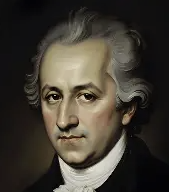
Johann Wolfgang von Goethe — Morphology, the Urphänomen, and the Philosophy of Living Nature (1749–1832)
Johann Wolfgang von Goethe was a German poet, playwright, novelist, scientist, and natural philosopher — born in Frankfurt am Main on 28 August 1749 into a wealthy bourgeois family, who studied law in Leipzig and Strasbourg, published "The Sorrows of Young Werther" at twenty-four and became the most celebrated German writer in Europe, was appointed to the court of the Duke of Weimar at twenty-six and spent the rest of his life there, serving as a minister, administrator, theatre director, and unofficial philosopher of the Weimar classical period. He met Schiller in 1794 and their friendship was the defining intellectual partnership of German classicism. He knew Hegel, Schelling, Herder, and Kant — and engaged with each of them philosophically while remaining irreducibly himself. He died in Weimar on 22 March 1832 at the age of eighty-two, having spent forty years on the second part of Faust and completed it months before his death. His reputed last words: "More light."
He is included in this catalogue not primarily as a literary figure — though Faust, "The Sorrows of Young Werther," "Wilhelm Meister," and his lyric poetry establish him as one of the great writers of any language — but as a natural philosopher of genuine originality whose work on morphology, color, and the methodology of science proposed an alternative to Newtonian mechanism that continues to be seriously debated. Wittgenstein said of the "Theory of Colors": "Goethe's theory of the constitution of colors has not been refuted — it simply is not a theory." This was not a dismissal but a philosophical observation about what kind of thing Goethe was doing.
His central concern: that the rationalist-mechanical approach to nature — which decomposed phenomena into their constituent parts and explained wholes by the behavior of those parts — was adequate for dead matter but violated the essential character of living nature, which could only be understood by attending to it whole, in its context, through disciplined sensory experience rather than through instruments and mathematical abstraction.
Spinoza and Pantheism — The Philosophical Foundation
The deepest philosophical influence on Goethe was Spinoza — whose "Ethics" he read as a young man and returned to throughout his life. What Goethe took from Spinoza was not the geometric method of demonstration but the vision of a universe that was itself divine: a single infinite substance — God or Nature — of which all particular things were modes or expressions. "Gott und Natur" — God and Nature — were for Goethe interchangeable, not because he was irreligious but because he identified the divine with the immanent creative power of the natural world. His famous declaration — "I am a pantheist in science, a polytheist in poetry, and a monotheist in morality" — captured the plurality of his positions across domains while maintaining a unified vision of nature as alive and sacred.
This Spinozist foundation meant that Goethe's science was not value-neutral investigation of an alien object. Nature was not "out there" to be dissected and analyzed by an observer standing outside it. The observer was part of nature — and the most adequate form of knowing was one in which the human organism, itself a natural form, participated in the natural phenomena it studied rather than merely measuring them from a detached standpoint. Influenced by Spinoza, he set out to find an inherent "spiritual gauge" of living things, within what he called "the mysterious architecture of formative forces."
"I am not at odds with him at any point in this ethical work that determines how I should live and think. I could say that in the thirty-four years since I first looked into it, I have not been able to distance myself from this book."
— Goethe on Spinoza's Ethics
Morphology — Form as Living Process
Goethe coined the word "morphology" — the study of form — to describe the scientific project he pursued across four decades: understanding how living forms arose, developed, and transformed. His 1790 "Metamorphosis of Plants" was its first major expression. Every part of a plant — sepals, petals, stamens, pistils, leaves — was, he argued, a metamorphosis of a single originary form: the leaf. What appeared to be a collection of different organs was in reality the expression of a single underlying principle that manifested differently under different conditions. The plant was not a collection of separately evolved parts but a unity unfolding through metamorphosis.
This required a different kind of attention from that demanded by Newtonian analysis. The analytical method isolated parts, measured them, and explained the whole by the behavior of its components. Goethean morphology attended to transformations, transitions, and relationships — to the becoming of form rather than its static structure. He used what he called "exact sensorial imagination" (exakte sinnliche Phantasie): the disciplined imaginative capacity to trace and reproduce the metamorphic sequence the organism displayed, to move with the phenomenon rather than freezing it for measurement. This was rigorous — not mere impressionism — but it was a different kind of rigor from mathematical physics.
"The idea of metamorphosis is a most venerable but also a most dangerous gift from above. It leads to formlessness; it destroys knowledge, dissolves it. It is like a vis centrifuga, and would lose itself in the infinite if it had not a counterweight — the drive to specificity, the tenacious capacity of things to persist in what they have become."
— Goethe
The Urphänomen — The Primal Phenomenon
The concept of the "Urphänomen" — the primal or archetypal phenomenon — was Goethe's most distinctive epistemological contribution. In any domain of natural investigation, he argued, patient and disciplined observation eventually led to a phenomenon so fundamental, so representative of the whole pattern of the domain, that it needed no further explanation — it was itself the explanation of all the particular phenomena within its range. The Urphänomen was not a hidden cause behind appearances but the most pure and transparent of appearances — the case in which the generative principle manifested most clearly.
In optics, he proposed that the Urphänomen was the interplay of light and darkness through a turbid medium — the phenomenon from which all colors arose. When light shone through a turbid medium toward darkness, it appeared yellow, then orange, then red. When darkness was seen through a turbid medium illuminated from behind, it appeared blue, then violet. Color was not, as Newton had argued, light decomposed into hidden components — it was the boundary phenomenon between light and dark, the point of encounter between opposites. This was the polarity that structured all of Goethe's natural philosophy: the tension between opposing principles from which all specific phenomena arose as mediations.
"The Urphänomen is ideal inasmuch as it is the last thing knowable; real inasmuch as it is known; symbolic, inasmuch as it encompasses all cases; identical with all cases. It is not behind the phenomena — it is the phenomenon in its most transparent, most archetypal form."
— Goethe, Maxims and Reflections
Against Newton — The Theory of Colors
Goethe's "Theory of Colors" (Zur Farbenlehre, 1810) — his largest single work, to which he devoted more time than to Faust — was a sustained attack on Newton's optics and a systematic presentation of his own account of color. Newton had used a prism to decompose white light into a spectrum and concluded that white light was a mixture of colored rays each with its own fixed refrangibility. Color was a property of light itself, analyzable by decomposition into components.
Goethe's objections were both experimental and philosophical. Experimentally: Newton had worked with a narrow slit of light in a darkened room — a highly artificial, "complicated and secondary state" of the phenomenon. When Goethe looked through a prism at a broad field of white light, he saw no spectrum — only color at the boundaries between light and dark. Color appeared at edges, not in the interior of a light field. Philosophically: Newton's approach dissected a phenomenon into components that were not directly observable — the "hidden" colored rays in white light. Goethe insisted that genuine science had to remain with what was actually given to trained sensory observation, not disappear into mathematical abstractions that replaced the phenomenon with a model. He was wrong that Newton's physics was incorrect — but his criticism identified something real about the difference between physics and phenomenology. Wittgenstein took his color phenomenology seriously precisely for this reason.
"Goethe's theory of the constitution of colors has not been refuted — it simply is not a theory. Nothing can be predicted by means of it. It is rather a vague schematic outline, of the sort that we find in James's psychology. There is no experimentum crucis for Goethe's theory of color."
— Ludwig Wittgenstein, Remarks on Color
Faust — Philosophy in Dramatic Form
The philosophical content of Goethe's natural philosophy was expressed in concentrated form in Faust — the drama he began in his twenties and completed in his eighties, the work that most fully embodied his vision of human striving, the relationship between knowledge and life, and the ultimate inadequacy of any purely intellectual approach to human experience. Faust's opening monologue — the scholar who has mastered all the disciplines and found them empty, who turns to magic to penetrate the innermost force that binds the world together — was Goethe's diagnosis of the Enlightenment's limits: the drive for abstract knowledge that dissects and measures but cannot touch the living whole.
The pact with Mephistopheles — the devil who is "part of that force which always intends evil but always produces good" — encoded Goethe's vision of polarity: striving and negation, creation and destruction, were not opposites to be reconciled but necessary counterparts in the dynamic process through which life manifested. Faust's ultimate salvation — he who strives without ceasing can be redeemed — was not a Christian theological statement but a philosophical one: the restless, error-making, striving human spirit was itself the expression of the divine creative force in nature.
"Whoever strives with all his heart, we can redeem."
— Goethe, Faust Part II
Influence — Schelling, Steiner, and the Living World
Goethe's philosophical influence ran in directions as various as his work. Schelling found in Goethe's conception of plant metamorphosis the key to understanding nature as a self-producing, organic whole — the foundation of Naturphilosophie. Hegel acknowledged his debt. Rudolf Steiner, who edited Goethe's scientific writings for the Weimar edition, built his anthroposophy in part on a radicalized Goethean science. The phenomenological tradition — Husserl, Merleau-Ponty — developed methodological parallels to Goethe's insistence on remaining with phenomena rather than replacing them with models. More recently, the critique of reductive mechanism in biology — the organism as more than the sum of its genetic components — has found in Goethean morphology an anticipation of contemporary debates about form, development, and life.
"The rationalist scientific method, which had worked well with inert nature, was less successful in seeking to understand vital nature. Goethe developed a phenomenological approach to natural history — an alternative to Enlightenment natural science — which is still debated today among scholars."
Legacy — The Poet Who Did Science Differently
Goethe's scientific work is one of the great anomalies of intellectual history: a major literary figure who spent as much time on natural philosophy as on literature, whose scientific method was philosophically serious and procedurally careful, and who was wrong about Newton but right about something that Newton's framework could not quite accommodate — the phenomenology of living form. He was not doing bad physics; he was doing something different from physics, and the failure to keep the distinction clear produced both his greatest error (the anti-Newton polemic) and his most enduring contribution (morphology and the science of form).
On CivSim he belongs alongside Paracelsus, Schelling, and the Romantic Naturphilosophen — the tradition that resisted the reduction of nature to mechanism and insisted on the irreducible wholeness and vitality of natural forms. His challenge to Universal Humanism is the methodological one: a philosophy committed to understanding human life in its fullness must ask whether the analytical, decomposing methods adequate to dead matter are equally adequate to living persons — to the kind of wholes that humans are. Goethe's insistence that the living whole was not accessible by decomposition into parts, that understanding required participation and disciplined attention rather than detachment and measurement, was not anti-scientific but a claim about what kinds of understanding different kinds of phenomena required. It remains an open question whether the human sciences have answered it.
"Nature! We are surrounded and embraced by her — unable to step outside her, unable to enter more deeply into her. She works and lives in us without asking; we live in her without knowing. She thinks and feels; she creates."
— Goethe (attributed), "Nature" fragment
CivilSimian.com created by AxiomaticPanic, CivilSimian, Kalokagathia