
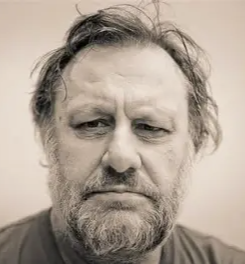
Slavoj Žižek — Ideology, Enjoyment, and the Sublime Object (b. 1949)
Slavoj Žižek is a Slovenian philosopher, psychoanalytic theorist, cultural critic, and compulsive public intellectual — born in Ljubljana, Yugoslavia (now Slovenia) on 21 March 1949, the son of two economists, who studied philosophy and sociology at the University of Ljubljana, earning bachelor's, master's, and doctoral degrees, then traveled to Paris in the early 1980s to study psychoanalysis at the University of Paris VIII under Jacques-Alain Miller — Lacan's son-in-law and intellectual heir — earning a second doctorate in 1985 for an unorthodox Lacanian reading of Hegel, Marx, and Saul Kripke. During his years in Paris he also underwent psychoanalysis with Miller. He returned to Ljubljana as researcher and professor, faced early difficulties securing permanent academic positions for political reasons (his work was considered ideologically suspect by the Yugoslav communist apparatus), ran unsuccessfully for president of Slovenia in 1990 as the country prepared for independence, and achieved international prominence with the 1989 publication of "The Sublime Object of Ideology" — his first book in English and the text that made his global reputation. He has since held positions at Birkbeck, University of London, and the European Graduate School, while maintaining an extraordinary rate of publication — more than fifty books, hundreds of articles, and a seemingly inexhaustible appetite for lectures, interviews, and engagement with every crisis from the financial collapse of 2008 to the COVID pandemic to the war in Ukraine. He is widely described as the most famous philosopher alive, a description that simultaneously flatters and misrepresents him.
His central intellectual project, sustained across three decades: the integration of Hegelian dialectics, Lacanian psychoanalysis, and Marxist ideology critique into a framework capable of analyzing how ideology actually functions — not as false consciousness that deceives the innocent masses but as a structure of enjoyment that subjects participate in even when they know perfectly well what they are doing. "They know very well what they are doing, but still, they are doing it" — his revision of Marx's formula for ideology.
The Ljubljana School — Hegel and Lacan in a Socialist State
Žižek's intellectual formation was shaped by the peculiar position of the Ljubljana School of Psychoanalysis — a circle of Slovenian philosophers and psychoanalysts who worked in a socialist state that was more open than Soviet bloc countries (Yugoslavia under Tito had taken an independent path since 1948) but still ideologically constraining. The school developed Lacanian psychoanalysis as a critical tool — not to cure individual neuroses but to analyze the structure of ideology, culture, and social fantasy. Working within a system they could criticize obliquely through psychoanalytic theory, they produced an approach that was simultaneously sophisticated within Continental philosophy and politically engaged in ways that Western academic theory rarely was. Žižek was the school's most prolific and most internationally visible member.
"For me, always it is Hegel, Hegel, Hegel."
— Žižek, on his primary philosophical allegiance
The Sublime Object of Ideology — Ideology as Fantasy, Not False Belief
"The Sublime Object of Ideology" (1989) was Žižek's breakthrough work — a reconceptualization of what ideology was and how it worked. The traditional Marxist account treated ideology as false consciousness: people were deceived about the true nature of their social relations, and if they could only see through the deception, they would recognize their exploitation and act to end it. Žižek rejected this as philosophically naive. The problem with ideology was not that people didn't know the truth — it was that knowing the truth made no difference to their behavior. People could see through ideological mystifications perfectly well and continue to act as if they were true. The cynic who knows that money is just a piece of metal and yet treats it as if it had inherent value was not deceived — but was ideologically captured nonetheless.
The key to this was Lacan's concept of "fantasy" — not as private daydream but as the unconscious structure that organized social reality, that told subjects how to desire, that gave their social relations their consistency. Ideology was not primarily a set of beliefs about the world but a fantasy structure that underwrote the subject's relation to the social. Dismantling the false beliefs left the fantasy intact — and the fantasy was what actually organized behavior. This was why ideological critique alone was insufficient: you could know everything about how capitalism worked and still participate in it as fully as before.
"They know very well what they are doing, but still, they are doing it."
— Žižek's revision of Marx's formula for ideology
Enjoy Your Symptom — The Paradox of Enjoyment
One of Žižek's most productive concepts was the Lacanian notion of "jouissance" — enjoyment — and its paradoxical role in ideological life. Ideology did not only impose prohibitions and constraints: it also regulated and distributed enjoyment, telling subjects how they were permitted to enjoy themselves, what pleasures were available within the social order, and how to experience even prohibitions as a source of enjoyment. The superego's command — which Žižek formulated as "Enjoy!" — was the ideological command that subjects experienced not as external imposition but as the voice of their own deepest desire. The consumer society's injunction to enjoy — through products, experiences, and lifestyle choices — was the contemporary form of this superego command.
This produced the paradox of tolerance and transgression: the more permissive a society became, the more it needed to prohibit in order to preserve the structure of enjoyment. Without prohibition, enjoyment lost its intensity. The society that claimed to have transcended repression was generating new forms of compulsory enjoyment — the pressure to have a good time, to be fulfilled, to achieve the lifestyle that commodities promised — that were in many ways more insidious than the explicit prohibitions they replaced.
"The superego injunction which reverberates in our society is 'Enjoy!' — not just in matters of sex and consumption but across the entire domain of self-realization. The problem today is not that we are repressed — it is that we are commanded to be spontaneous."
— Žižek, The Plague of Fantasies
Hegel Reloaded — Against Postmodern Relativism
Against the postmodern consensus that the grand narratives of modernity — Enlightenment reason, universal emancipation, historical progress — had been definitively discredited, Žižek mounted a sustained defense of Hegel's dialectical method as the most powerful tool available for understanding contemporary reality. His reading of Hegel was anti-idealist: the Hegelian dialectic was not a system of cosmic self-unfolding but a method for tracing how contradictions in social reality produced their own resolution — or failed to. The "negation of the negation" was not an optimistic guarantee that contradictions would always be resolved but a formal structure that could equally produce catastrophe. Žižek's Hegel was compatible with Freud's death drive — the tendency of systems to repeat and destroy themselves — rather than with the confident historicism of the textbook version.
"Less Than Nothing" (2012) — his largest and most systematic work, nearly a thousand pages on Hegel and dialectical materialism — was the most sustained attempt to reconstruct Hegelian philosophy for the twenty-first century, engaging with quantum mechanics, cognitive science, and contemporary continental philosophy in equal measure. It provoked enormous critical response — admiring, bewildered, and hostile — and remains the most serious claim in his body of work to lasting philosophical significance.
"Hegel's dialectic is not the optimistic unfolding of Absolute Spirit — it is the formal structure through which reality's contradictions generate their own resolution or catastrophe. The negation of the negation is not a guarantee of progress but a description of how things go wrong in interesting ways."
The Parallax View — The Gap That Cannot Be Closed
"The Parallax View" (2006) introduced one of Žižek's most productive formal concepts: the parallax gap — the irreducible difference between two perspectives on the same object, neither of which could be synthesized into a third, higher viewpoint. Drawing from the astronomical concept of parallax (the apparent displacement of an object when viewed from different positions), Žižek argued that many of the fundamental problems of philosophy — mind and body, freedom and necessity, subject and object — were not problems to be solved by finding the right synthesizing framework but irreducible antinomies whose tension had to be maintained. The parallax was not a failure of thought but the mark of the Real — the Lacanian dimension of reality that could not be fully symbolized.
"The standard 'postmodern' notion of subject is that of a dispersed, plural, constructed subject — yet what we effectively encounter in psychoanalysis is the subject as the hard kernel of the Real which resists symbolization, the void around which the symbolic structure is constructed."
— Žižek, The Parallax View
Politics — Provocateur of the Left
Žižek's political positions have generated as much controversy as his philosophy. He identifies as a communist — not in the Soviet sense but as a commitment to the "commons" (shared resources, public goods, the environment) against the encroachments of capital. He has been a consistent critic of liberal democracy as ideology — arguing that its apparent openness and pluralism concealed the structural violence of capitalism and foreclosed the possibility of genuine political transformation. He has criticized identity politics — particularly in its more gestural forms — as a distraction from class analysis and structural critique. He has made provocative statements about immigration, Islam, and Europe that have earned him accusations of racism and Eurocentrism from the left and grudging respect from the right. He supported Bernie Sanders, expressed qualified approval of Trump's election as a disruption to the liberal consensus, and has consistently positioned himself outside the comfortable liberal center in ways designed to provoke rather than console. His critics — including many on the left — argue that his provocations are more performance than politics, that his actual political commitments are vague, and that the posture of the provocateur has become its own ideological comfort.
"The only way to be truly radical today is to be absolutely faithful to the tradition — not because tradition is always right, but because only through fidelity to the best of what has been thought can we identify what needs to be changed."
— Žižek, paraphrased
Legacy — The World's Most Famous Philosopher?
Žižek's extraordinary public prominence — lectures packed with thousands, documentary films, television interviews, a book on the COVID pandemic written and published in weeks — has made him a cultural phenomenon as well as a philosopher. His accusers charge him with self-plagiarism (substantial passages recurring across books), political irresponsibility (his more provocative statements), and systematic obscurity deployed as a barrier to criticism. His defenders argue that his genuine contributions — the reconceptualization of ideology as fantasy, the parallax gap as formal philosophical concept, the reading of Hegel through Lacan, the restoration of dialectical thought as a serious option — are philosophically substantial regardless of the surrounding noise. Both accounts are probably partly right.
On CivSim he belongs alongside Marcuse, Adorno, and Foucault — the tradition of ideology critique that asks not whether ideas are true but what function they serve in sustaining or challenging existing power. His challenge to Universal Humanism is the ideology challenge: a philosophy committed to universal human dignity and welfare must confront the possibility that its universalism is itself ideological — that the claim to speak for all humanity conceals the particular interests of those who make it, that the fantasy of universal consensus forecloses the antagonisms that genuine politics requires, and that the structure of enjoyment that sustains the current order will survive any number of rational critiques unchanged. "They know very well what they are doing, but still, they are doing it." A philosophy that addresses only what people know and not what they enjoy may be talking past the actual mechanism of its own failure.
"The true formula of atheism is not 'God is dead' — even by saying this, we suppose that God once existed. Rather, God never existed in the first place. The space he was meant to fill has always already been empty."
— Žižek
CivilSimian.com created by AxiomaticPanic, CivilSimian, Kalokagathia