
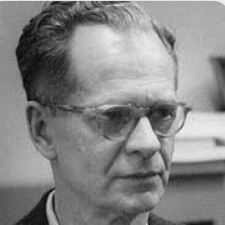
B. F. Skinner — Radical Behaviorism, Operant Conditioning, and the Technology of Human Behavior (1904–1990)
Burrhus Frederic Skinner was an American psychologist, behavioral scientist, social philosopher, and inventor — born on 20 March 1904 in Susquehanna, Pennsylvania, the son of a lawyer, who showed an early talent for building gadgets and contraptions, graduated from Hamilton College in 1926 with a passion for writing, spent two largely unsuccessful years attempting to become a professional writer, and enrolled at Harvard to study psychology in 1928 after reading Watson and Pavlov and concluding that the scientific study of behavior was what he had been looking for. He received his PhD from Harvard in 1931, taught at Minnesota and Indiana, and returned to Harvard in 1948 where he remained until his death. He died of leukemia on 18 August 1990, completing a lecture for the American Psychological Association ten days before his death. A 2002 survey ranked him the most influential psychologist of the twentieth century — ahead of Freud, Piaget, Bandura, and Festinger.
His major works spanned experimental psychology and social philosophy: "The Behavior of Organisms" (1938), which established operant conditioning; "Walden Two" (1948), a utopian novel depicting a society designed on behavioral principles; "Science and Human Behavior" (1953), his systematic account of behavior analysis; "Verbal Behavior" (1957), his behavioral analysis of language which provoked Noam Chomsky's famous review — arguably the document that launched cognitive science; and "Beyond Freedom and Dignity" (1971), which made the cover of Time magazine and became the most controversial philosophical book by a psychologist since Freud.
His central concern, pursued without deviation from his first laboratory experiments to his final lecture: that behavior was entirely the product of its environmental history — of the consequences that had followed past actions — and that a genuine science of behavior, combined with the willingness to apply it, could design social environments that produced human flourishing more reliably than any appeal to inner freedom, dignity, or moral character.
The Failed Writer — Literature's Loss, Science's Gain
Skinner's two years of attempted literary writing — what he called his "Dark Years" — are philosophically significant rather than merely biographical. He had planned to be a novelist. He read widely, wrote carefully, and concluded that he had nothing to say because he did not understand why human beings did what they did. The turn to psychology was not a retreat from the humanistic concerns of literature but their continuation by different means: he wanted to understand human behavior with the rigor that literature gestured toward but could not achieve. His two major popular books — "Walden Two" and "Beyond Freedom and Dignity" — were the products of that original literary impulse applied to psychological conclusions. The novelist's instinct for concrete social vision never left him; it became the utopian imagination that his critics found most disturbing.
"Give me a child and I'll shape him into anything."
— B. F. Skinner
Operant Conditioning — The Law of Effect Made Rigorous
The scientific foundation of Skinner's work was operant conditioning — the systematic investigation of how behavior was shaped and maintained by its consequences. Edward Thorndike had established the "Law of Effect": behaviors followed by satisfying consequences became more frequent; behaviors followed by unsatisfying consequences became less frequent. Skinner took this observation and made it the foundation of a precise experimental science. His "Skinner box" — an apparatus in which a rat or pigeon could press a lever or peck a key to receive food — allowed the systematic manipulation of reinforcement schedules and the precise measurement of behavioral effects.
What he discovered across decades of experimental work was that behavior was extraordinarily sensitive to its history of reinforcement — that different schedules of reinforcement (continuous, fixed-ratio, variable-ratio, fixed-interval, variable-interval) produced characteristically different patterns of behavior with remarkable consistency across species. Variable-ratio reinforcement — the schedule used by slot machines — produced the highest, most persistent rate of responding. This was not a metaphor but a finding: the same mathematical relationship governed lever-pressing in rats and gambling in humans. Behavior was lawful in a way that made a genuine predictive science possible.
"Skinner founded a science of operant behavior — a science of behavior attributed to purpose: the experimental analysis of behavior. In elaborating this science, he established a system of psychology that accounted for the mind without being mentalistic: behavior analysis."
Radical Behaviorism — The Philosophical Position
Skinner distinguished his position — "radical behaviorism" — from the methodological behaviorism of Watson, which simply refused to discuss mental states as a methodological policy. Radical behaviorism was a philosophical claim about what mental states were: not inner causes of behavior but patterns of behavior themselves, or dispositions to behave in certain ways under certain conditions. Thinking was subvocal speech. Feeling was a form of behavior. What we called "mind" was the behavioral repertoire of an organism — organized, complex, but not a separate entity that caused behavior from some non-physical domain.
This was not eliminativism about mental states — Skinner did not deny that thinking and feeling existed. He denied that they were autonomous causes of behavior standing outside the causal chain of organism-environment interaction. When we said someone acted because of their beliefs and desires, we were describing a pattern that itself needed explanation — and that explanation, when fully pursued, would be environmental and historical, not mentalistic. Beliefs and desires were real, but they were products of conditioning histories, not free-floating inner causes.
"The goal of a science of psychology is to predict and control an organism's behavior from its current stimulus situation and its history of reinforcement. Radical behaviorism treats mental states as patterns of behavior rather than inner causes — real, but not autonomous."
Verbal Behavior and the Chomsky Review
Skinner's "Verbal Behavior" (1957) attempted to extend the operant conditioning framework to language — arguing that verbal behavior was shaped and maintained by the same reinforcement contingencies that governed any other behavior. Words were not symbols that referred to inner mental representations — they were operants, functionally defined by their environmental effects. Language learning was not the acquisition of rules but the shaping of verbal behavior by the linguistic community.
Noam Chomsky's 1959 review — devastating, forty-three pages long — argued that Skinner's account was so radically underspecified that it explained nothing: that "stimulus," "response," and "reinforcement" had been extended so far beyond their laboratory meanings that they had become metaphors rather than scientific terms, that language acquisition required the postulation of innate linguistic structures that no purely behavioral account could explain, and that the poverty of the stimulus — the fact that children learned grammatical rules they had never directly encountered — was a decisive empirical argument against behaviorism. The review is widely credited with launching the cognitive revolution that replaced behaviorism as the dominant paradigm in psychology. It remains one of the most consequential critical reviews in the history of science.
"Chomsky's 1959 review of Verbal Behavior argued that Skinner's account was so underspecified that it explained nothing — that 'stimulus,' 'response,' and 'reinforcement' had become metaphors rather than scientific terms. The review is widely credited with launching the cognitive revolution."
Walden Two — The Behavioral Utopia
"Walden Two" (1948) was Skinner's first and most enduring extension of behavioral science to social design. The novel depicted a fictional community in which operant conditioning principles were applied systematically to the design of the physical and social environment — eliminating the inefficiencies, frustrations, and conflicts produced by conventional social arrangements. Children were raised in conditions designed to maximize positive reinforcement and minimize frustration. Work was organized to be intrinsically satisfying. Competition, jealousy, and aggression were engineered out of the community by eliminating the conditions that produced them. The result was a population that was genuinely happier, more productive, and more cooperative than the outside world — not because its members were morally better but because their environment was designed better.
It sold modestly for two decades and then became a counterculture bestseller in the 1960s — a utopian alternative to what Skinner's readers experienced as the irrationality of conventional society. Several real communities were founded on its principles. Its critics found it dystopian: a world in which human beings were shaped like laboratory animals, freedom was an illusion to be dissolved rather than a value to be protected, and the architects of the system had arrogated to themselves the power to define what "happiness" and "flourishing" meant for everyone else.
"We should not try to change people — we should design better environments."
— Skinner's core normative position, paraphrased
Beyond Freedom and Dignity — The Philosophical Challenge
"Beyond Freedom and Dignity" (1971) was the most direct philosophical statement of Skinner's social vision — and the most controversial. His argument: the concepts of freedom and dignity, as ordinarily understood, were obstacles to the design of better societies. "Freedom" meant the absence of aversive control — the elimination of punishments and threats. But positive reinforcement — designing environments that made desirable behaviors rewarding — was equally controlling without feeling coercive. People who lived in well-designed behavioral environments felt free even as they were being shaped by contingencies as surely as any prisoner responding to punishment. The feeling of freedom was not evidence of genuine autonomy but a product of the kind of control being exercised.
"Dignity" meant the attribution of credit to individuals for their achievements — treating good behavior as the expression of inner virtue. But if behavior was the product of environmental history, then the virtuous person had simply been fortunate enough to have been shaped by virtuous contingencies. The attribution of dignity to the individual was philosophically confused and practically harmful: it prevented us from looking at the environmental conditions that produced behavior, and made us blame individuals for what their conditioning histories had made them. The future of humanity, Skinner argued, depended on giving up these "pre-scientific" concepts and building the technology of behavior that could actually improve human lives.
"According to Skinner, the future of humanity depended on abandoning the concepts of individual freedom and dignity and engineering the human environment so that behavior was controlled systematically and to desirable ends rather than haphazardly."
Legacy — The Most Influential and Most Resisted
Skinner's specific theoretical framework — radical behaviorism — was largely superseded by cognitive science after Chomsky's review and the rise of cognitive psychology in the 1960s and 70s. Operant conditioning as a practical technology of behavior change remained enormously influential in applied settings: education, therapy (particularly behavior therapy and ABA), organizational management, and animal training. The philosophical arguments of "Beyond Freedom and Dignity" remain live and contested. His behavioral insights have been absorbed into social media design, advertising, and app development — the variable-ratio reinforcement schedules that shaped lever-pressing in rats now shape the compulsive checking behavior of smartphone users. Skinner himself would have regarded this as an illustration of his thesis: the technology of behavior is being applied, whether we acknowledge it or not, and the question is not whether to use it but who will use it and for whose benefit.
On CivSim he belongs alongside Watson, Freud, and William James — the tradition that tried to place the understanding of human behavior on a scientific footing adequate to the complexity of the subject. His challenge to Universal Humanism is the most radical available from within science itself: if behavior is entirely the product of environmental history, then the concepts of dignity, autonomy, and moral responsibility on which Universal Humanism grounds its axioms are philosophically confused — pre-scientific fictions that attribute to persons what properly belongs to their conditioning histories. The Skinnerian counter-argument to his own challenge: even if this is true, the humane design of environments that produce flourishing, cooperation, and care is exactly what a philosophy committed to human welfare should pursue. The disagreement is not about goals but about what human beings are — and whether what they are licenses the vocabulary of dignity.
"Education is what survives when what has been learned has been forgotten."
— B. F. Skinner
CivilSimian.com created by AxiomaticPanic, CivilSimian, Kalokagathia