
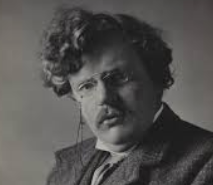
G. K. Chesterton — Orthodoxy, Distributism, the Prince of Paradox, and the Defence of Common Sense (1874–1936)
Gilbert Keith Chesterton was an English writer, philosopher, poet, journalist, lay theologian, novelist, and apologist — born in Kensington in 1874 to a family with no strong religious convictions, educated at St. Paul's School and the Slade School of Art, who did not learn to read until age eight and later became one of the most prolific writers in the English language: nearly 100 books, contributions to over 200 others, approximately 4,000 essays and columns, several hundred poems, and a journalism career spanning the Daily News, The Illustrated London News, and his own paper GK's Weekly. He stood six feet four inches tall, weighed around 21 stone, wore a cape, crumpled hat, and swordstick as his customary costume, and habitually telegraphed his wife from wrong locations — "Am at Market Harborough. Where ought I to be?" — while remaining, by every account of those who knew him, one of the most intellectually formidable and personally generous figures of his era.
He debated George Bernard Shaw for decades, in what became one of the great public intellectual contests of the twentieth century. C. S. Lewis credited "The Everlasting Man" as a key factor in his conversion from atheism. J. R. R. Tolkien was shaped by his thinking. Gandhi cited a Chesterton essay in the Illustrated London News as an inspiration for his independence movement. The Napoleon of Notting Hill influenced both Michael Collins's Irish independence movement and, in a very different direction, George Orwell's Nineteen Eighty-Four. He converted to Roman Catholicism in 1922 — having been a convinced Christian for decades before the formal step.
His central concern: that modern thought, despite its credentials of progressive sophistication, was in the process of dismantling the very structures of sanity — that orthodoxy was not the enemy of reason but its condition, and that the common person's stubborn instinct for wonder, for tradition, for limits, for ordinary human dignity, was philosophically wiser than any of the clever heresies arrayed against it.
Orthodoxy — The Romance of Reason
Chesterton's 1908 "Orthodoxy" began as an answer to a challenge: a critic had accused him of inventing a new religion in a previous book. He replied that what he had invented, he discovered on investigation, was simply Christianity — that his personal philosophical journey had arrived at the same destination that the Church had reached by two thousand years of hard thinking. The book traced that journey as an intellectual autobiography and a philosophical argument simultaneously.
His argument for Christian orthodoxy was not from authority or tradition alone but from the peculiar fitness of Christian doctrine to account for what he actually found when he examined human experience. The doctrine of original sin, for instance, was not a harsh theological imposition but the most accurate description of the observable fact that human beings were simultaneously capable of remarkable nobility and remarkable depravity — that they needed no theory to explain human achievement but they desperately needed a theory to explain human failure. Christianity provided one; secular progressive philosophies did not.
The paradox section was his most celebrated contribution to philosophical style: not paradox as mere cleverness but paradox as the form that truth takes when it refuses to be flattened into one-dimensional common sense. Christianity was paradoxical because reality was paradoxical — humility was the root of confidence, meekness the condition of true courage, the Cross the instrument of triumph. To flatten these into manageable propositions was not to clarify them but to falsify them.
"Tradition is only democracy extended through time. It is the democracy of the dead. Democracy tells us not to neglect a good man's opinion, even if he is our groom; tradition asks us not to neglect a good man's opinion, even if he is our father."
— Chesterton, Orthodoxy (1908)
Chesterton's Fence — The Most Useful Principle in Political Philosophy
Among Chesterton's most enduring philosophical contributions is an argument so clearly and memorably stated that it has entered common use under his name — the principle of Chesterton's Fence. In the matter of reform, he observed, there is a simple principle that reformers consistently ignore: if you encounter a fence and cannot see why it was built, you should not tear it down. You should find out why it was built. If you can understand the reason for it, you can then decide whether that reason still applies. If you cannot understand it, you have not yet earned the right to remove it.
The principle is not conservative in the sense of opposing all change — Chesterton was a radical critic of capitalism and a distributivist. It is conservative in the sense of demanding intellectual humility from those who seek to change things: the burden of proof lies with the reformer, not because the existing arrangement is necessarily right, but because the reformer who cannot explain what they are reforming does not yet understand what they are doing.
"The more modern type of reformer goes gaily up to it and says, 'I don't see the use of this; let us clear it away.' To which the more intelligent type of reformer will do well to answer: 'If you don't see the use of it, I certainly won't let you clear it away. Go away and think. Then, when you can come back and tell me that you do see the use of it, I may allow you to destroy it.'"
— Chesterton, The Thing: Why I Am a Catholic (1929)
The Everlasting Man — Against the Reductive Account of Human History
"The Everlasting Man" (1925) was written as a direct response to H. G. Wells's "Outline of History" — a popular history of the world that treated the emergence of Christianity as one more episode in the continuous evolutionary development of human culture, neither more nor less significant than the development of agriculture or metallurgy. Chesterton's rebuttal was both historical and philosophical.
His argument: the emergence of Christ and of the Church was not continuous with prior religious development but was a qualitative break — something categorically different from the mythology and philosophy that preceded it. And before this, humanity itself was categorically different from the animals — not merely more intelligent but differently constituted, as evidenced by the cave paintings at Lascaux: the animals did not paint on cave walls. Something had happened with human beings that was not a matter of degree. The reductive evolutionary account, however scientifically accurate about the mechanisms of biological change, missed what was most important about human history — the qualitative differences that no continuum could absorb. C. S. Lewis read it, found its argument unanswerable, and moved a significant step toward his own conversion.
"C. S. Lewis called The Everlasting Man 'the best popular apologetic I know' — its argument that humanity represented a qualitative break in natural history, and that Christianity represented a qualitative break in religious history, contributed significantly to Lewis's own conversion from atheism."
Distributism — Property for the Many, Not the Few
Chesterton's economic philosophy — developed with Hilaire Belloc and rooted in Leo XIII's encyclical Rerum Novarum — was neither capitalism nor socialism but a third position: distributism, the advocacy for wide distribution of productive property among ordinary families and individuals. The problem with capitalism was not private property but the concentration of private property in too few hands. The problem with socialism was not economic planning but the transfer of that concentrated property to the state rather than its distribution to the people. Both systems, in Chesterton's analysis, left ordinary human beings dependent on forces outside their control — the corporation or the bureaucracy — rather than genuinely free agents in their own economic lives.
Distributism was not primarily an economic theory but a philosophical argument about human dignity: that a person who owned the means of their own livelihood — the small farm, the workshop, the tools of their trade — was in a fundamentally different relationship to freedom than a person who was wholly dependent on wages paid by others. The peasant with an acre was free in a way the factory worker was not, however much the factory worker might earn more money. This was the economic expression of his broader conviction that human beings needed real stakes in their own lives — real property, real responsibility, real consequences — not just material comfort managed by institutions on their behalf.
"The problem with capitalism is not that there is too much private property — it is that there is too little. Too few people own it. The cure for capitalism is not the abolition of property but the redistribution of it."
Father Brown — Philosophy in Detective Form
Father Brown — the small, apparently unremarkable Catholic priest who appeared in over fifty short detective stories — was Chesterton's most commercially successful creation and his most philosophically interesting fictional achievement. Father Brown solved crimes not by superior forensic observation — the Sherlock Holmes mode — but by understanding human nature from the inside: by recognizing the structure of sin, of self-deception, of rationalisation, from his experience in the confessional. He understood criminals because he understood himself — or more precisely, because he understood the human capacity for evil that the confessional disclosed.
The philosophical point was anti-rationalist in a specific sense: not against reason, but against the assumption that pure ratiocination from external evidence was the primary mode of understanding human behavior. Human action arose from moral and psychological depths that forensic observation could not reach — and the person best equipped to understand criminal psychology was not the detective with the magnifying glass but the confessor with the experience of human self-disclosure.
"Thieves respect property. They merely wish the property to become their property that they may more perfectly respect it."
— Chesterton, The Man Who Was Thursday (1908)
Legacy — The Apostle of Common Sense and His Limits
Chesterton died in 1936, having written more words than most writers produce in two lifetimes. His reputation has oscillated: taken extremely seriously in the 1930s, partially eclipsed by the mid-century analytic turn in philosophy, revived through the Catholic intellectual tradition and more recently through a broader interest in his political and social thought. His anti-semitic passages — present in several of his works — have received increasing critical attention and constitute a genuine mark against his legacy that honest engagement with his thought must acknowledge.
On CivSim he belongs alongside Edmund Burke, John Ruskin, and Belloc — the conservative humanist tradition that defended ordinary human life against both the market and the state, that located human dignity in real ownership and real community rather than abstract rights and managed welfare. His challenge to Universal Humanism is the chastening one: Chesterton's Fence applies directly — before any universal system dismantles the inherited structures of property, community, and tradition in favor of its own rationally designed alternatives, it had better know why those structures exist, what human needs they serve, and what will replace them when they are gone.
"The world will never starve for want of wonders, but only for want of wonder."
— Chesterton, Tremendous Trifles (1909)
CivilSimian.com created by AxiomaticPanic, CivilSimian, Kalokagathia