
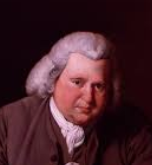
Erasmus Darwin — Zoonomia, The Botanic Garden, the Lunar Society, and Proto-Evolution (1731–1802)
Erasmus Robert Darwin was an English physician, natural philosopher, poet, inventor, botanist, abolitionist, and freemason — born in Nottinghamshire in 1731, educated at Cambridge and Edinburgh, who settled in Lichfield in 1756 where he ran a flourishing medical practice, treated poor patients without charge, declined an invitation from George III to become Physician to the King on the grounds that he could not leave his patients, and was described by Coleridge — who despised his poetry — as "the first literary character in Europe, and the most original-minded Man." He was a founding member of the Lunar Society of Birmingham, friend and colleague of Josiah Wedgwood, Matthew Boulton, James Watt, and Joseph Priestley, grandfather of Charles Darwin and Francis Galton, and the author of a theory of evolution seventy years before his grandson's.
He expressed this theory primarily in verse — embedding evolutionary speculation in annotated scientific poems with the conviction, unusual then and unusual now, that poetry and natural philosophy were not competing modes but complementary ones, each illuminating what the other could not reach alone. Few writers, as one scholar noted, have been so burdened with a surname that so clearly belongs to someone else.
His central concern: that the universe was a system of progressive development — that life had arisen from matter, complexity from simplicity, diversity of species from common origin, and human society from animal nature — and that this vision of unbroken natural progress was not a threat to wonder but its most complete expression.
The Lunar Society — The Midlands Enlightenment
The Lunar Society of Birmingham — named because it met on the full moon to give members enough light to travel home safely — was the most productive informal scientific association in eighteenth-century Britain. Its members included Matthew Boulton (manufacturer), James Watt (steam engineer), Josiah Wedgwood (pottery industrialist), Joseph Priestley (chemist, discoverer of oxygen), and Benjamin Franklin (statesman and natural philosopher), among others. Darwin was its intellectual center of gravity — the correspondent, the connector, the one who knew everything happening in natural philosophy and could relate it to medicine, poetry, and practical invention simultaneously.
The Society was the institutional nexus of the Midlands Enlightenment — the movement that united scientific inquiry with industrial application, philosophical radicalism with economic transformation, and reform politics with technological innovation. Erasmus Darwin embodied all of these connections personally: he advocated abolitionism and women's education, designed windmills and steering mechanisms and canal lifts, practiced medicine with unusual clinical imagination, and wrote scientific poetry that made natural philosophy accessible to readers who would never read a technical treatise.
"Darwin was a founding member of the Lunar Society of Birmingham, a discussion group of pioneering industrialists and natural philosophers — whose members were referred to as 'Lunaticks' and whose collective output helped drive Britain's early industrialization."
The Botanic Garden — Science in Verse
Darwin's "The Botanic Garden" (1791) — comprising "The Economy of Vegetation" and the earlier "The Loves of the Plants" (1789) — was the work that made him the most celebrated English poet of his day. It was illustrated by William Blake and Henry Fuseli. It was praised by Horace Walpole as "all, all, the most lovely poetry." It used the erotic taxonomy of Linnaeus — plant reproduction as courtship and congress — as the vehicle for a comprehensive tour of contemporary natural science, from steam engines to electrical phenomena, from geology to astronomy.
The form was deliberate and philosophically motivated: Darwin believed that poetry could communicate scientific ideas by engaging the imagination and the emotions in ways that technical prose could not. The extensive footnotes provided the scientific substance; the verse provided the memorable form. This was not popularization in the condescending sense but a genuine argument about how science and poetry served different but equally necessary cognitive functions — and about the need for both in an educated culture. The Romantics who plundered his imagery while dismissing his style — Coleridge, Wordsworth, Shelley — demonstrated through their practice how right he was about the value of scientific imagination, even as they rejected his mode of expressing it.
"The Temple of Nature was a 'glittering treasure trove of images and ideas' plundered by Shelley, Coleridge, and Wordsworth — who, even while appropriating his imagery, slurred Darwin for 'gaudiness and inane phraseology.' Coleridge called him 'the most original-minded Man' while also declaring he absolutely nauseated his poem."
Zoonomia — The Laws of Organic Life and Proto-Evolution
Darwin's "Zoonomia; or, The Laws of Organic Life" (1794–96) was his most ambitious scientific work — a comprehensive medical textbook that took twenty-five years to write, containing a system of pathology, a classification of diseases and treatments, and a chapter on "Generation" that articulated a theory of evolution seventy years before his grandson's "Origin of Species." A reviewer at the time claimed it "bids fair to do for Medicine what Sir Isaac Newton's Principia has done for Natural Philosophy." It was promptly translated into French, German, Italian, and Portuguese.
The evolutionary argument in "Zoonomia" was proto-Lamarckian: organisms changed over time in response to their needs and environments, and these changes were passed on to offspring. Darwin's formulation was speculative and visionary rather than mechanistically precise — he asked whether it would be too bold to imagine that all warm-blooded animals had arisen from one living filament, possessing the faculty of continuing to improve by its own inherent activity and of delivering those improvements by generation to posterity. The mechanism was wrong — it was acquired characteristics rather than natural selection — but the core intuition was right: common descent, progressive change, biological unity of all life. Charles Darwin, at the beginning of his B notebook on transformism, wrote a single word at the top: ZOONOMIA.
"Would it be too bold to imagine, that all warm-blooded animals have arisen from one living filament…possessing the faculty of continuing to improve by its own inherent activity, and of delivering down those improvements by generation to its posterity?"
— Erasmus Darwin, Zoonomia (1794)
The Temple of Nature — Life from the Sea
Darwin's posthumously published "The Temple of Nature; or, The Origin of Society" (1803) was his most complete evolutionary statement — a philosophical poem tracing the development of life from microscopic origins in the primordial sea through vegetative, animal, and finally human forms. The lines anticipated the fossil record sequence with a precision remarkable for their time: life beginning microscopically and invisibly in water, advancing through successive generations to new powers and larger limbs, developing from fish to reptiles to mammals to birds.
Charles Darwin annotated his personal copy of the poem in 25 places — far more than previously known — with particular attention to passages on sexual selection, the competition for reproduction, and the changes in species over time. Recent scholarship has argued that the resemblance between "The Temple of Nature" and "The Descent of Man" (1871) is closer than commonly acknowledged — that grandfather and grandson shared not just general evolutionary intuitions but specific concerns about sexual selection that the later work made scientific.
"Charles enumerated the details of evolution, but Erasmus anticipated its broad outlines; the younger Darwin wrote in prose, and the elder imagined in poetry — arguably the most significant writer of scientific verse in English, a sadly neglected genre."
Abolitionist, Suffragist, Radical — The Political Erasmus
Erasmus Darwin's evolutionary and materialist philosophy was continuous with his political radicalism. If all life shared common origin, if complexity arose from simplicity, if human beings were continuous with the natural world rather than set apart from it — then the hierarchies of race, sex, and class that his society treated as natural were contingent rather than essential. He was an abolitionist in an era when abolition was a radical position, a supporter of women's education at a time when it was widely opposed, and a sympathizer with the American and French revolutions.
His 1797 "Plan for the Conduct of Female Education" argued that women deserved the same intellectual formation as men — that the common practice of limiting women's education to ornamental accomplishments was a waste of human capacity and a disservice to society. His motto "E conchis omnia" — everything from shells — painted on his carriage in 1770, was spotted by the Canon of Lichfield Cathedral who accused him in satirical verse of renouncing his Creator. Darwin declined to change it.
"E conchis omnia" — Everything from shells.
The motto Darwin painted on his carriage in 1770, expressing in three Latin words the essence of evolutionary continuity: all complexity, all beauty, all life, from the simplest origins.
The Inventor — Practical Genius Alongside Theoretical Vision
Darwin's practical inventions were as various as his theoretical interests. He designed a horizontal windmill for Josiah Wedgwood's pottery works. He invented a steering mechanism for his carriage — now known as the Ackermann linkage — that was independently reinvented and adopted by the automobile industry 130 years later. He built a speaking machine from wood, silk, and leather that pronounced words convincingly enough to fool listeners who could not see the device. He designed a canal lift for barges. He sketched in 1779 — forty years before anyone else — a hydrogen-oxygen rocket engine with gas tanks, plumbing, pumps, and an elongated combustion chamber and expansion nozzle: the conceptual blueprint for the modern rocket motor. He founded four scientific societies. He was, as one scholar noted, the man who covered more academic fields successfully than any subsequent scientist.
"He is famous for founding four scientific societies throughout his life and successfully covering more academic fields than any subsequent scientist. One of the most exciting aspects of his work is how he presented his revolutionary theories — most of them embedded in long poems with philosophical notes."
Legacy — The Darwin Before Darwin
Erasmus Darwin died in 1802, a year after moving to Breadsall Priory near Derby. His final work was published posthumously. He was, for the first decades of the nineteenth century, better remembered than his grandson would be for the first decades of his career — the most celebrated English poet of the 1790s, the most comprehensive medical theorist of his generation, a natural philosopher whose evolutionary speculations had set in motion a chain of thought that his grandson would complete with the mechanism of natural selection.
On CivSim he belongs alongside Joseph Priestley, David Hartley, and the Lunar Society circle — the Midlands Enlightenment that understood science, philosophy, technology, and politics as aspects of a single progressive project. His challenge to Universal Humanism is the continuity challenge: that human beings are not set apart from nature by some categorical distinction but are part of its continuous development — and that a philosophy of human dignity must be grounded in that natural history rather than in claims of unique human privilege that our own evolutionary origins contradict.
"There is an irony that the greatest poetic encapsulation of evolution was written before there was an actual theory of natural selection. Literature anticipates and prepares; it can consider unrealised possibilities. Poetic fantasy prefigures scientific prose."
CivilSimian.com created by AxiomaticPanic, CivilSimian, Kalokagathia