
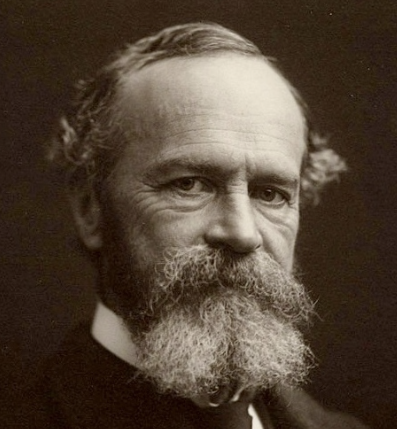
William James — Pragmatism, Radical Empiricism, and the Varieties of Religious Experience (1842–1910)
William James was an American philosopher, psychologist, and physician — born in New York City on 11 January 1842, the eldest son of the Swedenborgian theologian Henry James Sr. and the brother of the novelist Henry James and the diarist Alice James. His father was an unconventional, intellectually restless man who insisted on educating his children in Europe and then back in America, then Europe again, exposing them to multiple languages and intellectual traditions and denying them any fixed vocation until they had discovered it for themselves. William studied painting briefly, then chemistry, then medicine at Harvard, spending time in Brazil on Louis Agassiz's zoological expedition before his health collapsed. He earned his medical degree from Harvard in 1869 but never practiced medicine — teaching anatomy there from 1872, then psychology, then philosophy, remaining at Harvard until his resignation in 1907, three years before his death in Chocorua, New Hampshire on 26 August 1910.
He suffered a severe psychological crisis in his late twenties — depression, the sense that his will was paralyzed, that the world had no genuine moral order — which he resolved, as he later described in a thinly veiled passage in "The Varieties," by the conviction that his free will was real, and that choosing to act as if it were real was itself a free act that constituted its reality. The crisis and its resolution shaped everything he subsequently wrote. His major works were "The Principles of Psychology" (1890) — fourteen years in the writing, the most influential psychology textbook of the century — "The Will to Believe" (1897), "The Varieties of Religious Experience" (1902), "Pragmatism" (1907), and the posthumously published "Essays in Radical Empiricism" (1912). Bergson called him "the most original philosopher alive."
His central concern, threading all his work from psychology through philosophy to religion: that experience — rich, flowing, relational, including its emotional and volitional dimensions — was the proper starting point for philosophy, and that any philosophy which abstracted from experience to reach a tidier but thinner account of reality had falsified the subject it claimed to illuminate.
The Stream of Consciousness — Against the Atomism of Experience
The "Principles of Psychology" (1890) was the work that established James as the founder of American psychology — and its most enduring contribution was the concept of the "stream of consciousness" (later adopted by Virginia Woolf and the modernist novel), which challenged the dominant British empiricist tradition's atomistic account of experience. Hume and his successors had treated experience as composed of discrete "ideas" — separable mental atoms that were combined by the laws of association. James's observation: this was not what experience was actually like. Consciousness was not a sequence of discrete states but a flowing, continuous stream — undivided, always in transition, colored throughout by emotional tone and bodily feeling. "It is nothing jointed; it flows. A 'river' or a 'stream' are the metaphors by which it is most naturally described." The relations between experiences were just as real as the experiences themselves — a point that would become the foundation of his later radical empiricism.
"Consciousness does not appear to itself chopped up in bits. Such words as 'chain' or 'train' do not describe it fitly. It is nothing jointed; it flows. A 'river' or a 'stream' are the metaphors by which it is most naturally described."
— James, The Principles of Psychology
Pragmatism — Truth as What Works
Pragmatism — the philosophical method James developed from Charles Sanders Peirce's earlier formulations — proposed that the meaning of any idea was the practical difference it made to experience. Ideas were not static copies of reality but instruments for navigating experience — they were true insofar as they worked, insofar as they led us successfully through experience to the next stage. "Truth happens to an idea. It becomes true, is made true by events." This was not the vulgar claim that whatever was useful was true — James was careful to distinguish practical from narrowly self-interested — but the more radical claim that truth was not a static property of ideas that copied reality accurately but a dynamic property of ideas that proved their worth in experience.
The implications were significant. Abstract philosophical disputes that made no practical difference to experience were not genuine disputes at all — they were verbal tangles that dissolved once the question was properly put. The dispute between materialism and spiritualism, for instance, made no practical difference to the past — both accounts agreed that the past was what it was. The difference lay only in how we thought about the future — and James argued that the question of which account left more room for meaningful human action was itself a relevant consideration. Pragmatism was not relativism — not all ideas worked equally well — but it relocated the criterion of truth from correspondence to a static reality to coherence with and guidance through the ongoing flow of experience.
"Truth happens to an idea. It becomes true, is made true by events. Its verity is in fact an event, a process: the process namely of its verifying itself, its veri-fication. Its validity is the process of its valid-ation."
— James, Pragmatism
The Will to Believe — Rational Faith in Genuine Options
"The Will to Believe" (1897) was James's most controversial philosophical essay — an argument that in certain circumstances, faith before proof was not merely permissible but rationally required. The argument was precise and often misunderstood. James was not arguing for believing whatever you wanted. He was arguing that when a hypothesis was "live" (genuinely possible to believe), "forced" (the choice could not be avoided), and "momentous" (the stakes were high and the opportunity unique) — and when sufficient evidence was not available to decide the question — then the choice to believe or not to believe was itself an act of will that had real consequences. Refusing to believe on insufficient evidence was itself a choice — the choice of losing the goods that might come from believing rightly in order to avoid the error of believing wrongly. This trade-off was not automatically rational. In genuine options without available evidence, the will to believe could be justified.
"The greatest revolution of our generation is the discovery that human beings, by changing the inner attitudes of their minds, can change the outer aspects of their lives."
— William James
The Varieties of Religious Experience — Taking the Evidence Seriously
The Gifford Lectures delivered in Edinburgh in 1901–02 and published as "The Varieties of Religious Experience" (1902) was James's most enduring single work — a systematic, empirical examination of religious experience that took its subject seriously as evidence about reality rather than dismissing it as illusion or reducing it to pathology. His method was rigorously empirical: what did religious experiences actually consist of, across traditions and individuals? What were their fruits in the lives of those who had them? And what, if anything, did they suggest about the nature of reality?
His findings were philosophically careful rather than enthusiastically credulous. He distinguished the existential judgment (what caused the experience psychologically) from the spiritual judgment (what the experience was evidence of) — noting that reducing religious experience to its psychological causes did not settle the question of whether it tracked anything real. The argument from "origins" — that religious experience was "merely" nervous excitement, or sexual repression, or temporal-lobe activity — was logically irrelevant to its cognitive value. Many veridical experiences had undignified physiological causes. What mattered was the fruits: did religious experience produce people who were more generous, more capable of love and service, more alive to reality — or less? And if the fruits were good, and if the experience itself was the most direct evidence available about the nature of things, then dismissing it a priori was not scientific but dogmatic.
"Religious experiences point with reasonable probability to the continuity of our consciousness with a wider spiritual environment from which the ordinary prudential man — who is the only man that scientific psychology takes cognizance of — is shut off."
— James, A Pluralistic Universe
Radical Empiricism — Relations as Real
James's most technically demanding philosophical contribution was what he called "radical empiricism" — an epistemological doctrine with metaphysical implications. Traditional empiricism had taken sense-data as its basic units: the discrete, punctual impressions from which experience was built up. James argued this was not radical enough — that the relations between experiences were just as real, just as directly experienced, as the experiences themselves. When I experience "and," "then," "but," "beside," "from" — these were not mere formal connectives imposed by the mind on a passive stream of data but genuine features of experience. The conjunctions of experience were as empirically real as its disjunctions.
This had significant consequences. It meant that the world of pure experience — the world as it presented itself before any conceptual analysis — was rich, relational, continuous, and alive in a way that neither the materialist's atoms-in-the-void nor the idealist's categories-of-the-mind could fully capture. Experience itself, taken in its fullness, was neither purely subjective nor purely objective but the common ground from which both emerged. The metaphysics of "pure experience" that James built on this basis was unfinished at his death — but the move was philosophically important, anticipating phenomenological approaches to experience and influencing Bergson, Dewey, and Whitehead.
"Radical empiricism consists of the postulate that only things definable in terms drawn from experience shall be debatable among philosophers; the fact that relations between things are just as directly experienced as the things themselves; and the conclusion that the parts of experience hold together from next to next by relations that are themselves parts of experience."
— James, The Meaning of Truth
Pluralism and the Open Universe
Against the idealist tradition's "block universe" — in which all reality was ultimately One, and the apparent diversity of the world was a secondary appearance overlaid on an underlying unity — James consistently defended pluralism: the reality and irreducibility of the many. The universe was genuinely diverse, genuinely open, genuinely capable of surprise. The future was not fixed in advance — genuine novelty was possible, genuine freedom was real, and the universe was not a finished and completed whole but an ongoing, unfinished process in which human action could make a real difference. "We are like islands in the sea, separate on the surface but connected in the deep" — neither solipsistically isolated nor merged into an undifferentiated One.
This pluralism was not merely metaphysical but moral and political. James was a consistent opponent of imperialism — he was active in the Anti-Imperialist League against the American takeover of the Philippines — and his pluralism was continuous with his anti-imperialism: the same philosophical error that dissolved the many into the One in metaphysics produced the political error of dissolving diverse peoples into a single empire. "On a Certain Blindness in Human Beings" — his essay on the irreducible interiority of other lives — was the moral philosophy that followed from his metaphysics.
"We are like islands in the sea, separate on the surface but connected in the deep."
— William James, The Varieties of Religious Experience
Legacy — The Philosopher Who Kept Experience Whole
James's legacy spans more fields than any other American philosopher. In psychology: the stream of consciousness, functional psychology, the James-Lange theory of emotion, the study of habit — all foundational. In philosophy of religion: "The Varieties" remains the starting point for empirical study of religious experience. In philosophy: pragmatism became one of the major philosophical movements of the twentieth century through Dewey, Rorty, and others. Bergson acknowledged him as a parallel explorer; Wittgenstein's later philosophy has been read as pragmatist in spirit. His influence on Huxley's "Mind at Large" concept was direct. His influence on the recovery of experience as a philosophical category runs through phenomenology to contemporary philosophy of mind.
On CivSim he belongs alongside Bergson, Dewey, and Whitehead — the tradition of process and experience philosophy that resisted the reduction of reality to either matter or abstract reason. His challenge to Universal Humanism is the pluralism challenge — offered not as critique but as requirement: a philosophy committed to human dignity across all persons must take seriously the irreducible interiority of other lives — the "blindness" that James diagnosed in every person's inability to fully enter the experience of another. Universal Humanism must be grounded not in an abstract conception of the human but in the concrete, flowing, relational experience of actual human beings in all their variety — the islands that are separate on the surface but connected in the deep.
"Act as if what you do makes a difference. It does."
— William James
CivilSimian.com created by AxiomaticPanic, CivilSimian, Kalokagathia