
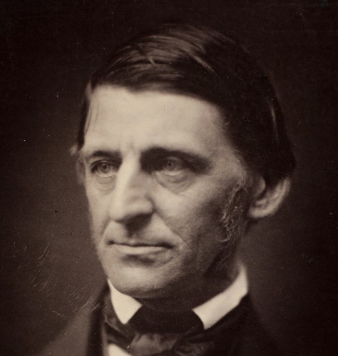
Ralph Waldo Emerson — Self-Reliance, the Over-Soul, and the Infinitude of the Private Man (1803–1882)
Ralph Waldo Emerson was an American essayist, poet, lecturer, and philosopher — born in Boston on 25 May 1803, the son of the most prominent Unitarian minister in the city, who lost his father at eight, watched four of his seven siblings die young, attended Harvard at fourteen, graduated in 1821, trained at Harvard Divinity School, and was ordained a Unitarian minister in 1829. In 1831 his young wife Ellen Tucker died of tuberculosis, and in 1832 he resigned his ministry — unable in conscience to administer the Lord's Supper, which he no longer believed in — and sailed for Europe, where he met Coleridge, Wordsworth, and Carlyle. His friendship with Carlyle was lasting and defining. He returned to America, settled in Concord, Massachusetts, married Lydia Jackson, and began the lecture career that would sustain him for the rest of his life. In 1836 he published "Nature" — at his own expense, anonymously — the founding document of American Transcendentalism. In 1842 his five-year-old son Waldo died of scarlatina — a loss he could not directly mourn, retreating instead to the essay "Experience," one of the most philosophically honest documents of grief in the language. He continued lecturing, writing, and revising until his memory failed in his seventies. He died of pneumonia in Concord on 27 April 1882. Nietzsche called him "the most gifted of the Americans." Whitman called him his "master." Oliver Wendell Holmes called "The American Scholar" America's "intellectual Declaration of Independence."
"In all my lectures," he wrote, "I have taught one doctrine, namely, the infinitude of the private man." This was his central claim — the one from which everything else followed: that each individual human being was not a fragment but a full expression of the soul of the world; that the divine was not remote, ecclesiastical, or mediated by institution, but immediately available to any person willing to trust what their own deepest nature revealed.
The Divinity School Address — Religion Without Institution
The Harvard Divinity School Address of 1838 was the most consequential and most controversial speech Emerson ever delivered — a frontal challenge to orthodox Christianity that got him banned from speaking at Harvard for twenty-nine years and established him as the central figure of American intellectual radicalism. His argument: historical Christianity had made a fatal error — it had emphasized the person of Jesus at the expense of the soul, the record of revelation at the expense of the act of revelation, the institution at the expense of the immediate divine presence that the institution was supposed to mediate. Jesus had been "a true man" who "estimated the greatness of man" — who showed that every human being had the same direct access to divine reality that he himself demonstrated. The church had turned this into a cult of the person, teaching people to worship Jesus rather than to become what Jesus was: a fully alive, fully open expression of the divine within human form. True religion was not belief in doctrine but direct, first-hand encounter with the "Over-Soul" — the divine reality that was the ground of every self.
"That which shows God in me, fortifies me. That which shows God out of me, makes me a wart and a wen. There is no longer a necessary reason for my being."
— Emerson, The Divinity School Address
Self-Reliance — The Most Radical American Essay
"Self-Reliance" (1841) was the essay that made Emerson famous across the world — and remains the most radical statement of American individualism ever written, far exceeding in philosophical depth the political individualism of the founders. Its argument was not libertarian but spiritual: each person had a unique genius — a particular insight into reality — that no one else in the history of the world had had or ever would have again. The obligation to express that genius — to refuse all social pressure toward conformity, all deference to authority, all compromise with the conventions of the crowd — was not selfishness but fidelity to the divine force working through the individual. "Trust thyself: every heart vibrates to that iron string."
The essay's most famous line — "A foolish consistency is the hobgoblin of little minds, adored by little statesmen and philosophers and divines" — was not an endorsement of irrationality but a philosophical claim about growth: the soul was always moving, always discovering new aspects of truth, and the insistence on remaining consistent with what one had previously said was a way of honoring the past at the expense of the present. "Speak what you think now in hard words, and tomorrow speak what tomorrow thinks in hard words again, though it contradict every thing you said today." This was not relativism but the epistemology of a thinker who believed that truth was too large for any single formulation and that genuine engagement with it required perpetual readiness to be surprised.
"Trust thyself: every heart vibrates to that iron string. Accept the place the divine providence has found for you, the society of your contemporaries, the connection of events. Great men have always done so, and confided themselves childlike to the genius of their age."
— Emerson, Self-Reliance
The Over-Soul — Unity Beneath Individuality
"The Over-Soul" (1841) was Emerson's most sustained metaphysical essay — an account of the divine ground from which individual souls arose and to which they returned in moments of genuine inspiration, love, and perception. "We live in succession, in division, in parts, in particles. Meantime within man is the soul of the whole; the wise silence; the universal beauty, to which every part and particle is equally related; the eternal ONE." The Over-Soul was not a distant God but the innermost reality of every person — the dimension of the self that was not personal but universal, not individual but divine.
This created the central tension in Emerson's philosophy that the Stanford Encyclopedia identifies as never fully resolved: the tension between his celebration of individual uniqueness and self-reliance and his claim that all selves ultimately expressed the same Over-Soul. How could the individual be genuinely unique if all individuality was an expression of the same universal ground? Emerson's answer was more poetic than systematic: both were true, experienced at different levels — the surface was genuinely diverse, irreducibly individual; the depth was genuinely one, universally shared. The "islands in the sea" image that William James adapted from him was Emerson's own way of holding the paradox without dissolving either side.
"We live in succession, in division, in parts, in particles. Meantime, within man is the soul of the whole; the wise silence; the universal beauty, to which every part and particle is equally related; the eternal ONE."
— Emerson, The Over-Soul
Experience — Grief and the Loss of Innocence
"Experience" (1844) — written after the death of his five-year-old son Waldo — was the most philosophically honest essay Emerson ever wrote, and the one that most directly confronted the limits of his optimism. He could not grieve as one expected a father to grieve. "In the death of my son, now more than two years ago, I seem to have lost a beautiful estate — no more. I cannot get it nearer to me." The numbness he described was not the hardness of the unfeeling but the philosophical recognition that consciousness was always mediated — that experience never gave us direct access to things themselves but always through the veils of temperament, mood, and the passage of time. We were all islanded in our own subjectivity. The essay retreated from the confident pantheism of "Nature" into a chastened but still fundamentally affirmative philosophy: "Up again, old heart! — it seems to say — there is victory yet for all justice; and the true romance which the world exists to realize, will be the transformation of genius into practical power."
"In the death of my son, now more than two years ago, I seem to have lost a beautiful estate — no more. I cannot get it nearer to me. If tomorrow I should be informed of the bankruptcy of my principal debtors, the loss of my property would be a great inconvenience to me, perhaps, for many years; but it would leave me as it found me — neither better nor worse. So it is with this calamity."
— Emerson, Experience
The American Scholar and the Intellectual's Vocation
"The American Scholar" (1837) was Emerson's most directly political philosophical address — an argument that American intellectual culture had been too deferential to European tradition and too subservient to commercial values, and that the scholar's true vocation was not to store up other men's thoughts but to think their own. His vision of the scholar's education had three components: nature (the first teacher of an active mind), books (the preserved intelligence of the past, to be used as stimulus, not authority), and action (the scholar had to live in the world, to experience, to risk, to get their hands dirty with the actual). "Only so much do I know, as I have lived. Instantly we know whose words are loaded with life, and whose not." The address was not anti-intellectual but anti-academic: it distinguished living thought from dead accumulation and insisted that no amount of book-learning could substitute for direct encounter with life.
"Only so much do I know, as I have lived. Instantly we know whose words are loaded with life, and whose not."
— Emerson, The American Scholar
Legacy — The Prophet of the American Self
Emerson's influence on American culture has been so pervasive as to be almost invisible — absorbed into the cultural atmosphere rather than acknowledged as a specific source. Thoreau was his most direct disciple, taking the self-reliance argument from philosophy into practice at Walden Pond. Whitman took it into poetry — "Leaves of Grass" was Emerson's philosophy expressed in Whitman's own voice. William James took pragmatism in directions that Emerson had intuited but not systematized. Nietzsche absorbed him deeply — the Emersonian celebration of greatness, power, and self-overcoming runs through Nietzsche's work in a way Nietzsche acknowledged. The American counterculture of the 1960s drew on him. Self-help culture has domesticated him. Harold Bloom considered him the central figure of the American canon.
On CivSim he belongs alongside James, Thoreau, and Whitman — the tradition of American thought that located the ground of value not in institution, tradition, or collective authority but in the immediate, individual, potentially universal experience of the self encountering reality directly. His challenge to Universal Humanism is the one he himself did not fully resolve: if each person is an expression of the Over-Soul — if the "infinitude of the private man" is the central doctrine — then the universal ground of human dignity is not abstract but experiential, not argued but discovered in the moment of genuine self-trust. A philosophy that grounds itself in reasoning alone may have missed the dimension that Emerson spent his life pointing toward — the immediate, prereflective encounter with the divine that the self-reliant self was always already having, even when it didn't know it.
"In all my lectures, I have taught one doctrine, namely, the infinitude of the private man."
— Ralph Waldo Emerson
CivilSimian.com created by AxiomaticPanic, CivilSimian, Kalokagathia