
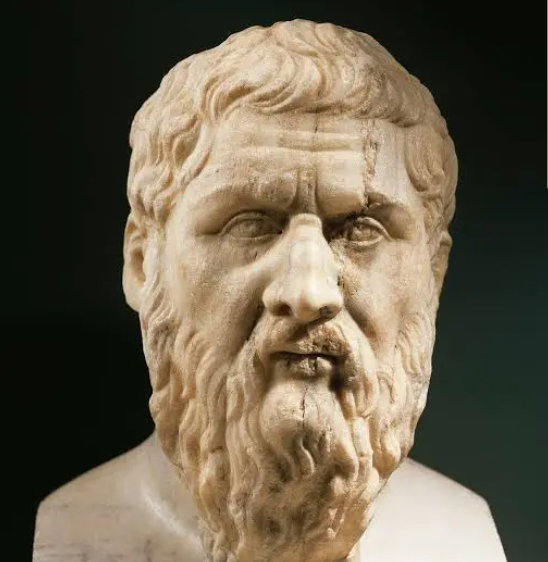
Plato
Member for
1 year 2 monthsPlato — The Theory of Forms, the Republic, and the Founding of Western Philosophy (c. 428–348 BCE)
Plato was an ancient Greek philosopher of Classical Athens — born around 428–423 BCE into one of the most distinguished aristocratic families in the city, a descendant through his mother Perictione of the great lawgiver Solon, and through his stepfather of the circle around Pericles. His brothers Glaucon and Adeimantus appear as interlocutors in the Republic. His mother's relatives Critias and Charmides were among the Thirty Tyrants who seized power after Athens's defeat in the Peloponnesian War — a family connection that complicated his political position as Athens restored its democracy. He encountered Socrates as a young man, was drawn into his circle, burned his early poems, and devoted himself to philosophy. He witnessed the trial and execution of Socrates by the Athenian democracy in 399 BCE — an event that permanently shaped his politics, his philosophy, and his view of democratic institutions. He traveled after Socrates's death — to Megara, to Egypt, to Italy, where he encountered the Pythagoreans — and returned to Athens around 387 BCE to found the Academy, the first institution of higher education in the Western world, where he taught for the rest of his life. His student Aristotle joined the Academy at seventeen and remained for twenty years. Plato died in Athens around 348–347 BCE, reportedly at the age of eighty, at a wedding feast.
All of his works have survived — an extraordinary circumstance — comprising roughly thirty-six dialogues and thirteen letters, spanning early Socratic dialogues (Euthyphro, Apology, Crito, Phaedo), the great middle works (Meno, Symposium, Republic, Phaedrus), and the late dialogues (Parmenides, Theaetetus, Sophist, Timaeus, Laws). He never speaks in his own name — every dialogue except the Laws features Socrates, whose voice is the vehicle for Platonic arguments whose relation to the historical Socrates is one of the most contested questions in the history of philosophy. Alfred North Whitehead's summary: "the safest general characterization of the European philosophical tradition is that it consists of a series of footnotes to Plato." This is not an exaggeration.
His central concern, from the early Socratic dialogues through the late systematic works: that reality had two levels — the changing, imperfect world of sensory experience and the unchanging, perfect world of Forms (or Ideas) — and that genuine knowledge, genuine virtue, and genuine political order required turning from the former toward the latter.
Socrates — The Teacher Who Wrote Nothing
Socrates wrote nothing. Everything we know of him — his arguments, his method, his character — comes through others, most fully through Plato. The "Socratic problem" — the question of how much the Platonic Socrates reflects the historical man — has exercised scholars for two centuries. The general consensus: the early dialogues (Euthyphro, Apology, Crito) reflect something closer to the historical Socrates, whose primary activity was the elenctic cross-examination of those who claimed expertise they did not possess, revealing that wisdom began with awareness of one's own ignorance. The middle and late dialogues' elaborate metaphysics — the Theory of Forms, the tripartite soul, the ideal city — are Plato's own development, even when put in Socrates's mouth.
Socrates's execution — tried for impiety and corrupting the youth, condemned by a jury of 501, dying by hemlock rather than accepting exile — was the founding trauma of Platonism. The Apology and the Phaedo were Plato's literary memorials: the first showing Socrates defending his philosophical mission, the second showing him facing death with philosophical equanimity, arguing for the immortality of the soul. That the most just man in Athens had been killed by the democracy was the political lesson Plato never forgot — and that produced the profoundly anti-democratic Republic.
"The unexamined life is not worth living for a human being."
— Socrates, in Plato's Apology
The Theory of Forms — Two Worlds
Plato's most distinctive and most influential philosophical contribution was the Theory of Forms — the claim that the world accessible to the senses was not the fundamental level of reality. The physical world was characterized by change, imperfection, and approximation: every beautiful thing would cease to be beautiful, every equal pair of sticks was only approximately equal, every just act was justice imperfectly embodied. Behind and beyond the physical world was the realm of Forms — unchanging, perfect, eternal archetypes of which physical things were imperfect copies or participations. The Form of Beauty was what all beautiful things had in common and what made them beautiful; the Form of Justice was what just acts approximated; the Form of the Good was the highest Form, the source from which all other Forms drew their being.
The epistemological consequence: genuine knowledge — episteme — was of the Forms, not of their physical instantiations. Sensory perception gave only opinion (doxa) — true or false belief about the changing world of appearances. Philosophical knowledge was of the stable, unchanging world of Forms — achieved not through perception but through reason, through the dialectical ascent toward the Good that philosophical education was designed to accomplish. This bifurcation of reality and knowledge — separating the knowable from the perceivable — was the move that defined Platonism and shaped the Western tradition for millennia.
"The lovers of sounds and sights delight in beautiful tones and colors and shapes and in everything that art fashions out of these, but their thought is incapable of seeing and delighting in the nature of the beautiful itself. Knowledge which is acquired under compulsion obtains no hold on the mind."
— Plato, Republic
The Allegory of the Cave — Ignorance, Education, and Return
The Allegory of the Cave — from Book VII of the Republic — was Plato's most celebrated single passage and one of the most influential philosophical images in history. Prisoners chained in a cave since childhood face a wall — unable to turn their heads, seeing only the shadows cast by objects carried in front of a fire behind them. They take the shadows for reality — the only reality they have ever known. When one prisoner is freed and turned toward the fire, then dragged up into the sunlight, he is first blinded, then gradually able to see objects, then the sun itself — the source of all visible things. Returning to the cave, he can no longer see the shadows clearly and appears foolish to those who have never left. If he tries to tell them the truth, they may kill him.
The allegory condensed Plato's entire philosophy: the cave was the world of sensory experience; the shadows were ordinary beliefs based on perception; the journey upward was philosophical education; the sun was the Form of the Good — the source of being and truth. The philosopher who returned to the cave — who descended from knowledge to politics — was Socrates. The prisoners who might kill him were the Athenian democrats who actually did. The allegory was simultaneously a theory of knowledge, a theory of education, a political philosophy, and an autobiography of Platonism.
"In the world of knowledge the idea of good appears last of all, and is seen only with an effort; and, when seen, is also inferred to be the universal author of all things beautiful and right, parent of light and of the lord of light in this visible world, and the immediate source of reason and truth in the intellectual."
— Plato, Republic, Book VII
The Republic — The Philosopher-King and the Just City
The Republic was Plato's most ambitious work — not primarily a treatise on politics but a sustained investigation of justice, using the parallel between the just city and the just soul to argue that justice was the harmonious ordering of parts according to their natural function. The tripartite soul — reason, spirit (thumos), and appetite — was just when reason governed, spirit obeyed reason and disciplined appetite, and appetite was constrained to its proper satisfactions. The tripartite city mirrored this: philosopher-rulers (reason), guardians/warriors (spirit), and producers (appetite) each performed their appropriate function without encroaching on the others'.
The philosopher-king — the ruler educated in mathematics, dialectic, and the ascent to the Forms, finally compelled to return to the cave — was the political culmination of the metaphysics. Only those who knew the Good could rule well; those who had seen the sun had no natural desire to return to managing shadows, but justice required it. Democracy — the regime in which the many ruled by opinion — was for Plato the second-worst constitution, surpassed in degradation only by tyranny, which democracy inevitably produced as unlimited freedom dissolved into appetite unlimited. The execution of Socrates — democracy's greatest crime — was for Plato the permanent evidence for democracy's unfitness to rule.
"Until philosophers are kings, or the kings and princes of this world have the spirit and power of philosophy, and political greatness and wisdom meet in one, and those commoner natures who pursue either to the exclusion of the other are compelled to stand aside, cities will never have rest from their evils."
— Plato, Republic
The Symposium and Eros — The Ladder of Love
The Symposium — Plato's most beautiful work — presented a series of speeches on the nature of love (Eros) culminating in the speech of Socrates, which he attributed to the wise woman Diotima. Eros was not a god but a great spirit, between divine and mortal, the intermediary through which humans reached toward what they lacked. The proper use of erotic desire was not satisfaction of any particular beautiful thing but ascent — from love of one beautiful body, to love of beautiful bodies in general, to love of beautiful souls, beautiful practices, beautiful knowledge, and finally to the Form of Beauty itself — "always subsisting of itself and by itself in an eternal oneness, while every lovely thing partakes of it." The Symposium's erotic ascent to the Form of Beauty was the most powerful literary expression of the Platonic philosophical journey — and the source of the Neoplatonic and Christian mystical traditions of ascent to the divine.
"This is the right way of approaching or being initiated into the mysteries of love — to begin with examples of beauty in this world, and using them as steps to ascend continually, always going higher and higher, until we reach the beautiful itself and know what it is to be beautiful."
— Plato, Symposium (Diotima's speech)
The Academy and the Transmission of Philosophy
The Academy — founded around 387 BCE in a grove of olive trees sacred to the hero Hecademus, northwest of Athens — was the first institution in the Western world devoted to higher education and philosophical research. It combined philosophy, mathematics, astronomy, and political science in a curriculum designed to produce the kind of minds that the Republic described. Aristotle joined it at seventeen and remained for twenty years, until Plato's death. The Academy continued for nearly nine hundred years after Plato — until Justinian closed it in 529 CE, the same edict that closed the Athenian philosophical schools generally and ended ancient philosophy. The final scholarchs — Proclus's successors — fled to the court of the Sassanid king Chosroes I in Persia. The stream of Platonic influence never fully stopped flowing: through Neoplatonism into Augustine and Christian theology; through Arabic translations into Islamic philosophy; through Petrarch and the Renaissance Platonists into modernity.
"The safest general characterization of the European philosophical tradition is that it consists of a series of footnotes to Plato."
— Alfred North Whitehead, Process and Reality
Legacy — The Source and the Problem
Plato is the most consequential figure in Western philosophy — not because he was always right but because the questions he raised, the methods he employed, and the frameworks he constructed defined the terrain on which Western philosophy has operated ever since. The problem of universals (what do particular things have in common?), the relation of knowledge to belief, the question of what justice requires, the structure of the ideal political community, the nature of love and beauty, the immortality of the soul, the existence of God, the nature of the Good — all were given their canonical Western formulations by Plato, and every subsequent philosopher has been working with, against, or around him.
Karl Popper's "The Open Society and Its Enemies" (1945) — one of the most influential political works of the twentieth century — identified Plato as the founding thinker of totalitarianism, arguing that the philosopher-king ideal was the intellectual ancestor of fascism and Stalinism. The debate over Plato's politics — whether the Republic was a sincere political proposal or a philosophical thought experiment — has never been settled. On CivSim he belongs at the root — the thinker before whom every philosophical tradition defined itself, whose idealism Universal Humanism both inherits and must critically engage. His challenge to Universal Humanism is the philosopher-king challenge: if genuine knowledge of the Good is possible, and if most people lack it, on what basis does a universal democracy of judgment make political decisions? His answer — philosopher-kings — was the most consequential wrong answer in the history of political philosophy. The question it was trying to answer — how do we ensure that political power is exercised by those with genuine wisdom — remains the hardest question in political philosophy, and Plato asked it first.
"One of the penalties for refusing to participate in politics is that you end up being governed by your inferiors."
— attributed to Plato (Socrates in the Republic)
CivilSimian.com created by AxiomaticPanic, CivilSimian, Kalokagathia