
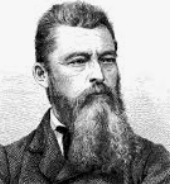
Ludwig Feuerbach — The Essence of Christianity, Projection Theory, and the Bridge from Hegel to Marx (1804–1872)
Ludwig Andreas Feuerbach was a German philosopher and anthropologist — born on 28 July 1804 in Landshut, Bavaria, the fourth son of the eminent jurist Paul Johann Anselm Ritter von Feuerbach (author of the Bavarian criminal code and champion of legal reform), brother of mathematician Karl Wilhelm Feuerbach, and uncle of painter Anselm Feuerbach. He began studying theology in Heidelberg under Karl Daub, then transferred to Berlin to study philosophy under Hegel himself — whose lectures he attended for two years, becoming a devoted student — before concluding that Hegel's idealism was theology in disguise and devoting the rest of his life to its systematic critique. He earned his doctorate at Erlangen in 1828, taught there briefly as a Privatdozent, published "Thoughts on Death and Immortality" in 1830 anonymously — a work denying personal immortality — which was attributed to him, caused a scandal, and permanently ended any prospect of a regular academic appointment. He spent the following decades as an independent scholar in the village of Bruckberg in rural Franconia, where his wife owned a small porcelain factory that kept them financially afloat. When the factory went bankrupt in 1860, he moved to Rechenberg near Nuremberg, where he lived in poverty until his death on 13 September 1872.
He is considered the pivotal transitional figure between Hegel and Marx — the philosopher who inverted Hegel's idealism into materialism and who provided Marx with the tools — projection theory, alienation, the critique of ideology — that Marx then turned from religion to political economy. Engels recalled that when "The Essence of Christianity" appeared in 1841, "we all became at once Feuerbachians" — a conversion that lasted until Marx's "Theses on Feuerbach" (1845) identified where the transitional figure had stopped short. George Eliot translated "The Essence of Christianity" into English in 1854 — her first major publication, and a work that transformed her own religious thinking.
His central concern: to "bring theology down to anthropology" — to demonstrate that the attributes assigned to God were the projected attributes of the human species itself, displaced onto an imaginary divine object, and that the recovery of those attributes for humanity was the philosophical task of the age.
Against Hegel — Inverting the Idealism
Feuerbach's philosophical formation was entirely within Hegelianism — and his break with it was correspondingly total. Hegel had argued that the development of history was the self-development of Absolute Spirit (Geist) through the medium of human consciousness: nature, history, art, religion, and philosophy were successive stages in Spirit's coming to know itself. Human consciousness was the vehicle through which the Absolute became self-aware. For Hegel, the finite was a moment in the development of the Infinite.
Feuerbach inverted this entirely. The Absolute was not the ground of finite human consciousness — human consciousness was the ground of the Absolute. God was not a reality of which human beings were finite expressions; God was a human creation — the projection of human attributes onto an imaginary infinite subject. The subject and the predicate of theology had been reversed: theology said "God is love" meaning that love was a property of a real God. Feuerbach said: love is the reality; "God" is love transformed into a subject, human loving capacity projected and hypostasized as a divine person. This inversion — turning Hegel right-side up, as Marx would later describe it — was the founding gesture of Feuerbach's philosophy.
"The intention of Feuerbach's critical philosophy is to break down both theology and speculative philosophy into anthropology. Not only religious consciousness, but also its sublimated philosophical form — Hegelian speculation — must be exposed as false consciousness. Actual material human being is taken as the positive starting point."
The Essence of Christianity — God as Human Projection
"The Essence of Christianity" (1841) was the work that made Feuerbach famous across Europe overnight — a sustained demonstration of the thesis that the attributes of God were the projected, objectified, and worshipped attributes of the human species itself. God was infinite: but what was infinity but the unlimited capacity for knowledge, love, and power that the human species possessed as a species, though no individual could actualize it? God was all-knowing: but knowledge was a human faculty, infinitely projected onto a divine subject. God was love: but love was the most fundamental human need and power, projected outward and called divine. God was perfect: but perfection was the human species contemplating its own unrealized potential, personifying that potential as an external being, and worshipping what was in fact its own best self.
The mechanism was alienation — the same concept Marx would later apply to labor. In projecting its own attributes onto God, humanity impoverished itself: "the more man attributes to God, the less he retains for himself." The riches of human nature — knowledge, love, will, justice — were transferred to a transcendent subject and the human being who had made the transfer was left with their negation: ignorance, need, weakness, sinfulness. Religion was not merely intellectually false; it was practically self-destructive — a form of collective self-alienation in which humanity denied and diminished itself in the very act of worshipping its own projected magnificence.
"The more man attributes to God, the less he retains for himself. God is rich, man is poor. God knows all, man is ignorant. God is good, man is sinful. God is mighty, man is powerless. The impoverishment of man is the necessary reverse of the enrichment of God."
— Feuerbach, The Essence of Christianity
The New Philosophy — Love, Sensuousness, and the I-Thou
Feuerbach's philosophy was not merely negative — the critique of religion — but claimed a positive alternative: a "new philosophy" grounded in sensuous materialism, the primacy of embodied human existence, and the irreducible reality of the relation between human beings. His most distinctive positive contribution was the emphasis on intersubjectivity — the claim that the fundamental unit of human existence was not the isolated individual but the I-Thou relation. Human consciousness was from the beginning relational: "I" was constituted through encounter with "Thou." This relationship — of love, recognition, and response — was the real content that religion had mythologized as God.
Martin Buber's "I and Thou" (1923) — one of the most influential works of twentieth-century philosophy and theology — drew directly on Feuerbach's formulation of the I-Thou relation, though Buber directed it toward a theology of genuine encounter that Feuerbach himself would have rejected. The trajectory from Feuerbach to Buber is one of the most interesting transmissions in modern intellectual history: the atheist's analysis of the I-Thou relation becoming the foundation for a renewed philosophical theology.
"The individual man for himself does not have man's being in himself, either as a moral being or a thinking being. Man's being is contained only in community, in the unity of man with man — a unity which rests, however, only on the reality of the difference between I and Thou."
— Feuerbach, Principles of the Philosophy of the Future
Marx's Critique — The Theses on Feuerbach
Marx's eleven "Theses on Feuerbach" (written 1845, published posthumously 1888) were the document through which Marx defined his own position by identifying where Feuerbach had stopped short. The Theses were brief, compressed, and devastating in their diagnosis. Feuerbach's materialism was "contemplative" rather than "practical" — it understood the world but did not transform it. He had correctly identified that religion was a human projection — but he had not asked why human beings produced such projections, or what conditions of their practical, material life made the religious inversion of reality both necessary and appealing. The answer was not philosophical but social and economic: religion was the "sigh of the oppressed creature," the consolation of a world that needed to be changed. "The philosophers have only interpreted the world in various ways; the point is to change it." — the Eleventh Thesis — was directed specifically at Feuerbach.
Feuerbach remained a materialist but a passive one — his materialism was still individual and sensuous, not social and practical. He saw the transformation of religious consciousness as a matter of philosophical enlightenment. Marx argued that philosophical enlightenment was insufficient: the material conditions that produced religion had to be transformed, not merely the ideas that arose from them. The critique of heaven was the prelude to the critique of earth.
"Feuerbach resolves the religious essence into the human essence. But the human essence is no abstraction inherent in each single individual. In its reality it is the ensemble of the social relations. Feuerbach, who does not enter upon a criticism of this real essence, is consequently compelled to abstract from the historical process."
— Marx, Theses on Feuerbach, Thesis VI
Later Influence — Freud, Stirner, and Secular Humanism
Feuerbach's projection theory had a life beyond Marx that was in some ways more enduring. Freud's account of religion in "The Future of an Illusion" (1927) — the argument that God was the projection of the childhood wish for a powerful, protective father — was structurally identical to Feuerbach's argument and acknowledged a debt to it. Both located the origin of God in human psychology — for Feuerbach in the species' attributes, for Freud in infantile needs — and both argued that recognizing the projection was both intellectually necessary and psychologically liberating. Max Stirner's "The Ego and Its Own" (1844) directed its anarchist critique partly against Feuerbach, using his own analysis — God as an abstraction created by humans — to argue that "Man" and "Humanity" were equally dangerous abstractions that enslaved the individual to an imaginary general essence. George Eliot's translation and her subsequent fiction was among the most consequential literary transmissions of philosophical ideas in the Victorian period.
"When Engels recalled reading The Essence of Christianity, he wrote: 'We all became at once Feuerbachians.' George Eliot, who translated it in 1854, found in it the philosophical grounding for the secular humanism that shaped Middlemarch and Daniel Deronda. Freud's critique of religion repeated its structural argument in a psychological register half a century later."
Legacy — The Bridge Who Was Crossed
Feuerbach's fate was to be the thinker through whom others passed on their way to somewhere else. He was indispensable to Marx, who then superseded him. He was indispensable to Nietzsche's project, without being named. He was indispensable to Freud's account of religion, without full acknowledgment. His positive vision — sensuous materialism, the I-Thou relation, love as the fundamental human bond — was less influential than his negative argument, and his rural isolation in Bruckberg cut him off from the intellectual currents that absorbed and transformed his ideas. He died poor, having joined the Social Democratic Workers' Party in his final years, his ideas having transformed European thought while he himself lived in obscurity.
On CivSim he belongs alongside Hegel, Marx, and Stirner — the generation of Young Hegelians who dismantled German Idealism from within and redirected its energies toward the critique of religion, politics, and economics. His challenge to Universal Humanism is double. The first: if religion is projection — if God is humanity worshipping its own best self — then any philosophy that grounds universal human dignity in transcendent foundations must answer Feuerbach's question: are those foundations themselves projections, and if so, what authorizes the projection? The second, more generous reading: Feuerbach's positive philosophy — that love, knowledge, and will are the genuine content of what religion called God — is itself a form of secular Universal Humanism, recovering the riches that religion had alienated from humanity and returning them to their rightful owner. "The divine being is nothing other than the human being, or rather, the human nature purified, freed from the limits of the individual man."
"The divine being is nothing other than the human being, or rather, the human nature purified, freed from the limits of the individual man, projected into the heavens and worshipped as another, distinct being — divinity is the estranged human self."
— Feuerbach, The Essence of Christianity
CivilSimian.com created by AxiomaticPanic, CivilSimian, Kalokagathia