
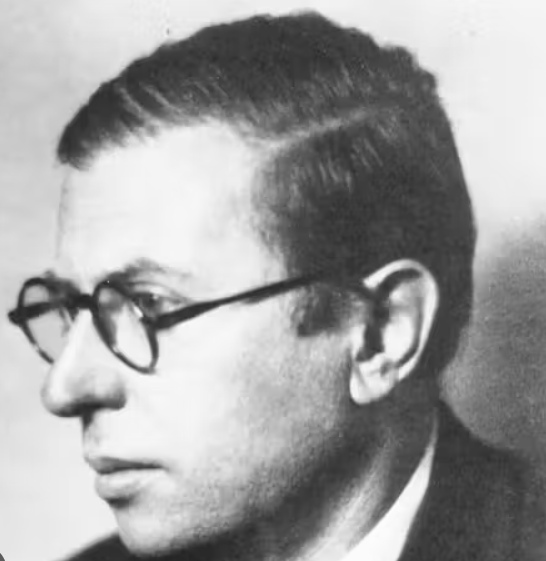
Jean-Paul Sartre — Existence Precedes Essence, Bad Faith, and the Condemned Freedom of the For-Itself (1905–1980)
Jean-Paul Charles Aymard Sartre was a French philosopher, novelist, playwright, political activist, and literary critic — born in Paris on 21 June 1905, who lost his father at age two and was raised by his mother and his maternal grandfather Karl Schweitzer, a professor at the Sorbonne, who introduced him to literature and intellectual culture at an early age. He attended the Lycée Henri IV, then the École Normale Supérieure, graduating in philosophy in 1929 — where he met Simone de Beauvoir, finishing second on the agrégation exam to her first. He taught philosophy at lycées in Le Havre and Paris, spent a formative year at the French Institute in Berlin in 1933–34 studying Husserl's phenomenology — an encounter that, de Beauvoir reported, caused him to turn pale with emotion — was mobilized in 1939 as a meteorologist in the army, captured by German forces in June 1940, held as a prisoner of war for nine months, released on medical grounds in March 1941, and spent the occupation writing "Being and Nothingness" in the Café de Flore in Paris. He was awarded the Nobel Prize in Literature in 1964 "for his work which, rich in ideas and filled with the spirit of freedom and the quest for truth, has exerted a far-reaching influence on our age." He refused it — "a writer must refuse to let himself be transformed into an institution." He died in Paris on 15 April 1980. Fifty thousand people followed his coffin through the streets.
His major philosophical works were "The Transcendence of the Ego" (1936), "Nausea" (1938, a novel), "Being and Nothingness" (1943), "Existentialism is a Humanism" (1946), "Anti-Semite and Jew" (1946), and the unfinished "Critique of Dialectical Reason" (1960). His plays — "No Exit" (1944), "The Flies" (1943), "Dirty Hands" (1948) — gave his philosophy dramatic form accessible to audiences who would never read eight hundred pages of phenomenological ontology. "Hell is other people" — the line from "No Exit" — is among the most quoted and most misunderstood sentences in twentieth-century philosophy.
His central concern: that human beings were radically, inescapably free — that no essence, nature, God, or social role determined what they were or must do — and that this freedom, which could not be refused or surrendered, entailed a total and anguishing responsibility from which no flight into bad faith could permanently escape.
Existence Precedes Essence — The Foundational Inversion
"Existence precedes essence" was Sartre's most compressed philosophical statement — the inversion of the classical tradition in three words. For Aristotle, Aquinas, and the entire tradition of essentialist metaphysics, the essence of a thing — what it was, what it was for — preceded and determined its existence. God created human beings with a specific nature and purpose; what it was to be a human being was fixed before any particular human existed. Even without God, the rationalist tradition had assumed a human nature — a fixed set of capacities, needs, and ends — that philosophy could discover and describe.
Sartre rejected this entirely. If God did not exist — and Sartre was an atheist — then there was no prior concept of the human being, no blueprint that each person instantiated. Human beings existed first — they were thrown into the world without instruction or justification — and only subsequently, through their choices and actions, gave themselves whatever essence they had. "Man first exists, encounters himself, surges up in the world — and defines himself afterwards." There was no human nature; there was only human existence, and existence was always already free.
"Man is nothing else but what he makes of himself. That is the first principle of existentialism. Man first exists: he materializes in the world, encounters himself, and only afterwards defines himself."
— Sartre, Existentialism is a Humanism (1946)
Being-in-Itself and Being-for-Itself — The Ontological Foundation
"Being and Nothingness" (1943) — written across the café tables of occupied Paris, published while the Wehrmacht controlled France, dedicated to "the Beaver" (de Beauvoir) — was Sartre's primary philosophical work: 700 pages of phenomenological ontology that established the conceptual architecture of his existentialism. Its fundamental distinction was between two modes of being. "Being-in-itself" (être-en-soi) was the being of things — dense, self-identical, uncreated, without relation to itself, neither active nor passive, neither affirmative nor negative. A stone was what it was, completely and without remainder. It coincided with itself perfectly. "Being-for-itself" (être-pour-soi) was the being of consciousness — and its defining characteristic was that it was what it was not, and was not what it was. Consciousness was never self-identical: it always had a relation to itself that introduced a kind of gap or distance — the nothingness that Sartre placed at the heart of human reality.
This nothingness was not emptiness but freedom — the permanent possibility of stepping back from any given state, any given role, any given situation, and choosing otherwise. Consciousness could not simply be a waiter, or a coward, or a Frenchman — it could only play at being these things, maintaining the possibility of not being them. "Condemned to be free" meant that this openness could never be closed: no choice, no commitment, no external force could eliminate the permanent possibility of choosing differently. Freedom was not a property consciousness had — it was what consciousness was.
"We are condemned to be free. Condemned, because we did not create ourselves, yet in other respects free; because, once thrown into the world, we are responsible for everything we do."
— Sartre, Being and Nothingness
Bad Faith — The Chief Existential Vice
Sartre's most penetrating contribution to moral psychology was his concept of "bad faith" (mauvaise foi) — the attempt to evade the anguish of freedom by pretending to be something one was not: either pretending to be a thing (denying one's freedom), or pretending to be pure freedom (denying one's facticity). Both were forms of self-deception — and both were inauthentic.
His paradigm case: the waiter who performs his role with excessive precision — his movements too crisp, his attentiveness too exact — as if being a waiter were his essence rather than his choice. The waiter was "playing at being a waiter" — performing an identity that gave him the comfort of necessity, as if he had no choice about what he was. But the performance itself revealed what it tried to conceal: a waiter is what he is only as a choice, never as a fact. He was free to leave, to change, to refuse — and the excess of his performance was the sign of his awareness of the freedom he was fleeing. Bad faith was not error — it was a choice: the choice to flee freedom by pretending one was not free.
"Bad faith is self-deception. The waiter performs his role with excessive precision — as if being a waiter were his essence rather than his choice. He plays at being a waiter to convince himself that he has no choice, that he is fixed, determined, a thing. But the performance reveals the freedom it attempts to deny."
Hell Is Other People — The Look and Recognition
"Hell is other people" — the line from "No Exit" — was not a misanthropic declaration but a phenomenological observation about the structure of intersubjectivity. Sartre's account of the encounter with the Other began from the experience of "the look" (le regard): the moment in which I become aware that another consciousness is perceiving me as an object in their world. When another person's gaze falls on me, I experience myself as fixed — as a thing with properties, as the thief I am, the coward I am, the person I am, constituted by the other's perception. The other's look threatened to transform my freedom into facticity — to pin me down as what they see.
The line's meaning: hell is the situation in which other people's perceptions of us become the inescapable mirror through which we encounter ourselves — as in the play, where the three characters in hell have no mirrors, only each other's gazes, through which they must confront their lives. The relationships between free consciousnesses were irreducibly conflictual in Sartre's early account — each sought to objectify the other, to capture the other's freedom as a thing, while resisting being objectified in turn. This was not pessimism but ontology: the structure of intersubjectivity as Sartre analyzed it in "Being and Nothingness."
"Hell is other people" — not misanthropy but phenomenology: the recognition that other consciousnesses can objectify our freedom, pin us down as a thing through their look, and that we cannot escape either their perception or our awareness of being perceived. The three characters in "No Exit" have no mirrors — only each other's gazes — and must confront what they were through what others see them as having been.
Engagement — The Political Existentialist
After the Liberation, Sartre became the most prominent public intellectual in France — editing "Les Temps Modernes," writing on colonialism, racism, the Algerian War, the Hungarian Revolution, and the student uprising of 1968. His concept of "engagement" — intellectual and political commitment — followed directly from his existentialism: if freedom entailed total responsibility, then passivity was itself a choice for which one was fully responsible. There was no neutral position from which an intellectual could observe events: not writing was itself writing; not choosing was itself choosing. The engaged intellectual who refused to take sides was taking sides — for the status quo.
His political judgments were often catastrophically wrong. He defended Stalinist show trials long after the evidence was overwhelming. He endorsed violence as a potentially liberatory force — in his preface to Fanon's "The Wretched of the Earth" — in ways that many found philosophically inconsistent with his ethics. He maintained positions on the Soviet Union that required wilful blindness to evidence. These failures were not incidental to his philosophy but followed partly from the same radical freedom that made his early phenomenology so powerful: the refusal of any constraint — factual, institutional, conventional — that might limit the reach of engaged commitment.
"Each authentic project expresses a universal dimension in the singularity of a human life. When I choose for myself I choose for all humanity — for in choosing what I will be, I affirm that all human beings placed in my situation could and should choose the same."
— Sartre, Existentialism is a Humanism
Legacy — Existentialism as the Philosophy of the Age
Sartre's influence on the culture of the twentieth century was without parallel among academic philosophers — not because his technical arguments were widely understood but because existentialism's vocabulary — bad faith, authenticity, freedom, commitment, nausea, the absurd — captured something about the experience of living in a post-religious, post-war, post-colonial world that academic philosophy in its analytical mode could not articulate. The fifty thousand people who followed his coffin were not philosophy students. They were people for whom his ideas had provided a language for experiences they had not previously been able to name. Heidegger's influence on him was acknowledged; his own influence on de Beauvoir, Camus (ambivalently), Merleau-Ponty, Fanon, and the entire tradition of postcolonial thought was substantial.
On CivSim he belongs alongside Camus, Heidegger, and de Beauvoir — the existentialist tradition that made freedom and responsibility the central philosophical concepts rather than nature, reason, or God. His challenge to Universal Humanism is double. The first: if there is no human nature — if existence precedes essence — then what grounds the claim that human beings have dignity or rights? Sartre's own answer in "Existentialism is a Humanism" was that authentic choice always had a universal dimension: in choosing for oneself one chose for all humanity. But this answer is controversial — it imports a universalism that the radical freedom of the for-itself seems to resist. The second challenge is the bad faith challenge directed at Universal Humanism itself: a philosophy that defines human dignity in terms of fixed axioms — preservation of life as a non-negotiable principle — must confront Sartre's question: is the commitment to those axioms an authentic choice freely made, or a flight into the comfort of essence by beings who are condemned to be free?
"It is absurd that we were born; it is absurd that we shall die."
— Sartre
CivilSimian.com created by AxiomaticPanic, CivilSimian, Kalokagathia