
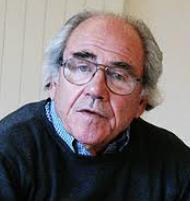
Jean Baudrillard — Simulacra, Hyperreality, and the Desert of the Real (1929–2007)
Jean Baudrillard was a French philosopher, sociologist, cultural theorist, and provocateur — born on 27 July 1929 in Reims, the grandson of peasants, the son of civil servants, the first member of his family to pursue university education, who studied German language and literature before turning to sociology, taught at secondary schools in France in the 1950s, was introduced to sociology through Henri Lefebvre at Nanterre, and became one of the most controversial and influential theoretical voices of the second half of the twentieth century. He taught at the University of Paris X-Nanterre from 1966 to 1987 and at the European Graduate School in his final years. He died in Paris on 6 March 2007 after a long illness.
His intellectual trajectory moved from Marxist sociology of consumption through structuralist semiotics to a distinctive post-Marxist theory of simulation and hyperreality that made him the emblematic philosopher of postmodern culture — a label he accepted only ironically. His major works include "The System of Objects" (1968), "The Consumer Society" (1970), "Symbolic Exchange and Death" (1976), "Simulacra and Simulation" (1981), "America" (1986), and "The Gulf War Did Not Take Place" (1991). Neo in "The Matrix" (1999) hides contraband in a hollowed-out copy of "Simulacra and Simulation." The Wachowskis acknowledged Baudrillard's influence explicitly. Baudrillard himself was unimpressed — he thought the film had misunderstood him completely.
His central concern: that in advanced consumer society the relationship between representation and reality had fundamentally inverted — that signs no longer referred to an underlying reality but circulated autonomously, generating their own effects, producing a condition in which the map preceded the territory and the image was more real than what it imaged.
The Early Marxist — Consumer Society as Sign System
Baudrillard's early work combined Marxist political economy with Roland Barthes's semiotics to produce a distinctive critique of consumer society. Marx had identified two kinds of value in commodities: use-value (what the thing did) and exchange-value (what it fetched on the market). Baudrillard added a third: sign-value — the meaning a commodity conveyed as part of a system of social differentiation. A luxury car was not purchased primarily for its use (transportation) or even its exchange-value but for what it signified: status, taste, identity. Consumer objects functioned as a language — a system of signs through which social position was communicated, performed, and contested.
This was already a departure from orthodox Marxism: it relocated the primary dynamic of consumer society from production (the locus of exploitation in Marx's analysis) to consumption and signification. The alienation of consumer society was not primarily from the products of one's labor but from the sign-system within which one's identity was constituted — a system one had not chosen and could not step outside. People did not merely consume goods; they consumed signs — and in doing so were consumed by a code that determined what it meant to be a subject in late capitalist society.
"Baudrillard's early work combines Marxist political economy and semiotics influenced by Roland Barthes in a critique of everyday life in consumer society, in which things have symbolic value in addition to use and exchange value. Consumption functions as a language — people communicate social identity and status through the objects they purchase."
The Break with Marx — Symbolic Exchange and Death
"Symbolic Exchange and Death" (1976) marked Baudrillard's decisive break with both Marxism and with the productivist assumptions underlying it. Marx's political economy, he argued, was not the critique of capitalism but its mirror — it reproduced the same logic of production, utility, and value that it claimed to oppose. The genuine outside of capitalist exchange was not socialist production but symbolic exchange — the kind of gift-giving, sacrifice, and expenditure without return that characterized pre-capitalist societies and that the logic of capital had systematically suppressed. Drawing on Mauss's "The Gift" and Bataille's theory of excess, he proposed that the refusal of productive rationality — the willingness to give without expectation of return — was the only genuine resistance to the code.
The argument was as much anthropological as political: death was the exemplary form of symbolic exchange — the event that could not be accumulated, commodified, or productive of value, that broke definitively with the logic of exchange and investment. Modern society's terror of death — its systematic exclusion of mortality from the visible social world — was the other side of its devotion to production: both were expressions of the same refusal of expenditure without return.
"Baudrillard broke with Marxism to develop an account of postmodern society in which consumer and electronic images have become more real than physical reality and in which simulations of reality have displaced their originals, leaving only 'the desert of the real.'"
— Britannica
Simulacra and Simulation — The Four Orders of Appearance
"Simulacra and Simulation" (1981) was Baudrillard's most systematic and most influential work — the text that established his international reputation and that generated the academic "Baudrillard scene" of the 1980s. Its argument developed a theory of the successive orders of appearance — the stages through which the relationship between signs and reality had evolved. In the first order, signs were faithful copies of an underlying reality. In the second, signs distorted or masked reality. In the third, signs masked the absence of underlying reality. In the fourth — the contemporary order — signs bore no relation to any reality at all; they were pure simulacra, self-referential images that produced their own hyperreal world.
Disneyland was Baudrillard's paradigm case. Disneyland appeared to be obviously artificial — a fantasy world of calculated unreality. But this was precisely its ideological function: it existed to make us believe that the rest of America was real. Presenting itself as imaginary, it allowed everything outside it to appear genuine. In reality, both were simulations. The distinction between the real and the simulated had collapsed — not because everything had become fake but because the category of the real itself had been colonized by simulation, producing a "hyperreal" that was more vivid, more total, and more immediately compelling than any reality it might have referred to.
"The simulacrum is never that which conceals the truth — it is the truth which conceals that there is none. The simulacrum is true."
— Baudrillard, Simulacra and Simulation (citing Ecclesiastes, ironically)
America — Hyperreality as Landscape
"America" (1986) — a travelogue written during Baudrillard's visits to the United States — was his most readable work and the one that made him globally famous beyond academic philosophy. America, he argued, was not a society that had failed to achieve the sophistication of European culture — it was the only society that had fully realized the hyperreal condition. European intellectuals who looked at America with condescension were looking at their own future with denial. The desert was the perfect landscape for this argument: a land without depth, without history, without the palimpsest of European culture, where everything was surface — speed, light, highways, sprawl, simulation. America was not behind modernity; it was ahead of it, in a space where modernity had already exhausted itself and left only its effects behind.
"America is neither dream nor reality. It is a hyperreality. It is a hyperreality because it is a utopia which has behaved from the very beginning as though it were already achieved. Everything here is real and pragmatic, and yet it is all the stuff of dreams too."
— Baudrillard, America
The Gulf War Did Not Take Place — Simulation as History
Baudrillard's most notorious provocation was a series of articles — published before, during, and after the 1991 Gulf War — arguing that the war "did not take place" in the sense that its mediatized representation had displaced the event itself. He was not denying that people died, or that bombs fell, or that a military operation had been conducted. He was arguing that what the world witnessed and responded to was not the war itself but its simulation — a media event staged for consumption, sanitized, spectacular, choreographed, in which the real violence was hidden behind the clean lines of radar screens and the language of "surgical strikes." The war that "took place" in the media and the war that took place in the desert were two different events with different logics — and in the era of hyperreality, the former had displaced the latter in the experience and politics of every observer not physically present.
The argument attracted enormous controversy and considerable misunderstanding. Critics accused him of callousness toward the victims of actual violence. Baudrillard's response was that the accusation confirmed his point: the simulation had so thoroughly colonized the capacity to think about the event that the philosophical argument about representation was read as a denial of the physical reality of death.
"The Gulf War is the first war conducted in accordance with the principle that it is better for it not to take place than to leave traces that would be too visible. We will never know what an Iraqi taking part in this war experienced. That experience is definitively lost."
— Baudrillard, The Gulf War Did Not Take Place
Legacy — The Theorist Who Became a Simulacrum
Baudrillard's reception was itself a demonstration of his thesis. "Baudrillard" — the brand, the buzzword, the academic fashion — circulated through the humanities of the 1980s and 90s largely detached from serious engagement with his actual arguments. He became a name to cite, a style to imitate, a theoretical accessory — a simulacrum of his own work. He found this unsurprising and entirely consistent. His critics — and they were substantial and serious — charged that his framework was unfalsifiable, that his deliberate aphoristic obscurity was intellectual bad faith, that his denial of any position from which critique could be mounted made his own critical project self-undermining. If there was no real outside the simulation, from where exactly was he offering his analysis?
On CivSim he belongs alongside Debord, Foucault, Lyotard, and Derrida — the French theoretical tradition that interrogated the conditions under which knowledge, reality, and power were constituted in advanced capitalist societies. His challenge to Universal Humanism is the most corrosive available from within contemporary theory: if the categories of "the human," "dignity," "rights," and "welfare" are themselves simulacra — signs that circulate in a media-saturated environment without guaranteed referent in any underlying reality — then a philosophy built on those categories may be constructing its foundation in hyperreal sand. The political philosopher who ignores the media-simulation dimension of contemporary politics — who acts as if rational argument directly shapes the real — is operating with an innocence that Baudrillard's framework cannot afford.
"We live in a world where there is more and more information, and less and less meaning."
— Jean Baudrillard, Simulacra and Simulation
CivilSimian.com created by AxiomaticPanic, CivilSimian, Kalokagathia