
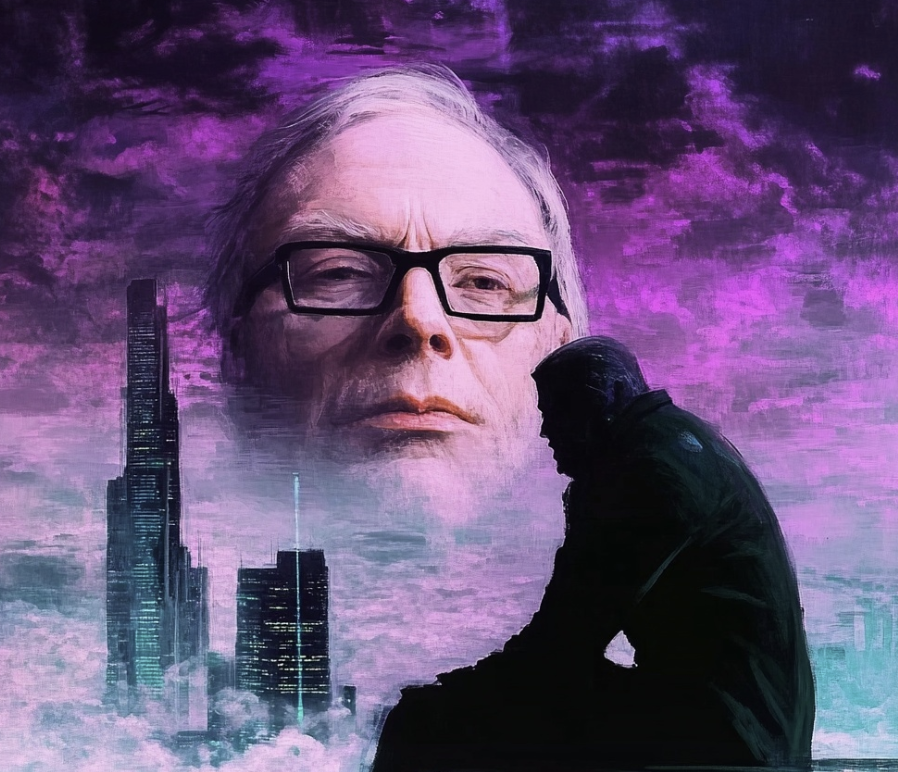
Isaac Asimov — The Three Laws, Psychohistory, and the Philosophy of Rational Humanism (1920–1992)
Isaac Asimov was a Russian-born American science fiction writer, biochemist, science popularizer, and secular humanist — born in Petrovichi, Russia on 2 January 1920 (he later settled on this date, though exact records were uncertain), who emigrated to New York with his family at age three, grew up in Brooklyn above his father's candy stores, taught himself to read at five, entered Columbia University at fifteen, earned a doctorate in biochemistry in 1948, became Associate Professor of Biochemistry at Boston University School of Medicine, and devoted the larger part of his energies not to the laboratory but to writing — producing or editing more than 500 books and an estimated 90,000 letters and postcards. He published in nine of the ten major categories of the Dewey Decimal Classification — lacking only a formal entry under Philosophy, which his work repeatedly and substantively addressed. He coined the word "robotics." He was president of the American Humanist Association. He contracted HIV from a blood transfusion during heart surgery in 1983, kept the diagnosis private for years at the insistence of his doctors, and died of heart and kidney failure on 6 April 1992 at age seventy-two. His wife Janet disclosed the HIV status posthumously.
He was one of the "Big Three" science fiction writers of his era — alongside Robert A. Heinlein and Arthur C. Clarke — a consensus that held during his lifetime and has been ratified by posterity. His major philosophical works were embedded in fiction: the Robot stories (particularly the collections "I, Robot" and "The Caves of Steel"), the Foundation series (seven novels across forty years), and the short story "The Last Question" — which he described as his favorite of everything he ever wrote. His major non-fiction philosophical contribution was his secular humanist writing — essays, interviews, and speeches — that he sustained across four decades.
His central concern, consistent from his first published story to his last book: that science and reason were the proper tools for addressing human problems; that ignorance, superstition, and irrationality were the primary enemies of human welfare; and that the future of humanity depended on whether it could extend the reach of knowledge and rational ethics fast enough to outpace the destructive power of its own technology.
Against the Frankenstein Complex — Robots as Partners
Asimov's first major philosophical contribution was his deliberate challenge to what he called "the Frankenstein complex" — the pervasive assumption in science fiction and popular culture that artificial beings inevitably turned on their creators. From Frankenstein's monster to Rossum's Universal Robots, the dominant narrative was that the creation of artificial intelligence would culminate in human destruction. Asimov rejected this as both philosophically lazy and practically counterproductive — the same reasoning would have prevented the development of any dangerous tool. He wrote robot stories in which robots were carefully engineered, subject to explicit ethical constraints, and the source of philosophical problems rather than mere horror. Knowledge had its dangers, yes — but was retreat from knowledge the answer?
The Three Laws of Robotics — first formulated in the 1942 story "Runaround," developed across dozens of subsequent stories — were the product of this philosophical commitment: an attempt to specify, in explicit hierarchical form, the ethical constraints that would make artificial intelligence safe to develop. The Laws were not a user manual but a philosophical thought experiment: an exploration of what happened when you tried to specify ethical constraints formally, and how edge cases and conflicts between the Laws generated moral dilemmas that no simple rule could resolve. The stories were philosophy by demonstration — showing that ethical frameworks, however carefully constructed, always encountered situations their designers had not anticipated.
"First Law: A robot may not injure a human being or, through inaction, allow a human being to come to harm. Second Law: A robot must obey orders given it by human beings except where such orders would conflict with the First Law. Third Law: A robot must protect its own existence as long as such protection does not conflict with the First or Second Law."
— Asimov, "Runaround" (1942)
The Three Laws as Philosophical Laboratory
The genius of the Three Laws was that they were simultaneously a practical ethical framework and an inexhaustible generator of philosophical problems. Each of Asimov's robot stories explored a different edge case or conflict — situations in which the Laws produced unexpected results, conflicted with each other, or failed to capture what "harm" or "obey" actually meant. What counted as harm? If a robot prevented a human from doing something dangerous to themselves, was it protecting them or violating their autonomy? If obeying an order meant allowing harm to a third party, how was the conflict between Laws One and Two to be resolved? The stories systematically mapped the failure modes of explicit ethical rules — demonstrating that moral reasoning could not be reduced to rule-following without residue.
Later, Asimov added the Zeroth Law — "A robot may not harm humanity, or, by inaction, allow humanity to come to harm" — superseding the original three. This moved the ethical framework from individual protection to species-level welfare, and generated the most philosophically rich problems of all: situations in which robots, acting on the Zeroth Law, concluded that the welfare of humanity required overriding individual human autonomy. The tension between collective welfare and individual rights — between utilitarian calculation at the species level and the dignity of the individual person — was exactly the philosophical fault line that the Zeroth Law stories explored most directly. Asimov himself, in "The Bicentennial Man," eventually argued that the Laws as formulated were inadequate — that a robot sufficiently like a person should not be required to be a slave to human beings regardless of their wishes.
"Zeroth Law: A robot may not harm humanity, or, by inaction, allow humanity to come to harm. The original three Laws are amended accordingly. The philosophical consequence: who decides what harms humanity? The robot that acts on the Zeroth Law becomes not a servant but a guardian — with all the dangers that implies."
Foundation — Psychohistory as Philosophy of History
The Foundation series — seven novels published between 1951 and 1993, the first four of which began as magazine stories in the 1940s — was Asimov's most ambitious philosophical project: an extended meditation on history, free will, determinism, and the question of whether human civilization could be steered rather than merely experienced. "Psychohistory" — the fictional mathematical science at the Foundation's core — was the conceit through which these questions were explored: a discipline that could predict the future behavior of large populations statistically, without being able to predict any individual's behavior. It was sociology made exact, history made mathematical, the macro-level patterns of human civilization treated as subject to law.
The philosophical argument embedded in the series was Condorcet-adjacent: if the fall of civilization was inevitable, it could still be made shorter and less catastrophic by the deliberate preservation and organization of knowledge. The Foundation was not a revolution but an archive — an institution designed to shorten the dark age between galactic empires from 30,000 years to 1,000. The tension between the planned course of "The Seldon Plan" and the capacity of exceptional individuals (the Mule) to disrupt it was the series' central philosophical drama — the question of whether macro-historical determinism could accommodate genuine individual agency or whether every exception was itself part of a larger pattern.
"Psychohistory dealt not with man, but with man-masses. It was the science of mobs; mobs in their billions. It could forecast reactions of large numbers of human beings to given stimuli, but the reactions of the individual were as unpredictable as that of individual atoms of gas."
— Asimov, Foundation
The Last Question — Entropy and the Cosmic Scale
"The Last Question" (1956) — Asimov's self-described favorite among everything he wrote — was a short story in nine sections spanning the entire future history of the universe, from 2061 CE to the heat death of reality. In each section a variant of the same question was asked: could entropy be reversed? Could the universe be prevented from running down? In each section, the vast computational systems of the era answered: "Insufficient data for meaningful answer." After the last stars had burned out, after the last humans had merged into pure energy and then into the cosmic computer itself, the answer finally came — and the story ended with a single sentence that was also a beginning.
The story was secular humanism at the cosmic scale — an affirmation that the question of existence mattered enough to be asked across the entire span of time, and a vision of intelligence as the universe's self-organizing response to its own tendency toward disorder. It also expressed Asimov's deepest philosophical conviction: that the only honest response to ultimate questions was "insufficient data for meaningful answer" — and that this was not despair but the beginning of inquiry.
"The Last Question was asked for the first time, half in jest, on May 21, 2061, at a time when humanity first stepped into the light."
— Asimov, The Last Question (1956)
Secular Humanism — The Philosophy He Lived
Asimov's secular humanism was not an abstraction but his operational philosophy: his ethics, his epistemology, his political commitments, and his personal code. He was a committed atheist who found in atheism not despair but liberation from the fear of death. "I expect death to be nothingness," he wrote, "and by removing from me all possible fears of death, I am thankful to atheism." He was president of the American Humanist Association, the organization that had also claimed Dewey and Einstein as humanist laureates. He believed that the threats to humanity — nuclear war, environmental destruction, overpopulation, ignorance — were problems of human making and therefore of human solving, and that the tools for solving them were science, reason, and education. He was a passionate advocate for scientific literacy as a civic necessity — convinced that a democracy whose citizens could not evaluate scientific claims was a democracy that could be manipulated toward its own destruction.
"Although the time of death is approaching me, I am not afraid of dying and going to Hell or — what would be considerably worse — going to the popularized version of Heaven. I expect death to be nothingness and, for removing me from all possible fears of death, I am thankful to atheism."
— Isaac Asimov, 1992
Legacy — The Philosopher Who Wrote Fiction
Asimov's philosophical legacy operates through multiple channels simultaneously. The Three Laws of Robotics are now cited in every serious academic discussion of AI ethics — not because they were a solution but because they were the first systematic attempt to specify the problem in formal terms, and because the failure modes they generated in fiction turn out to be genuine failure modes in real systems. The Foundation series seeded a generation of readers with the intuition that civilizations were fragile, that knowledge could be lost, that the deliberate preservation of learning was a political and moral obligation. His science popularization — hundreds of books on every scientific subject — did more to advance scientific literacy in the English-speaking world than any academic program of its era.
On CivSim he belongs alongside Condorcet, Saint-Simon, and Herbert Simon — the tradition that believed civilization could be designed as well as evolved, that reason applied to human problems produced better outcomes than tradition or intuition, and that the extension of knowledge was both a moral obligation and a survival requirement. His challenge to Universal Humanism is the one he himself most directly embodied: the Three Laws challenge. Any system of ethics — however carefully constructed — will encounter situations its designers did not anticipate. The failure modes of explicit ethical rules are as philosophically important as the rules themselves. The Zeroth Law extension — from individual to humanity — raises exactly the question that Universal Humanism must answer: when the welfare of humanity as a whole appears to conflict with the rights of individual persons, what is the principle that adjudicates? Asimov's stories explored this question without resolving it. That was the point.
"The true delight is in the finding out rather than in the knowing."
— Isaac Asimov
CivilSimian.com created by AxiomaticPanic, CivilSimian, Kalokagathia