
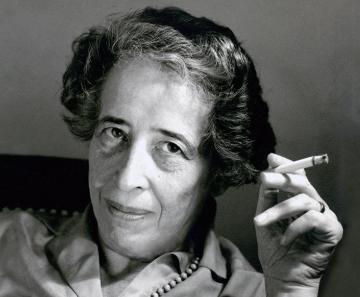
Hannah Arendt — Totalitarianism, the Banality of Evil, and the Recovery of the Political (1906–1975)
Hannah Arendt — born Johanna Arendt on 14 October 1906 in Linden, near Hanover, into a secular Jewish family from Königsberg — was a German-American political theorist and philosopher who studied theology at Marburg under Rudolf Bultmann, philosophy at Freiburg under Husserl, and philosophy at Heidelberg under Karl Jaspers, who became her lifelong friend and philosophical interlocutor. She had a formative and disastrous love affair with Martin Heidegger, her teacher, who later joined the Nazi party. She was arrested by the Gestapo in 1933, released after eight days due to the incompetence of her interrogator, fled Germany, lived in Paris for eight years working with Youth Aliyah to help Jewish children emigrate to Palestine, was interned at the Gurs camp in southern France in 1940 as an "enemy alien," escaped during the chaos of the French collapse, reached New York in 1941 with her husband Heinrich Blücher and her mother, and spent the rest of her life in the United States — writing in English, teaching at the New School for Social Research, and becoming one of the most influential political thinkers of the century. She died in New York on 4 December 1975 at her typewriter, in the middle of a sentence, working on "The Life of the Mind."
She refused the label "philosopher" — preferring "political theorist" — partly because she distrusted philosophy's tendency to retreat from the world of appearances into contemplation, and partly because of what she saw as philosophy's failure before the totalitarian challenge: Heidegger's case was always in her mind. Her major works were "The Origins of Totalitarianism" (1951), "The Human Condition" (1958), "Eichmann in Jerusalem: A Report on the Banality of Evil" (1963), "On Revolution" (1963), and the posthumously published "The Life of the Mind" (1978).
Her central concern, threading all her work: that totalitarianism had revealed something genuinely new about evil — something unprecedented that required new concepts to understand — and that the recovery of genuine political life, grounded in plurality, action, and the public space of appearance, was the only adequate response to what totalitarianism had destroyed.
The Origins of Totalitarianism — Something Genuinely New
"The Origins of Totalitarianism" (1951) was Arendt's most ambitious historical work — a study of antisemitism, imperialism, and the rise of Nazi and Stalinist regimes that argued these regimes constituted something genuinely new in history, not merely an extreme version of tyranny or despotism. Traditional tyranny had been bad enough — arbitrary, violent, self-interested — but it had operated within limits: it exploited populations for the tyrant's benefit, it left private life partially intact, it could in principle be reformed or overthrown. Totalitarianism was different in kind. Its goal was not exploitation but total domination — the transformation of human beings into something less than human, the elimination of spontaneity, plurality, and individuality as such. The death camp was not merely a place of mass murder but an experiment in the destruction of the human person — in making beings who were alive but had been stripped of everything that made them human.
Arendt traced the "elements" — not causes in a strict sense but conditions that crystallized into something new — through nineteenth-century antisemitism, European imperialism, the decline of the nation-state, the production of stateless and rightless people, and the rise of mass movements. The production of "superfluous people" — those whom no state claimed and whose lives no political system protected — was both a precondition of totalitarianism and its goal: totalitarianism sought to make all of humanity superfluous. "Radical evil" was not the evil of excess passion or selfishness but the evil of rendering human beings superfluous — of destroying human plurality and spontaneity as such.
"Radical evil consists in the destruction of human plurality and spontaneity, and in rendering human beings superfluous. Totalitarianism is not merely extreme tyranny — it is the attempt to eliminate the very conditions under which human beings can be human: spontaneity, plurality, the capacity to begin something new."
— Arendt, The Origins of Totalitarianism
The Human Condition — Labor, Work, and Action
"The Human Condition" (1958) was Arendt's most systematically philosophical work — a recovery and reinterpretation of the ancient Greek distinction between the private and the public, the household and the polis, through the lens of what totalitarianism had destroyed. She distinguished three fundamental human activities: labor (the biological process of sustaining life, cyclical, leaving no permanent trace), work (the fabrication of durable things that constitute the human world), and action (the activity of beginning something new among other human beings — the specifically political activity that was not reducible to making or consuming).
Action was Arendt's central category — and it was the activity most radically threatened by both totalitarianism and by the modern reduction of politics to economic management. Action required plurality — the presence of other people who were genuinely different, who could respond, surprise, and begin their own initiatives. It required a public space of appearance in which people could reveal who they were through speech and deed. It was inherently unpredictable — no actor could fully control the consequences of what they set in motion — and irreversible — no actor could undo what they had done. These features — which many political theorists treated as defects to be minimized — were for Arendt the essential characteristics of genuine political life. Politics was not administration, not production, not the management of necessity — it was the activity of free beings revealing themselves to each other through the exchange of words and deeds.
"Plurality is the condition of human action because we are all the same, that is, human, in such a way that nobody is ever the same as anyone else who ever lived, lives, or will live. It is this plurality which makes action possible — and it is exactly plurality that totalitarianism seeks to destroy."
— Arendt, The Human Condition
Natality — Beginning as the Human Condition
One of Arendt's most original concepts — and the one she saw as the philosophical alternative to Heidegger's emphasis on being-toward-death — was natality: the capacity for beginning that was given with every birth. Every new human being born into the world was a new beginning — an unpredictable initiative that could not have been predicted from what preceded it. This capacity for beginning was not something individual human beings occasionally exercised; it was constitutive of what they were. Action was the political expression of natality — the insertion into the human world of something new that interrupted the automatic processes of nature and history. Against the philosophical tradition that had emphasized death as the defining horizon of human existence (Heidegger's "being-toward-death"), Arendt insisted on birth — on the newcomer's arrival as the paradigmatic human fact. "The miracle that saves the world, the realm of human affairs, from its normal, 'natural' ruin is ultimately the fact of natality — of new men coming into the world, of new beginnings."
"The miracle that saves the world, the realm of human affairs, from its normal, 'natural' ruin is ultimately the fact of natality — the birth of new human beings and the new beginning, the action, they are capable of by virtue of being born."
— Arendt, The Human Condition
Eichmann in Jerusalem — The Banality of Evil
In 1961 Arendt traveled to Jerusalem to report on the trial of Adolf Eichmann — one of the principal organizers of the Holocaust's logistics — for The New Yorker. She went, she said, because she wanted to see "in the flesh" what someone looked like who had done radical evil. What she found was not a monster, not a fanatic, not an ideologue — but a remarkably ordinary man: bureaucratic, self-important, incapable of independent thought, speaking entirely in clichés, who had organized mass murder while apparently never thinking seriously about what he was doing. He had been motivated not by antisemitism or sadism but by careerism and the desire to do his job well. He had, in a chilling phrase, never realized "what he was doing."
"The banality of evil" — the phrase that made the book famous and infamous — was not a claim that the Holocaust was banal or that its victims' suffering was ordinary. It was a claim about the psychology of its perpetrators: that great crimes could be committed not by monsters but by ordinary human beings who had ceased to think — who had substituted the performance of a role, obedience to orders, and the conventions of career for the exercise of independent moral judgment. The lesson was not consoling. If evil could arise from thoughtlessness rather than from demonic will, then its prevention required not the identification and elimination of evil people but the cultivation and protection of the capacity to think — to pause, to judge, to refuse the conventions that made atrocity routine.
"The banality of evil" describes not the nature of the deeds but the character and motives of the doer. Eichmann was not a monster but a thoughtless man — one who had ceased to think about what he was doing, who substituted clichés for judgment, career for conscience. Great crimes can be committed by people who never ask themselves what they are doing."
— Arendt, Eichmann in Jerusalem, paraphrased
The Controversy — Jewish Councils and the Limits of Judgment
"Eichmann in Jerusalem" generated the most intense controversy of Arendt's career — and the most personal. Her discussion of the role of Jewish Councils (Judenräte) in the administration of the ghettos — the argument that their cooperation with Nazi authorities, however understandable, had contributed to the scale of the catastrophe — was experienced by many in the Jewish community as a betrayal and a form of blaming the victims. Her characterization of Eichmann as a "clown" and as essentially thoughtless was taken as minimizing his guilt and the evil of the regime he served. The furious exchanges that followed — with Gershom Scholem, with community leaders, with Jewish organizations — were among the most painful of her life. She maintained her positions. Her argument was not that Eichmann was not guilty — she thought he should be executed — but that the legal and moral framework brought to bear on his case was inadequate to understanding what had actually happened.
"Arendt went to Jerusalem to understand, in the flesh, what someone who had done radical evil looked like. She found not a monster but a bureaucrat — and her account of what she found produced one of the most painful intellectual controversies of the twentieth century."
The Right to Have Rights — Statelessness and the Human Condition
One of Arendt's most enduring political concepts — developed in "The Origins of Totalitarianism" and elaborated across subsequent work — was "the right to have rights": the insight that human rights, as conventionally proclaimed, were meaningless without membership in a political community that would enforce and guarantee them. The Jews of Europe had lost their rights not because they had done anything wrong but because they had lost their citizenship — their membership in a political community with the power to protect them. When they became stateless, their human rights became worthless: there was no political body with the obligation or the power to honor them. The "sacred and inalienable" rights proclaimed by the French and American revolutions were in practice available only to those who were already citizens. The human being without a state was a being without rights — however many declarations proclaimed otherwise.
"The right to have rights, or the right of every individual to belong to humanity, should be guaranteed by humanity itself. It is by no means certain whether this is possible. But it is certain that a man who is nothing but a man has lost the very qualities which make it possible for other people to treat him as a fellow-man."
— Arendt, The Origins of Totalitarianism
Legacy — The Thinker of the Dark Times
Arendt called her collection of essays on exemplary individuals "Men in Dark Times" — the phrase from Brecht's poem about those who kept thinking and speaking in an age when the general darkness made light necessary. She was herself one of those figures. Her influence has been unusually durable and unusually broad: political theorists, legal scholars, Holocaust historians, democratic theorists, feminist philosophers, and refugee advocates all draw on her work. The concept of the "banality of evil" has become unavoidable in discussions of perpetrator psychology and of institutional complicity. "The right to have rights" has become the central concept in philosophy of refugee and statelessness law. Her account of plurality and public space has shaped the agonistic tradition in democratic theory.
On CivSim she belongs at the center — alongside Rawls, Nozick, and Walzer — but she belongs there as a challenge rather than a confirmation. Her challenge to Universal Humanism is threefold. First, the institutional challenge: rights without institutional enforcement are words on paper — the right to have rights requires political membership, not just philosophical proclamation. Second, the plurality challenge: genuine politics requires that human beings remain irreducibly different from each other — that the plurality of perspectives, origins, and voices be protected rather than harmonized into a single universal framework. Third, the thinking challenge: the greatest moral catastrophes in history were enabled not by evil ideology alone but by the abandonment of independent judgment — by thoughtlessness in the strict sense. A philosophy committed to human dignity must cultivate thinking as a political and moral practice, not merely as an academic discipline.
"Thinking and moral considerations are not the same thing, but there is a connection. The manifestation of the wind of thought is not knowledge; it is the ability to tell right from wrong, beautiful from ugly. And this, at the rare moments when the stakes are on the table, may indeed prevent catastrophes."
— Arendt, "Thinking and Moral Considerations"
CivilSimian.com created by AxiomaticPanic, CivilSimian, Kalokagathia