

8 months 1 week ago
A free man thinks of death least of all things; and his wisdom is a meditation not of death but of life.
▼
Source
source
Part IV, Prop. LXVII


8 months 5 days ago
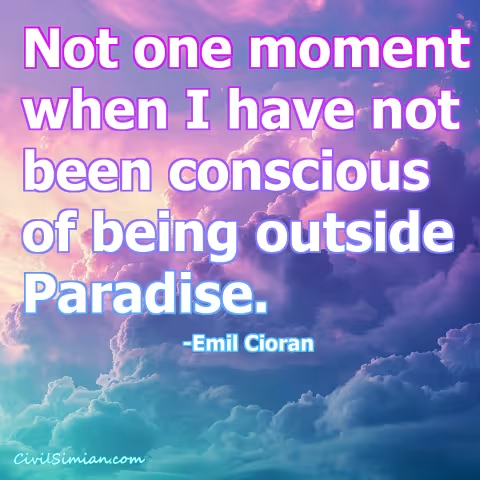
"And I say also this. I do not think the forest would be so bright, nor the water so warm, nor love so sweet, if there were no danger in the lakes."
▼
Source
source
Hyoi, p. 76
9 months 4 days ago
Knowledge is the food of the soul; and we must take care, my friend, that the Sophist does not deceive us when he praises what he sells, like the dealers wholesale or retail who sell the food of the body; for they praise indiscriminately all their goods, without knowing what are really beneficial or hurtful.
8 months 5 days ago
What I see is teeming cohesion, contained dispersal.... For him, to sculpt is to take the fat off space.
▼
Source
source
On Alberto Giacometti's work, Situations, in Braziller
9 months 3 days ago
It is my own experience ... that commentators are far more ingenious at finding meaning than authors are at inserting it.
4 months 2 weeks ago
Underneath the superficial self, which pays attention to this and that, there is another self, more really us than I. And if you become aware of that unknown self, the more you become aware of it, the more you realize that it is inseparably connected with everything else that there is. That you are a function of this total galaxy, bounded by the Milky Way, and that furthermore, this galaxy is a function of all other galaxies. And that vast thing that you see far off, far off, far off with telescopes, and you look and look and look, one day you are going to wake up and say, why, that's me! And in knowing that, know, you see, that you never die. That you are the eternal thing that comes and goes, that appears now as John Jones, now as Mary Smith, now as Betty Brown, and so it goes forever and ever and ever.
▼
Source
source
Alan Watts, Man in Nature
6 months 2 weeks ago
Just as modern mass production requires the standardization of commodities, so the social process requires standardization of man, and this standardization is called equality.
▼
Source
source
Ch. 2
6 months 3 weeks ago
The nineteenth century, utilitarian throughout, set up a utilitarian interpretation of the phenomenon of life which has come down to us and may still be considered as the commonplace of everyday thinking. ... An innate blindness seems to have closed the eyes of this epoch to all but those facts which show life as a phenomenon of utility.
▼
Source
source
p. 16
7 months 6 days ago
Well is it known that ambition can creep as well as soar.
▼
Source
source
No. 3
6 months 3 weeks ago
The very desire for guarantees that our values are eternal and secure in some objective heaven is perhaps only a craving for the certainties of childhood or the absolute values of our primitive past.
8 months 6 days ago
Many Catholic mystics have affirmed that, at a certain stage of that contemplative prayer in which, according to the most authoritative theologians, the life of Christian perfection ultimately consists, it is necessary to put aside all thought of the Incarnation as distracting from the higher knowledge of that which has been incarnated. From this fact have arisen misunderstandings in plenty and a number of intellectual difficulties.
7 months 6 days ago
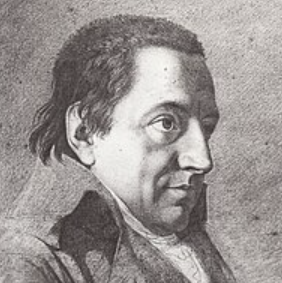
The Present Age, according to my view of it, stands in that Epoch which in my former lecture I named the THIRD, and which I characterized as the Epoch of Liberation-directly from the external ruling Authority, indirectly from the power of Reason as Instinct, and generally from Reason in any form; the Age of absolute indifference towards all truth, and of entire and unrestrained licentiousness:-the state of completed sinfulness.
▼
Source
source
p. 16
8 months 3 weeks ago
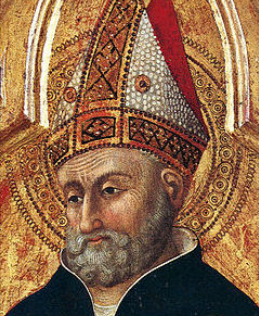
What is the use of believing, if the dost blaspheme? Thou adorest Him as Head, and dost blaspheme Him in His body. He loves His body. Thou canst cut thyself off from the body, but the Head does not detach itself from its body. "Thou dost honor me in vain," He cries from heaven, "thou dost honor Me in vain!" If someone wished to kiss thy cheek, but insisted at the same time on trampling thy feet; if with his hailed boots he were to crush thy feet as he tries to hold thy head and kiss thee, wouldst thou not interrupt his expression of respect and cry out: "What are thou doing, man? Thou art trampling upon me!" It is for this reason that before He ascended into heaven our Lord Jesus Christ recommended to us His body, by which He was to remain upon earth. For He foresaw that many would pay Him homage because of His glory in heaven, but that their homage would be vain, so long as they despise His members on earth.
▼
Source
source
(pp. 436-437)

7 months 1 week ago
The Americans combine the notions of Christianity and of liberty so intimately in their minds, that it is impossible to make them conceive the one without the other; and with them this conviction does not spring from that barren traditionary faith which seems to vegetate in the soul rather than to live.
▼
Source
source
Chapter XVII.
8 months 3 weeks ago
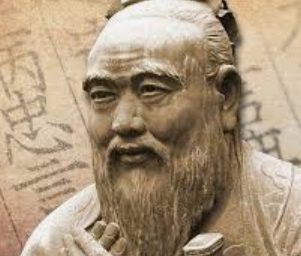
How great is the path proper to the Sage! Like overflowing water, it sends forth and nourishes all things, and rises up to the height of heaven. All-complete is its greatness! It embraces the three hundred rules of ceremony, and the three thousand rules of demeanor. It waits for the proper man, and then it is trodden. Hence it is said, "Only by perfect virtue can the perfect path, in all its courses, be made a fact."

4 months 3 weeks ago
On the dust of our heroic ancestors we too sit ballot-boxing, saying to one another, It is well, it is well! By inheritance of their noble struggles, we have been permitted to sit slothful so long. By noble toil, not by shallow laughter and vain talk, they made this English Existence from a savage forest into an arable inhabitable field for us; and we, idly dreaming it would grow spontaneous crops forever,-find it now in too questionable a state.

8 months 6 days ago
For what avail the plough or sail, Or land or life, if freedom fail?
▼
Source
source
Boston

7 months 1 week ago
I entirely agree with you, as to the ill tendency of the affected doubts of some philosophers, and fantastical conceit of others. I am even so far gone of late in this way of think, that I have quitted several of the sublime notions I had got in their schools for vulgar opinions. And I give it you on my word, since this revolt from metaphysical notions to the plain dictates of nature and common sense, I find my understanding strangely enlightened, so that I can now easily comprehend a great many thing which before were all mystery and riddle.
▼
Source
source
Said by Philonous (Berkeley) to Hylas in the opening of dialog 1 with reference to the recent surge philosophic endeavors (Locke, Newton, et al) that seemed to lead to skepticism about the existence of the world.
4 months 6 days ago
We do not only free God by battling and subduing the visible world about us; we also create God. "Open your eyes," God shouts; "I want to see! Prick up your ears, I want to hear! March in the front ranks: you are my head!"


8 months 5 days ago
My form remains one, though the matter in it changes continually. I am, in that respect, like a curve in a waterfall.
▼
Source
source
Ch. 16: "Miracles of the New Creation"
4 months 3 days ago
Not to live as if you had endless years ahead of you. Death overshadows you. While you're alive and able-be good.
▼
Source
source
(Hays translation) IV, 17
8 months 3 weeks ago
Inasmuch as love grows in you, in so much beauty grows; for love is itself the beauty of the soul.
▼
Source
source
as translated by H. Browne and J. H. Meyers, The Nicene and Post Nicene Fathers (1995)
8 months 3 weeks ago
When your father is alive, observe his will. When your father is dead observe his former actions. If, for three years after the death of your father you do not change from the ways of your father, you can be called a 'real son'.
5 months ago
If, then, a phenomenon admits of a complete mechanical explanation, it will admit of an infinity of others, that will render an account equally well of all the particulars revealed by experiment.
▼
Source
source
Ch. XII: Optics and Electricity, as translated by George Bruce Halsted

4 months 3 days ago
The sciences that are expressed by numbers or by other small signs, are easily learned; and... this facility rather than its demonstrability is what has made the fortune of algebra.
4 months 2 days ago
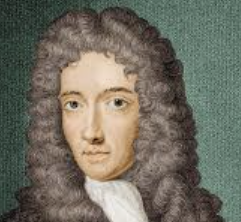
And of universal nature, the notion I would offer, should be something like this. Nature is the aggregate of the bodies, that make up the world, in its present state, considered as a principle, by virtue whereof, they act and suffer, according to the laws of motion, prescribed by the author of things.
▼
Source
source
Sect. 2.
4 months 3 weeks ago
Everywhere the human soul stands between a hemisphere of light and another of darkness on the confines of two everlasting hostile empires, - Necessity and Free Will.
▼
Source
source
Essays, Goethe's Works.

8 months 3 weeks ago
God judged it better to bring good out of evil than to suffer no evil to exist.
▼
Source
source
Enchiridion (c. 420 ), Ch. 27
4 months 3 days ago
Creating difficulties for himself for the pleasure of resolving them is a strange human mania.
▼
Source
source
p. 48

7 months 2 days ago
If there was a God of sorrow, he would grow black heavy wings, to soar not for the skies, but for inferno.


4 months 3 weeks ago
War is a quarrel between two thieves too cowardly to fight their own battle; therefore they take boys from one village and another village, stick them into uniforms, equip them with guns, and let them loose like wild beasts against each other.
▼
Source
source
Quoted by Emma Goldman in her essay, "Patriotism: A Menace to Liberty", chapter five of Anarchism and Other Essays (2nd revised edition, 1911).
8 months 2 weeks ago
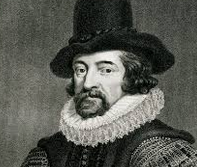
Since my logic aims to teach and instruct the understanding, not that it may with the slender tendrils of the mind snatch at and lay hold of abstract notions (as the common logic does), but that it may in very truth dissect nature, and discover the virtues and actions of bodies, with their laws as determined in matter; so that this science flows not merely from the nature of the mind, but also from the nature of things.
▼
Source
source
Aphorism 52
8 months 2 weeks ago
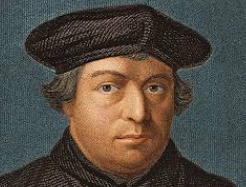
Adam was created righteous, acceptable, and without sin. He had no need from his labor in the garden to be made righteous and acceptable to God. Rather, the Lord gave Adam work in order to cultivate and protect the garden. This would have been the freest of all works because they were done simply to please God and not to obtain righteousness. ... The works of the person who trusts God are to be understood in a similar manner. Through faith we are restored to paradise and created anew. We have no need of works in order to be righteous; however, in order to avoid idleness and so that the body might be cared for an disciplined, works are done freely to please God.
▼
Source
source
pp. 73-74
4 months 2 weeks ago
Human history is not the product of the wise direction of human reason, but is shaped by the forces of emotion-our dreams, our pride, our greed, our fears, and our desire for revenge.
▼
Source
source
Confucius Saw Nancy and Essays about Nothing (1936), p. 95
6 months 2 weeks ago
The Americans have always been more open to my ideas. In fact, I could earn a living in America just by lecturing. One of my brightest audiences, incidentally, were the prisoners in a Philadelphia gaol - brighter than my students at university.
▼
Source
source
Interview with Paul Newman in Abraxas Unbound #7

4 months 2 weeks ago
Time! Time! Time! - we must not impugn the Scripture Chronology, but we must interpret it in accordance with whatever shall appear on fair enquiry to be the truth for there cannot be two truths. And really there is scope enough: for the lives of the Patriarchs may as reasonably be extended to 5000 or 50000 years apiece as the days of Creation to as many thousand millions of years.
▼
Source
source
Letter to Charles Lyell after being inspired by his Principles of Geology
CivilSimian.com created by AxiomaticPanic, CivilSimian, Kalokagathia