
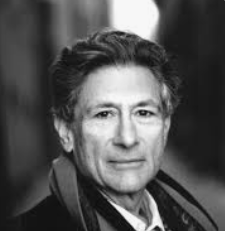
Edward Said — The Critic of Empire, Culture, and Intellectual Conscience (1935–2003)
Edward Said was the conscience of the late twentieth century — a literary critic who transformed how the world understands culture, power, and imperialism. He revealed that empires do not rule by force alone, but by stories, images, and systems of knowledge that define who is civilized, who is backward, and who gets to speak. For Said, culture was never innocent. It was a battlefield.
A Life Between Worlds
Born in Jerusalem and raised in Cairo, Said grew up suspended between cultures, languages, and identities. He later described himself as perpetually “out of place” — a condition that became central to his intellectual outlook.
Educated in elite British and American schools, he mastered the Western literary canon while never fully belonging to the world it represented. This double vision — intimate knowledge paired with critical distance — allowed Said to see what insiders often miss: how culture quietly enforces power.
“Exile is strangely compelling to think about but terrible to experience.”
Orientalism — Exposing the Cultural Machinery of Empire
Said’s most famous work, Orientalism (1978), detonated a revolution across the humanities. The book argued that the “Orient” — the Middle East, Asia, and North Africa — was not simply discovered by the West, but constructed through literature, scholarship, art, and colonial administration.
Western depictions of the East, Said showed, consistently portrayed it as exotic, irrational, passive, and inferior — the perfect opposite of a rational, masculine, progressive West. These representations were not accidental. They made domination appear natural.
Knowledge, in this view, was a form of power. To describe a people was already to control them.
“The Orient was almost a European invention.”
Culture, Canon, and Complicity
Said did not reject Western culture — he knew it too well. He was a distinguished scholar of literature, deeply versed in Conrad, Austen, Flaubert, and Shakespeare.
His radical claim was subtler and more disturbing: even great works of art can participate in systems of domination. Novels, operas, travel writing, and academic texts often assume imperial expansion as background fact — normal, unquestioned, invisible.
Canonical culture, Said argued, must be read contrapuntally — attending not only to what it says, but to what it silences.
“There is no such thing as a delivered presence, but a re-presence.”
The Intellectual as Exile and Dissenter
Said believed the intellectual’s role was not to serve power, but to unsettle it. He rejected the image of the expert as neutral technician.
True intellectuals, he argued, are outsiders — figures who speak uncomfortable truths, cross boundaries, and refuse tribal loyalty. Their task is not consensus, but conscience.
This stance earned Said admiration and hostility in equal measure. He was frequently attacked for refusing to soften his critique of imperialism, nationalism, and authoritarianism — whether Western or Middle Eastern.
“The intellectual’s role is to ask questions, not to consolidate power.”
Palestine and the Refusal of Silence
Said was one of the most prominent Palestinian voices in the West. He insisted that Palestinian history and suffering could not be erased by dominant narratives.
His advocacy was uncompromising: he condemned Israeli occupation, rejected simplistic binaries, and criticized Arab leadership when it failed its people. He supported coexistence, but never at the cost of truth.
For Said, justice required narrative repair — restoring voices excluded from history.
Music, Humanism, and Late Thought
Alongside politics and criticism, Said was a gifted pianist and music theorist. Music, he believed, offered a model of non-coercive coexistence — multiple voices held together without domination.
In his later years, he defended a renewed humanism: not a universalism blind to difference, but a critical humanism grounded in history, empathy, and responsibility.
Even as illness overtook him, Said continued writing, arguing that critique must remain unfinished — always open to revision.
Legacy — Speaking Truth Across Power
Edward Said reshaped literature, history, anthropology, political theory, and cultural studies. Postcolonial thought begins with his intervention — and cannot escape it.
His enduring lesson is demanding: culture is never neutral, identity is never innocent, and silence always benefits power. To read, to teach, to speak — these are ethical acts.
Said remains a model of the engaged intellectual — one who stood at the crossroads of scholarship and struggle, refusing comfort in the face of injustice.
“Humanism is the only, and I would go so far as saying the final, resistance we have against the inhuman practices and injustices that disfigure human history.”
CivilSimian.com created by AxiomaticPanic, CivilSimian, Kalokagathia