
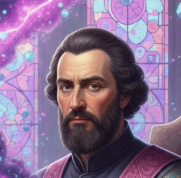
Giordano Bruno — The Martyr of the Infinite Universe and the Free Mind (1548–1600)
Giordano Bruno was not merely a philosopher but a cosmic heretic — a man who shattered the medieval image of a small, closed universe and replaced it with an infinite, living cosmos filled with worlds. His thought fused metaphysics, astronomy, mysticism, and radical intellectual freedom, and it ultimately cost him his life. Bruno stands as one of history’s most uncompromising defenders of thought without chains.
A Dominican Monk Who Refused to Obey the World
Born Filippo Bruno in Nola, near Naples, he entered the Dominican Order as a young man and adopted the name Giordano. Brilliant, restless, and fiercely independent, he quickly earned suspicion for questioning orthodox theology and reading forbidden texts. His mind ranged too widely for monastic walls.
Accused of heresy early in life, Bruno fled Italy and spent decades wandering across Europe — Paris, London, Geneva, Wittenberg, Prague — living as a fugitive intellectual. He lectured, debated, provoked, and published, leaving behind a trail of admirers and enemies wherever he went.
“I do not fear death, for I know the soul cannot perish.”
An Infinite Universe Filled with Worlds
Bruno embraced Copernicus but went far beyond him. Where Copernicus merely displaced Earth from the center, Bruno destroyed the very idea of a cosmic center. The universe, he argued, is infinite, without boundary, populated by countless stars — each a sun — surrounded by their own worlds.
This was not astronomy alone but metaphysics. An infinite God, Bruno reasoned, would create an infinite cosmos. Limiting the universe would be an insult to divine power. Humanity, therefore, occupies no privileged position. We are citizens of a boundless cosmic republic.
“There are countless suns and countless earths all rotating around their suns.”
Pantheism — God Everywhere, Matter Alive
Bruno rejected the sharp divide between God and creation. Instead, he proposed a radical form of pantheism: God is not a distant ruler outside the universe but the living substance within it. Nature itself is divine, animated, intelligent, and dynamic.
Matter, for Bruno, is not inert. It pulses with form, energy, and spirit. Every being expresses the same infinite principle in different modes. This vision dissolved the hierarchy separating heaven and earth, sacred and profane, spirit and body.
“Divinity is present in all things, not outside them.”
Memory, Imagination, and the Power of the Mind
Bruno was also famous for his work on memory and imagination. He developed elaborate mnemonic systems, believing that the mind, when properly trained, could mirror the structure of the cosmos itself. Knowledge was not passive reception but creative participation.
For Bruno, imagination was a cosmic force. To think freely was to align oneself with the generative power of nature. Intellectual liberation and cosmic understanding were inseparable.
“Imagination is the eye of the soul.”
Trial, Condemnation, and Execution
In 1592 Bruno was betrayed and arrested by the Roman Inquisition. After eight years of imprisonment and interrogation, he refused to recant his beliefs. His charges were theological as much as cosmological: denial of the Trinity, belief in an eternal universe, the divinity of nature, and the freedom of thought.
In 1600 he was burned alive in Rome’s Campo de’ Fiori. According to tradition, he told his judges that they pronounced the sentence with greater fear than he received it.
“You tremble more in pronouncing this sentence than I do in hearing it.”
Legacy — Prophet of the Modern Cosmos
Bruno was not a scientist in the modern sense, but his vision anticipated modern cosmology, existentialism, and secular humanism. He became a symbol of intellectual martyrdom — not for a single theory, but for the right to think without limits.
Today he stands as a warning and an inspiration: a reminder that expanding the universe often threatens those who profit from keeping it small. Bruno’s ashes fed no doctrine — but his ideas ignited centuries.
“Truth does not change because it is, or is not, believed by a majority of the people.”
CivilSimian.com created by AxiomaticPanic, CivilSimian, Kalokagathia