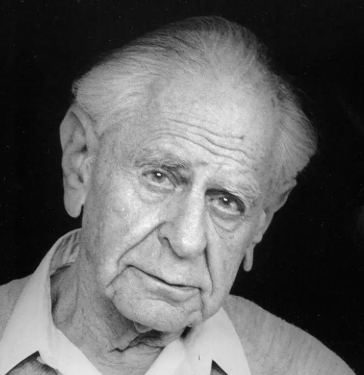
This book raises issues that might not be apparent from the table of contents. It sketches some of the difficulties faced by our civilization — a civilization which might be perhaps described as aiming at humanness and reasonableness, at equality and freedom; a civilization which is still in its infancy, as it were, and which continues to grow in spite of the fact that it has been so often betrayed by so many of the intellectual leaders of mankind. It attempts to show that this civilization has not yet fully recovered from the shock of its birth — the transition from the tribal or "enclosed society," with its submission to magical forces, to the 'open society' which sets free the critical powers of man. It attempts to show that the shock of this transition is one of the factors that have made possible the rise of those reactionary movements which have tried, and still try, to overthrow civilization and to return to tribalism.
0
⚖0
▼Source
source
Introduction; part of this has sometimes been paraphrased : Our civilization has not yet fully recovered from the shock of its birth — the transition from the tribal or 'closed society', with its submission to magical forces, to the 'open society' which s
I see now more clearly than ever before that even our greatest troubles spring from something that is as admirable and sound as it is dangerous — from our impatience to better the lot of our fellows. For these troubles are the by-products of what is perhaps the greatest of all moral and spiritual revolutions of history, a movement which began three centuries ago. It is the longing of uncounted unknown men to free themselves and their minds from the tutelage of authority and prejudice. It is their attempt to build up an open society which rejects the absolute authority to preserve, to develop, and to establish traditions, old or new, that measure up to their standards of freedom, of humaneness, and of rational criticism. It is their unwillingness to sit back and leave the entire responsibility for ruling the world to human or superhuman authority,and their readiness to share the burden of responsibility for avoidable suffering, and to work for its avoidance. This revolution has created powers of appalling destructiveness; but they may yet be conquered.
If in this book harsh words are spoken about some of the greatest among the intellectual leaders of mankind, my motive is not, I hope, the wish to belittle them. It springs rather from my conviction that, if our civilization is to survive, we must break with the habit of deference to great men. Great men may make great mistakes; and as the book tries to show, some of the greatest leaders of the past supported the perennial attack on freedom and reason. Their influence, too rarely challenged, continues to mislead those on whose defence civilization depends, and to divide them. The responsibility of this tragic and possibly fatal division becomes ours if we hesitate to be outspoken in our criticism of what admittedly is a part of our intellectual heritage. By reluctance to criticize some of it, we may help to destroy it all.
Bold ideas, unjustified anticipations, and speculative thought, are our only means for interpreting nature: our only organon, our only instrument, for grasping her. And we must hazard them to win our prize. Those among us who are unwilling to expose their ideas to the hazard of refutation do not take part in the scientific game.
0
⚖0
▼Source
source
Ch. 10 "Corroboration, or How a Theory Stands up to Tests", section 85: The Path of Science, p. 280.
I believe that the advance of science depends upon the free competition of thought, and thus upon freedom, and that it must come to an end if freedom is destroyed (though it may well continue for some time in some fields, especially in technology).
0
⚖0
▼Source
source
Ch. 10 "Corroboration, or How a Theory Stands up to Tests", section 85: The Path of Science, p. 279, note 2.
Science is not a system of certain, or well established, statements; nor is it a statement which steadily advances towards state of finality. Our science is not knowledge (epistēmē): it can newer claim to have attained truth, or even substitute for it, such as probability. . . . We do not know; we can only guess.
0
⚖0
▼Source
source
Ch. 10 "Corroboration, or How a Theory Stands up to Tests", section 85: The Path of Science, p. 278.
Science does not rest upon solid bedrock. The bold structure of its theories arises, as it were, above a swamp. It is like a building erected on piles. The piles are driven down from above into the swamp, but not down to any natural or 'given' base; and if we stop driving the piles deeper, it is not because we have reached firm ground. We simply stop when we are satisfied that the piles are firm enough to carry the structure, at least for the time being.
0
⚖0
▼Source
source
Ch. 5 "The Problem of the Empirical Basis", Section 30: Theory and Experiment, p. 94.
The game of science is, in principle, without end. He who decides one day that scientific statements do not call for any further test, and that they can be regarded as finally verified, retires from the game.
0
⚖0
▼Source
source
Ch. 2 "On the Problem of a Theory of Scientific Method", Section 11: Methodological Rules as Conventions, p. 32.