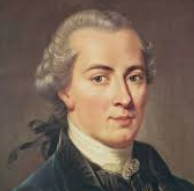
[T]here used to be in the old days three intellectual arguments for the existence of God, all of which were disposed of by Immanuel Kant in the Critique of Pure Reason; but no sooner had he disposed of those arguments than he invented a new one, a moral argument, and that quite convinced him. He was like many people: in intellectual matters he was skeptical, but in moral matters he believed implicitly in the maxims that he had imbibed at his mother's knee. That illustrates what the psychoanalysts so much emphasize — the immensely stronger hold upon us that our very early associations have than those of later times.
I, for one, while I would not choose to dismiss Kant, am certainly prepared to dismiss his writing style. It was, indeed, in his own day, profitably parodied by Fichte.
0
⚖0
▼Source
source
Stephen K. Roney, “Postmodernist Prose and George Orwell”, Academic Questions (Spring 2002)
I was shocked many years ago when a physicist said to me that Kant was the greatest astrophysicist in a hundred-year period. And I asked “Why do you say that? You talk about Kant-Lagrange hypothesis?” He said “No, that was only a hypothesis. Kant showed by a very eloquent geometrical argument that we live near the edge of landscape galaxy in the center of the sphere that resembles Andromeda nebula”. I never heard of that, no philosopher told me that, no historian of philosophy told me that, an astronomer told me that! It was Steven Weinberg; he then said that Kant was the only astrophysicist in about a hundred years who believed that star clustering could be accounted for by gravitation alone.
0
⚖0
▼Source
source
Hilary Putnam, in [https://www.hardproblem.ru/en/posts/interviews/interview-with-hilary-putnam/ interview] with Vadim Vasilyev and Dmitry Volkov (April 21, 2010)
Individualism, united with altruism, has become the basis of our western civilization. It is the central doctrine of Christianity ('love your neighbor,' say the Scriptures, not 'love your tribe'); and it is the core of all ethical doctrines which have grown from our civilization and stimulated it. It is also, for instance, Kant's central practical doctrine ("always recognize that human individuals are ends, and do not use them as mere means to your end.")
0
⚖0
▼Source
source
Karl Popper, summarizing some of Kant's philosophy, in The Open Society and Its Enemies (1945, p. 102; part of this has sometimes been treated as if it were a direct quote of Kant: Always recognize that human individuals are ends, and do not use them as m
For Kant, there are no different religions, but rather different forms of belief in divine revelation [...] among which Christianity, as far as we know, is the most appropriate.
0
⚖0
▼Source
source
Marcello Pera, Perché dobbiamo dirci cristiani, p. 43; quoted in Alessandro Roveri, [http://www.ilponterivista.com/article_view.php?intId=10 La conversione di Marcello Pera al cattolicesimo], Il ponte, January-February 2009
Kant's view of the nature of what is "actually real" remained unaltered throughout his life. Reality is in itself a system of existing thought-essences brought into a unity by teleological relations that are intuitively thought by the Divine intellect, and by this very act of thought posited as real. ...If one... makes Kant either a sceptical agnostic who teaches the unknowableness of things-in-themselves, or a subjective idealist for whom there is no reality in itself at all, he will never be able to make anything of his philosophy. ...Kant is no forbidding or threatening name, but a kindly disposed patron.It happens that for many the Critique of Pure Reason is the first philosophical book that they seriously attempt to read. ...the book is not well suited to this purpose. Kant himself would not have recommended it. He did not even write the Prolegomena for pupils, but for future teachers of philosophy. ...They presuppose nothing less than an acquaintance with the entire state of philosophy at the time, with dogmatism and scepticism, with Leibniz and Hume....Kant's philosophy is the door to the philosophy of our century, and the door to the Kantian philosophy is the Critique of Pure Reason.
0
⚖0
▼Source
source
, [https://books.google.com/books?id=tGMdAAAAMAAJ Immanuel Kant: His Life and Doctrine] (1902) Preface to the First Edition (1898) pp. xiii-xv.
Nothing works a more complete and penetrating disaster than every "impersonal" duty, every sacrifice before the Moloch of abstraction.—To think that no one has thought of Kant's categorical imperative as dangerous to life! … What destroys a man more quickly than to work, think and feel without inner necessity, without any deep personal desire, without pleasure—as a mere automaton of duty? That is the recipe for decadence, and no less for idiocy. … Instinct at fault in everything and anything, instinct as a revolt against nature, German decadence as a philosophy—that is Kant!
0
⚖0
▼Source
source
Nietzsche in The Antichrist (1895), section 11, H. L. Mencken's translation
Unlike vision, touch, or smell, which are prewired and based on Kantian a priori knowledge, the spatial map presents us with a new type of representation, one based on a combination of a priori knowledge and learning.
The very fact that the totality of our sense experiences is such that by means of thinking (operations with concepts, and the creation and use of definite functional relations between them, and the coordination of sense experiences to these concepts) it can be put in order, this fact is one which leaves us in awe, but which we shall never understand. One may say " the eternal mystery of the world is its comprehensibility." It is one of the great realizations of Immanuel Kant that the setting up of a real external world would be senseless without this comprehensibility.