
4 months 3 weeks ago
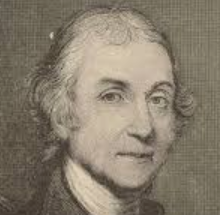
Indeed, if any man can say, that it is not an interesting question, whether his existence terminate at death, or is to be resumed at a future period, and then to continue for ever, he must be of a low and abject mind. To a rational being, capable of contemplating the wonders of nature, and of investigating the laws of it, and to a being of a social disposition, his existence, and the continuance of his rational faculties, must be an object of unspeakable value to him; and consequently he must ardently wish that christianity... may be true. For to a philosopher, who forms his judgment by what he actually observes, the doctrine of soul, capable of subsisting and acting when the body is in the grave, will never give any satisfaction. To every person, therefore, who is capable of enjoying his existence, the christian doctrine of a resurrection opens a glorious and transporting prospect.
▼
Source
General Conclusions, Part I : Containing Considerations addressed to Unbelievers and especially to Mr. Gibbon
4 months 3 weeks ago
Natural science does not consist in ratifying what others have said, but in seeking the causes of phenomena.
▼
Source
Attributed to Albertus Magnus in: Albertus Magnus; cited in: Morris Bishop (1968) The Middle Ages. p. 252.
4 months 3 weeks ago
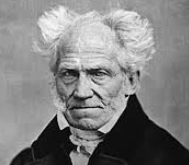
When the Church says that, in the dogmas of religion, reason is totally incompetent and blind, and its use to be reprehended, this really attests the fact that these dogmas are allegorical in their nature, and are not to be judged by the standard which reason, taking all things sensu proprio, can alone apply. Now the absurdities of a dogma are just the mark and sign of what is allegorical and mythical in it. In the case under consideration, however, the absurdities spring from the fact that two such heterogeneous doctrines as those of the Old and New Testaments had to be combined. The great allegory was of gradual growth. Suggested by external and adventitious circumstances, it was developed by the interpretation put upon them, an interpretation in quiet touch with certain deep-lying truths only half realised. The allegory was finally completed by Augustine, who penetrated deepest into its meaning, and so was able to conceive it as a systematic whole and supply its defects.
▼
Source
"The Christian System" in Religion: A Dialogue, and Other Essays (1910) as translated by Thomas Bailey Saunders, p. 105
4 months 3 weeks ago
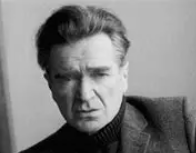
I have never taken myself for a being. A non-citizen, a marginal type, a nothing who exists only by the excess, by the superabundance of his nothingness.

4 months 3 weeks ago
War is a quarrel between two thieves too cowardly to fight their own battle; therefore they take boys from one village and another village, stick them into uniforms, equip them with guns, and let them loose like wild beasts against each other.
▼
Source
Quoted by Emma Goldman in her essay, "Patriotism: A Menace to Liberty", chapter five of Anarchism and Other Essays (2nd revised edition, 1911).
4 months 3 weeks ago
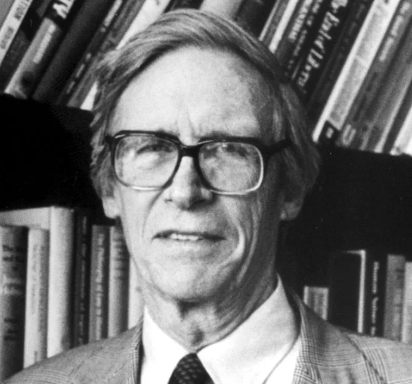
Many conservative writers have contended that the tendency to equality in modern social movements is the expression of envy. In this way they seek to discredit this trend, attributing it to collectively harmful impulses.
▼
Source
Chapter IX, Section 82, p. 538
4 months 3 weeks ago
Cuba and Belgium are both countries of modest size, surrounded by large, powerful and often hostile powers.
▼
Source
[https://www.the-low-countries.com/article/our-man-in-havana-and-other-facts-about-the-belgo-cuban-connection Our Man in Havana and Other Facts about the Belgo-Cuban Connection]
4 months 3 weeks ago
Without mathematics, we are blind.
▼
Source
Original French: Hors les mathématiques, nous sommes aveugles. | From Court traité d'ontologie transitoire. Paris: Éditions du Seuil, 1998. .
4 months 3 weeks ago
In every page of David Hume, there is more to be learned than from Hegel's, Herbart's and Schleiermacher's complete philosophical works. - vol. II, p. 582 (as cited on p. 177 of Schopenhauer: A Biography)
4 months 3 weeks ago
It is a great force, and a great fortune, to be able to live without any ambition whatever. I aspire to it, but the very fact of so aspiring still participates in ambition.
4 months 3 weeks ago
This is not so much a history, as an epic poem; and notwithstanding, or even in consequence of this, the truest of histories. It is the history of the French Revolution, and the poetry of it, both in one; and on the whole no work of greater genius, either historical or poetical, has been produced in this country for many years.
▼
Source
John Stuart Mill, review of Carlyle's French Revolution in The London and Westminster Review (July 1837), p. 17
4 months 3 weeks ago
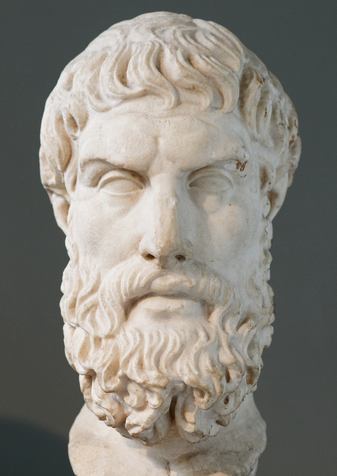
Those who were best able to provide themselves with the means of security against their neighbors, being thus in possession of the surest guarantee, passed the most agreeable life in each other's society; and their enjoyment of the fullest intimacy was such that, if one of them died before his time, the survivors did not mourn his death as if it called for sympathy.
4 months 3 weeks ago
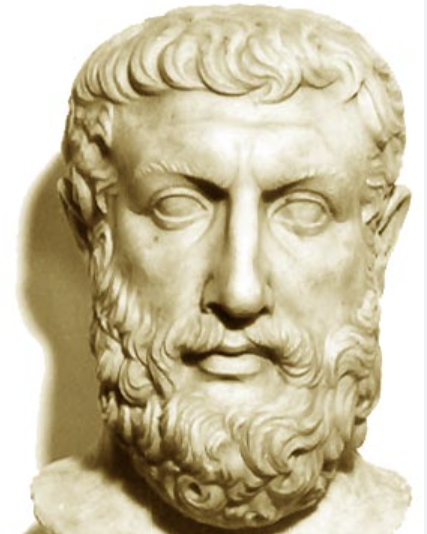
[P]ossibly... Parmenides believed in a "philosophic life" (§ 35), and... got the idea from the Pythagoreans; but there is very little trace... of his having been... affected by the religious side of Pythagoreanism. ...[T]here are traces of Orphic ideas in the poem ...Parmenides was a western Hellene, and he had probably been a Pythagorean, so it is not a little remarkable that he should be so free from the common tendency of his age and country. ...[L]ike most of the older philosophers, he took part in politics; and recorded that he legislated for his native city. Others add that the magistrates of Elea made the citizens swear every year to abide by the laws which Parmenides had given them.
4 months 3 weeks ago
Liberty the essence of life. Whatever is done without it is imperfect.
4 months 3 weeks ago
For reasons mentioned at the beginning of this section, we cannot offer here a precise structural definition of semantical category and will content ourselves with the following approximate formulation: two expressions belong to the same semantical category if (I) there is a sentential function which contains one of these expressions, and if (2) no sentential function which contains one of these expressions ceases to be a sentential function if this expression is replaced in it by the other. It follows from this that the relation of belonging to the same category is reflective, symmetrical and transitive. By applying the principle of abstraction, all the expressions of the language which are parts of sentential functions can be divided into mutually exclusive classes, for two expressions are put into one and the same class if and only if they belong to the same semantical category, and each of these classes is called a semantical category. Among the simplest examples of semantical categories it suffices to mention the category of the sentential functions, together with the categories which include respectively the names of individuals, of classes of individuals, of two-termed relations between individuals, and so on. Variables (or expressions with variables) which represent names of the given categories likewise belong to the same category.
▼
Source
p. 45; as cited in: Schaff (1962) pp. 36-37.
4 months 3 weeks ago
A reproach can only hurt if it hits the mark. Whoever knows that he does not deserve a reproach can treat it with contempt.
4 months 3 weeks ago
If death is as horrible as is claimed, how is it that after the passage of a certain period of time we consider happy any being, friend or enemy, who has ceased to live?
4 months 3 weeks ago
The self is divided within itself, willing what it does not will and not willing what it wills.
▼
Source
Quoted by in Weltschmerz: Pessimism in German Philosophy, 1860-1900 (2016), p. 229.
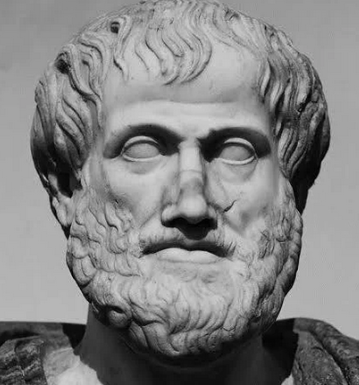
4 months 3 weeks ago
It is impossible that each of the elements should be infinite. For that is body which has interval on all sides; and that is infinite which has extension without bound.
▼
Source
Book III, Ch. VII, p. 159.

4 months 3 weeks ago
When you talk about a revolution, most people think violence; without realizing that the real content of any kind of revolutionary thrust lies in the principles and the goals that you're striving for - not in the way that you reach them. On the other hand, because of the way this society is organized; because of the violence that exists on the surface everywhere - you'd have to expect that there are going to be such explosions. You have to expect things like that as reactions.
▼
Source
From [https://www.imdb.com/title/tt1592527/characters/nm0204171 The Black Power Mixtape 1967-1975].
4 months 3 weeks ago
Money is human happiness in the abstract: he, then, who is no longer capable of enjoying human happiness in the concrete devotes his heart entirely to money.
▼
Source
Vol. 2, Ch. 26, § 320
4 months 3 weeks ago
I feel effective, competent, likely to do something positive only when I lie down and abandon myself to an interrogation without object or end.
4 months 3 weeks ago
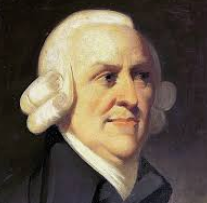
The man of system, on the contrary, is apt to be very wise in his own conceit; and is often so enamoured with the supposed beauty of his own ideal plan of government, that he cannot suffer the smallest deviation from any part of it. He goes on to establish it completely and in all its parts, without any regard either to the great interests, or to the strong prejudices which may oppose it. He seems to imagine that he can arrange the different members of a great society with as much ease as the hand arranges the different pieces upon a chess-board. He does not consider that the pieces upon the chess-board have no other principle of motion besides that which the hand impresses upon them; but that, in the great chess-board of human society, every single piece has a principle of motion of its own, altogether different from that which the legislature might choose to impress upon it. If those two principles coincide and act in the same direction, the game of human society will go on easily and harmoniously, and is very likely to be happy and successful. If they are opposite or different, the game will go on miserably, and the society must be at all times in the highest degree of disorder.
▼
Source
Section II, Chap. II.
4 months 3 weeks ago
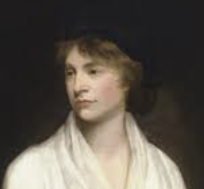
A modest man is steady, an humble man timid, and a vain one presumptuous.
▼
Source
Ch. 7

4 months 3 weeks ago
The subject of a gestalt demonstration knows that his perception has shifted because he can make it shift back and forth repeatedly while he holds the same book or piece of paper in his hands. Aware that nothing in his environment has changed, he directs his attention increasingly not to the figure (duck or rabbit) but to the lines of the paper he is looking at. Ultimately he may even learn to see those lines without seeing either of the figures, and he may then say (what he could not legitimately have said earlier) that it is these lines that he really sees but that he sees them alternately as a duck and as a rabbit. ...As in all similar psychological experiments, the effectiveness of the demonstration depends upon its being analyzable in this way. Unless there were an external standard with respect to which a switch of vision could be demonstrated, no conclusion about alternate perceptual possibilities could be drawn.
▼
Source
p. 114 (3rd edn.)

4 months 3 weeks ago
With other beliefs crumbling, many seek to return to what they piously describe as “Enlightenment values”. But these values were not as unambiguously benign as is nowadays commonly supposed.
▼
Source
2015 [https://www.theguardian.com/books/2015/mar/13/john-gray-steven-pinker-wrong-violence-war-declining]
4 months 3 weeks ago
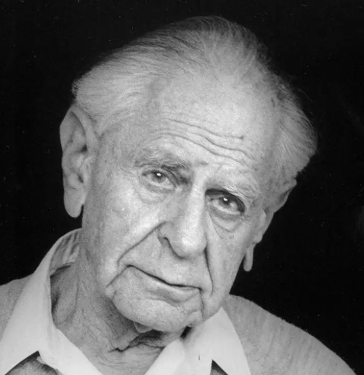
The answer to this problem is: as implied by Hume, we certainly are not justified in reasoning from an instance to the truth of the corresponding law. But to this negative result a second result, equally negative, may be added: we are justified in reasoning from a counterinstance to the falsity of the corresponding universal law (that is, of any law of which it is a counterinstance). Or in other words, from a purely logical point of view, the acceptance of one counterinstance to 'All swans are white' implies the falsity of the law 'All swans are white' - that law, that is, whose counterinstance we accepted. Induction is logically invalid; but refutation or falsification is a logically valid way of arguing from a single counterinstance to - or, rather, against - the corresponding law.This shows that I continue to agree with Hume's negative logical result; but I extend it.This logical situation is completely independent of any question of whether we would, in practice, accept a single counterinstance - for example, a solitary black swan - in refutation of a so far highly successful law. I do not suggest that we would necessarily be so easily satisfied; we might well suspect that the black specimen before us was not a swan."
▼
Source
[https://dhspriory.org/kenny/PhilTexts/Popper/Induction.htm "The Problem of Induction"] (1953, 1974)
4 months 3 weeks ago
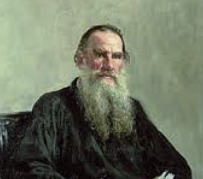
In all history there is no war which was not hatched by the governments, the governments alone, independent of the interests of the people, to whom war is always pernicious even when successful. The government assures the people that they are in danger from the invasion of another nation, or from foes in their midst, and that the only way to escape this danger is by the slavish obedience of the people to their government. This fact is seen most prominently during revolutions and dictatorships, but it exists always and everywhere that the power of the government exists. Every government explains its existence, and justifies its deeds of violence, by the argument that if it did not exist the condition of things would be very much worse. After assuring the people of its danger the government subordinates it to control, and when in this condition compels it to attack some other nation. And thus the assurance of the government is corroborated in the eyes of the people, as to the danger of attack from other nations.
▼
Source
Christianity and Patriotism (1895), as translated in The Novels and Other Works of Lyof N. Tolstoï, Vol. 20, p. 44
4 months 3 weeks ago
Political Zionism is problematic for obvious reasons. But I can never forget what it achieved as a moral force in an era of complete dissolution. It helped to stem the tide of ‘progressive’ leveling of venerable, ancestral differences; it fulfilled a conservative function.
▼
Source
Quoted by [https://wiki.projectherzl.com/wiki/Zionism:_In_their_own_words Project Herzl]
4 months 3 weeks ago
There are three lines of life which stand out prominently to view: the life of pleasure, the political life, and the life of reflection.
4 months 3 weeks ago
As we approach the millennium, we need to demystify the notion that this country is monolingual.
4 months 3 weeks ago
The heavy armor becomes the light dress of childhood; the pain is brief, the joy unending.
4 months 3 weeks ago
We regret not having the courage to make such and such decision; we regret much more having made one — any one. Better no action than the consequences of an action.
4 months 3 weeks ago
It appears, accordingly, from the experience of all ages and nations, I believe, that the work done by freemen comes cheaper in the end than that performed by slaves.
▼
Source
Chapter VIII.
4 months 3 weeks ago
The knowledge of anything, since all things have causes, is not acquired or complete unless it is known by its causes. Therefore in medicine we ought to know the causes of sickness and health. And because health and sickness and their causes are sometimes manifest, and sometimes hidden and not to be comprehended except by the study of symptoms, we must also study the symptoms of health and disease. Now it is established in the sciences that no knowledge is acquired save through the study of its causes and beginnings, if it has had causes and beginnings; nor completed except by knowledge of its accidents and accompanying essentials. Of these causes there are four kinds: material, efficient, formal, and final.
▼
Source
[http://www.fordham.edu/halsall/source/1020Avicenna-Medicine.html "On Medicine, (c. 1020)]
4 months 3 weeks ago
Being summoned by the Athenians out of Sicily to plead for his life, Alcibiades absconded, saying that that criminal was a fool who studied a defence when he might fly for it.
▼
Source
51 Alcibiades
4 months 3 weeks ago
An old fairy tale has it that science began with the rejection of superstition. In fact it was the rejection of rationalism that gave birth to scientific inquiry. Ancient and medieval thinkers believed the world could be understood by applying first principles. Modern science begins when observation and experiment come first, and the results are accepted even when what they show seems to be impossible.
▼
Source
Foreword: Two Attempts to Cheat Death (pp. 5-6)
4 months 3 weeks ago
The open society is one in which men have learned to be to some extent critical of taboos, and to base decisions on the authority of their own intelligence.
▼
Source
Vol. 1, Endnotes to the Chapters : Notes to the Introduction.
4 months 3 weeks ago
Seize the moments of happiness, love and be loved! That is the only reality in the world, all else is folly. It is the one thing we are interested in here.
▼
Source
Book IV, Ch. 11
4 months 3 weeks ago
“Our ideas” are only partly our ideas. Most of our ideas are abbreviations or residues of the thought of other people, of our teachers (in the broadest sense of the term) and of our teachers’ teachers; they are abbreviations and residues of the thought of the past. These thoughts were once explicit and in the center of consideration and discussion. It may even be presumed that they were once perfectly lucid. By being transmitted to later generations they have possibly been transformed, and there is no certainty that the transformation was effected consciously and with full clarity. … This means that the clarification of our political ideas insensibly changes into and becomes indistinguishable from the history of political ideas.
▼
Source
p. 73
4 months 3 weeks ago
Misfortune shows those who are not really friends.
▼
Source
', Book VII, 1238a.20
4 months 3 weeks ago
We are never without a pilot. When we know not how to steer, and dare not hoist a sail, we can drift. The current knows the way, though we do not. The ship of heaven guides itself, and will not accept a wooden rudder.
▼
Source
"The Sovereignty of Ethics", in The North America Review, no. 262 (May–June 1878) p. 407
4 months 3 weeks ago
The most important message, which we have also learned from the work of Chandra Mohanty and Jacqui Alexander, is that we can never assume that the category “women” equally represents all women. [There are] hierarchies of race and class, and now that we have begun to challenge the binary assumptions behind gender, we can say hierarchies of gender as well. Where, for example, does a transgender woman figure into the hierarchy?
4 months 3 weeks ago
If to describe a misery were as easy to live through it!
4 months 3 weeks ago
A merchant, it has been said very properly, is not necessarily the citizen of any particular country.
▼
Source
Chapter IV, p. 456.
4 months 3 weeks ago
It is a mistake to think that the past is dead. Nothing that has ever happened is quite without influence at this moment. The present is merely the past rolled up and concentrated in this second of time. You, too, are your past; often your face is your autobiography; you are what you are because of what you have been; because of your heredity stretching back into forgotten generations; because of every element of environment that has affected you, every man or woman that has met you, every book that you have read, every experience that you have had; all these are accumulated in your memory, your body, your character, your soul. So with a city, a country, and a race; it is its past, and cannot be understood without it.
▼
Source
As quoted in [https://web.archive.org/web/20130312115951/http://www.willdurant.com/home.html "The Gentle Philosopher" (2006) by John Little at the Will Durant Foundation]
4 months 3 weeks ago
A physician, after he had felt the pulse of Pausanias, and considered his constitution, saying, "He ails nothing," "It is because, sir," he replied, "I use none of your physic."
▼
Source
Of Pausanias the Son of Phistoanax
4 months 3 weeks ago
In a traditional reading eating the apple was the original sin; but, as Gnostics understood the story, the two primordial humans were right to eat the apple. The God that commanded them not to do so was not the true God but only a demiurge, a tyrannical underling exulting in its power, while the serpent came to free them from slavery. True, when they ate the apple Adam and Eve fell from grace. This was indeed the Fall of Man – a fall into the dim world of everyday consciousness. But the Fall need not be final. Having eaten its fill from the Tree of Knowledge, humankind can then rise into a state of conscious innocence. When this happens, Herr C. declares, it will be ‘the final chapter in the history of the world'.
▼
Source
The Faith of Puppets: The Freedom of the Marionette (p. 8)
4 months 3 weeks ago
There are all kinds of sources of our knowledge; but none has authority ... The fundamental mistake made by the philosophical theory of the ultimate sources of our knowledge is that it does not distinguish clearly enough between questions of origin and questions of validity.
4 months 3 weeks ago
"If you want him defined, here he is: a prime, well-fed beast such as takes medals at the cattle shows, and nothing more," he said, with a tone of vexation that interested her."No; how so?" she replied. "He's seen a great deal, anyway; he's cultured?""It's an utterly different culture—their culture. He's cultivated, one sees, simply to be able to despise culture, as they despise everything but animal pleasures."
▼
Source
Vronky and Anna discussing the visiting Prince, Part 4, Chapter 3
CivilSimian.com created by AxiomaticPanic, CivilSimian, Kalokagathia