

The proletariat is that class in society which lives entirely from the sale of its labor and does not draw profit from any kind of capital; whose weal and woe, whose life and death, whose sole existence depends on the demand for labor - hence, on the changing state of business, on the vagaries of unbridled competition.
I forsook the company and the dinner-parties, the port-wine and champagne of the middle-classes, and devoted my leisure-hours almost exclusively to the intercourse with plain working men; I am both glad and proud of having done so. Glad, because thus I was induced to spend many a happy hour in obtaining a knowledge of the realities of life-many an hour, which else would have been wasted in fashionable talk and tiresome etiquette; proud, because thus I got an opportunity of doing justice to an oppressed and calumniated class of men who with all their faults and under all the disadvantages of their situation, yet command the respect of every one but an English money-monger.
Incomprehensible and immutable is the love wherewith God loves. He did not begin to love us only on the day we were reconciled to Him by the blood of His Son; He loved us before the world was made, that we too might become His sons together with His Only-begotten Son, long before we had any existence.
Holy Christendom has, in my judgment, no better teacher after the apostles than St. Augustine.
We are alive within mystery, by miracle. "Life," wrote Erwin Chargaff, "is the continual intervention of the inexplicable." We have more than we can know. We know more than we can say. The constructions of language (which is to say the constructions of thought) are formed within experience, not the other way around. Finally we live beyond words, as also we live beyond computation and beyond theory. There is no reason whatever to assume that the languages of science are less limited than other languages.
The very man who has argued you down will sometimes be found, years later, to have been influenced by what you said.
We have Divine Wisdom in the mortal body.Whatever does harm to the body, ruins the House of the Eternal.
The light dove, cleaving the air in her free flight, and feeling its resistance, might imagine that its flight would be still easier in empty space.
We have no right to believe a thing true because everybody says so unless there are good grounds for believing that some one person at least has the means of knowing what is true, and is speaking the truth so far as he knows it. However many nations and generations of men are brought into the witness-box they cannot testify to anything which they do not know. Every man who has accepted the statement from somebody else, without himself testing and verifying it, is out of court; his word is worth nothing at all. And when we get back at last to the true birth and beginning of the statement, two serious questions must be disposed of in regard to him who first made it: was he mistaken in thinking that he knew about this matter, or was he lying?
The inherent contradiction of human life has now reached an extreme degree of tension: on the one side there is the consciousness of the beneficence of the law of love, and on the other the existing order of life which has for centuries occasioned an empty, anxious, restless, and troubled mode of life, conflicting as it does with the law of love and built on the use of violence. This contradiction must be faced, and the solution will evidently not be favourable to the outlived law of violence, but to the truth which has dwelt in the hearts of men from remote antiquity: the truth that the law of love is in accord with the nature of man. But men can only recognize this truth to its full extent when they have completely freed themselves from all religious and scientific superstitions and from all the consequent misrepresentations and sophistical distortions by which its recognition has been hindered for centuries.
There are men who astonish and delight, men who instruct and guide. Some men's words I remember so well that I must often use them to express my thought. Yes, because I perceive that we have heard the same truth, but they have heard it better.
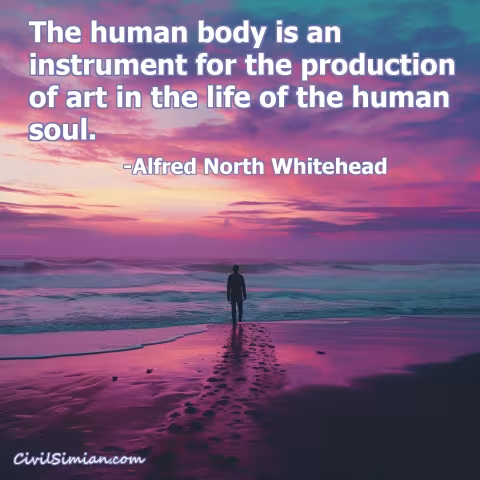
Art expresses, it does not state; it is concerned with existences in their perceived qualities, not with conceptions symbolized in terms.
Logical consequences are the scarecrows of fools and the beacons of wise men.
The self-surmounter can never put up with the man who has ceased to be dissatisfied with himself.
Don't discuss yourself, for you are bound to lose; if you belittle yourself, you are believed; if you praise yourself, you are disbelieved.
I hold agitation to be essential, not only to the obtaining of good and just measures, but to the existence of a free Government itself. If you choose to adopt the principle of Bishop Horsley, that the people have nothing to do with the laws but to obey them, then, indeed, you may deprecate agitation; but, while we live in a free country, and under a free Government, your deprecation is vain and untenable... I say that the slave-trade would never have been abolished without agitation. I say that slavery would never have been abolished without agitation... What is agitation when it is examined, but the mode in which the people in the great outer assembly debate?
A robot, the man had said, is logical but not reasonable.
Not all women, in fact, very few, have had the good fortune to live and work among women and men actively involved in the feminist movement. Many of us live in circumstances and environments where we must engage in feminist struggle alone, with only occasional support and affirmation.
There exists, I grant you, a clinical depression, upon which certain remedies occasionally have effect; but there exists another kind, a melancholy underlying our very outbursts of gaiety and accompanying us everywhere, without leaving us alone for a single moment. And there is nothing that can rid us of this lethal omnipresence: the self forever confronting itself.
It might be plausibly maintained, that in almost every one of the leading controversies, past or present, in social philosophy, both sides were in the right in what they affirmed, though wrong in what they denied.
The kingdom, its states, and its families, may be perfectly ruled; dignities and emoluments may be declined; naked weapons may be trampled under the feet; but the course of the Mean cannot be attained to.
Autumn is a second Spring when every leaf is a flower.
In Administrative Behavior, bounded rationality is largely characterized as a residual category - rationality is bounded when it falls short of omniscience. And the failures of omniscience are largely failures of knowing all the alternatives, uncertainty about relevant exogenous events, and inability to calculate consequences. There was needed a more positive and formal characterization of the mechanisms of choice under conditions of bounded rationality... Two concepts are central to the characterization: search and satisficing.
The best work is not what is most difficult for you; it is what you do best.
Believe me, my friends, you are yet very deficient with regard to the best modes of training your children, or of arranging your domestic concerns.
When things fall out opportunely for the person concerned, he is not apt to be critical about the how or why, his own immediate personal convenience seeming a sufficient reason for the strangest oddities and revolutions in our sublunary things.
I have seen manners that make a similar impression with personal beauty, that give the like exhilaration and refine us like that; and in memorable experiences they are suddenly better than beauty, and make that superfluous and ugly. But they must be marked by fine perception, the acquaintance with real beauty. They must always show control; you shall not be facile, apologetic, or leaky, but king over your word; and every gesture and action shall indicate power at rest. They must be inspired by the good heart. There is no beautifier of complexion, or form, or behavior, like the wish to scatter joy, and not pain, around us.
The Christian Scholastics... might have shown that God Himself said that He had "imprinted an active principle in the elements of matter (Gen. i; Is. lxvi).
The trouble with fiction... is that it makes too much sense. Reality never makes sense.
Nothing is so fatal to the progress of the human mind as to suppose that our views of science are ultimate; that there are no mysteries in nature; that our triumphs are complete, and that there are no new worlds to conquer.
While we are reading these sentences, this fair modern world seems only a reprint of the Laws of Menu with the gloss of Culluca. Tried by a New England eye, or the mere practical wisdom of modern times, they are the oracles of a race already in its dotage, but held up to the sky, which is the only impartial and incorruptible ordeal, they are of a piece with its depth and serenity, and I am assured that they will have a place and significance as long as there is a sky to test them by.
Tibetan prayer wheels: you write a prayer on a paper, put the rolled paper on a wheel, and turn it automatically, without thinking. In this way, the wheel itself is praying for me, instead of me - or more precisely, I myself am praying through the medium of the wheel. The beauty of it all is that in my psychological inferiority I can think about whatever I want, I can yield to the most dirty and obscene fantasies, and it does not matter because - to use a good old Stalinist expression - 'whatever I am thinking, objectively I am praying.'
Since you cannot do good to all, you are to pay special regard to those who, by the accidents of time, or place, or circumstance, are brought into closer connection with you.
One of the scribes came to Jesus and asked him, "Which is the first of all commandments?" Jesus replied,"The first is this: Hear, O Israel! The Lord our God is Lord alone! You shall love the Lord your God with all your heart, with all your soul, with all your mind, and with all your strength. The second is like: You shall love your neighbor as yourself. There is no other commandment greater than these."
In 1903 there appeared Problems of Idealism, a collection of essays many of whose authors had recently been Marxists, but which condemned Marxism and materialism for their moral nihilism, contempt of personality, determinism, and fanatical pursuit of social values regardless of the individuals who made up society; they also attacked Marxism for its uncritical worship of progress and sacrifice of the present to the future.
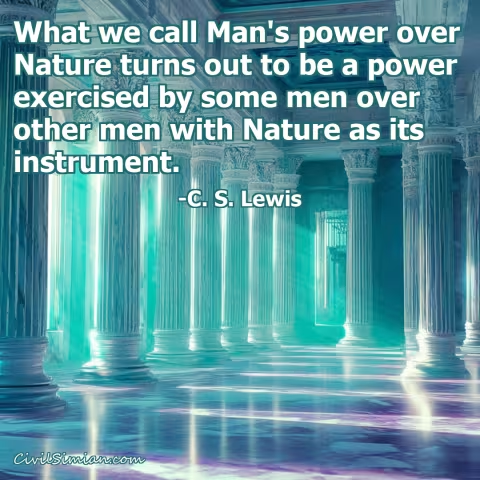
We indeed, who are beings of finite powers, are forced to make use of instruments. And the use of an instrument sheweth the agent to be limited by rules of another's prescription, and that he cannot obtain his end but in such a way, and by such conditions. Whence it seems a clear consequence, that the supreme unlimited agent useth no tool or instrument at all. The will of an Omnipotent Spirit is no sooner exerted than executed, without the application of means; which, if they are employed by inferior agents, it is not upon account of any real efficacy that is in them, or necessary aptitude to produce any effect, but merely in compliance with the laws of nature, or those conditions prescribed to them by the First Cause, who is Himself above all limitation or prescription whatsoever.
Some will object that the Law is divine and holy. Let it be divine and holy. The Law has no right to tell me that I must be justified by it.
My parents, both of whom spoke Russian fluently, made no effort to teach me Russian, but insisted on my learning English as rapidly and as well as possible. They even set about learning English themselves, with reasonable, but limited, success.In a way, I am sorry. It would have been good to know the language of Pushkin, Tolstoy, and Dostoevski. On the other hand, I would not have been willing to let anything get in the way of the complete mastery of English. Allow me my prejudice: surely there is no language more majestic than that of Shakespeare, Milton, and the King James Bible, and if I am to have one language that I know as only a native can know it, I consider myself unbelievably fortunate that it is English.
To receive applause for works which do not demand all our powers hinders our advance towards a perfecting of our spirit. It usually means that thereafter we stand still.
The problem is that rural America has been a colony, certainly throughout my lifetime. I don't think anybody's paid attention to rural America since about 1945 or '50. Certainly not since 1952, when Eisenhower's Secretary of Agriculture said to the farmers: "Get big or get out." They've just abandoned rural America to corporations and technologies.
All large political questions are at bottom economic questions.
The eulogies of my intelligence are positively intended to evade the question "Is what she says true?"
The human being is not the lord of beings, but the shepherd of Being.
CivilSimian.com created by AxiomaticPanic, CivilSimian, Kalokagathia