

3 months 3 weeks ago
His great and real work was the attack on Utilitarianism: which did real good, though there was much that was muddled and dangerous in the historical philosophy which he preached as an alternative. It is his real glory that he was the first to see clearly and say plainly the great truth of our time; that the wealth of the state is not the prosperity of the people. Macaulay and the Mills and all the regular run of the Early Victorians, took it for granted that if Manchester was getting richer, we had got hold of the key to comfort and progress. Carlyle pointed out (with stronger sagacity and humour than he showed on any other question) that it was just as true to say that Manchester was getting poorer as that it was getting richer: or, in other words, that Manchester was not getting richer at all, but only some of the less pleasing people in Manchester.
▼
Source
G. K. Chesterton in The Victorian Age in Literature.
3 months 3 weeks ago
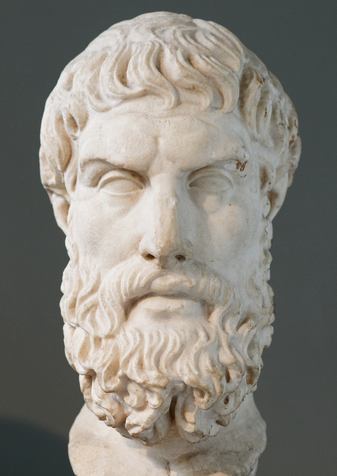
He who is not satisfied with a little, is satisfied with nothing.
▼
Source
The Essential Epicurus : Letters, Principal Doctrines, Vatican sayings, and fragments (1993) edited by Eugene Michael O'Connor, p. 99
3 months 3 weeks ago
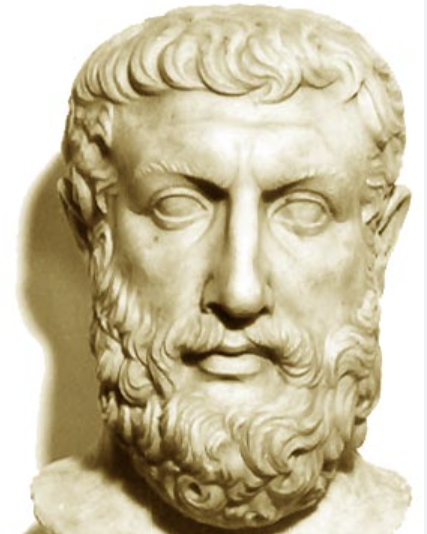
What is clear is that Parmenides is making a conscious attempt at some kind of a new start. Like Descartes, he is trying to find an unassailable starting-point on which something further can be built. This search is understandable, given the intellectual situation of the time. The principles of the Milesians had yielded no one clearly true system, but a number of rival ones — in itself a scandal. Heraclitus had made the whole of cosmology suspect by revealing deep-seated contradictions at its heart. In the background, the Pythagoreans were directly or indirectly stimulating new lines of thought and using them, perhaps, for their own mysterious purposes.
▼
Source
Edward Hussey, in The Presocratics, Classical Life and Letters (1982), p. 105.
3 months 3 weeks ago
I am sorry... to have occasion to admonish Mr. Gibbon, that he should have distinguished better than he has done between christianity itself, and the corruptions of it. ...He should not have taken it for granted, that the doctrine of three persons in one God, or the doctrine of atonement for the sins of all mankind, by the death of one man, were any parts of the christian system; when, if he had read the New Testament for himself, he must have seen the doctrine of the proper unity of God, and also that of his free mercy to the penitent, in almost every page of it.
▼
Source
General Conclusions, Part I : Containing Considerations addressed to Unbelievers and especially to Mr. Gibbon
3 months 3 weeks ago
Do there exist many worlds, or is there but a single world? This is one of the most noble and exalted questions in the study of Nature.
▼
Source
Attributed to Albertus Magnus in: R.C. Bless (1996) Discovering the cosmos. p. 686.
3 months 3 weeks ago
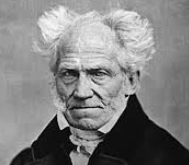
In a field of ripening corn I came to a place which had been trampled down by some ruthless foot; and as I glanced amongst the countless stalks, every one of them alike, standing there so erect and bearing the full weight of the ear, I saw a multitude of different flowers, red and blue and violet. How pretty they looked as they grew there so naturally with their little foliage! But, thought I, they are quite useless; they bear no fruit; they are mere weeds, suffered to remain only because there is no getting rid of them. And yet, but for these flowers, there would be nothing to charm the eye in that wilderness of stalks. They are emblematic of poetry and art, which, in civic life—so severe, but still useful and not without its fruit—play the same part as flowers in the corn.
▼
Source
“Similes, Parables and Fables” Parerga and Paralipomena, vol. 2, § 380A

3 months 3 weeks ago
Buddhism calls anger "corruption of the mind," Manicheism "root of the tree of death." I know this, but what good does it do me to know?
3 months 3 weeks ago
[U]nder no circumstances, and no matter how completely time and events disprove his lurid vaticinations, should the English-speaking world forget this man, nor fail to hold in honor his unsurpass'd conscience, his unique method, and his honest fame. Never were convictions more earnest and genuine. Never was there less of a flunkey or temporizer. Never had political progressivism a foe it could more heartily respect.
▼
Source
Walt Whitman, Specimen Days & Collect (1882–1883), p. 174
3 months 3 weeks ago
A wise man, who puts himself under the government of reason, will be able to receive an injury with calmness, and to treat the person who committed it with lenity; for he will rank injuries among the casual events of life, and will prudently reflect that he can no more stop the natural current of human passions, than he can curb the stormy winds.
3 months 3 weeks ago
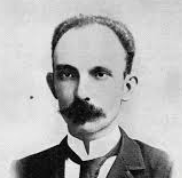
The conceited villager believes the entire world to be his village. Provided that he can be mayor, humiliate the rival who stole his sweetheart, or add to the savings in his strongbox, he considers the universal order good, unaware of those giants with seven-league boots who can crush him underfoot, or of the strife in the heavens between comets that go through the air asleep, gulping down worlds.
3 months 3 weeks ago
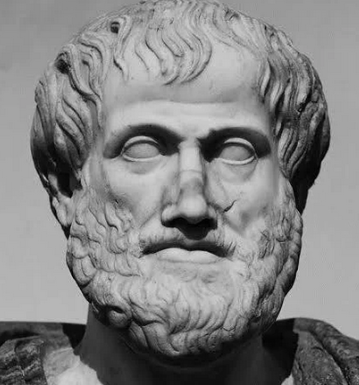
It is necessary that every thing which is harmonized, should be generated from that which is void of harmony, and that which is void of harmony from that which is harmonized. ...But there is no difference, whether this is asserted of harmony, or of order, or composition... the same reason will apply to all of these.
▼
Source
Book I, Ch. VI, p. 57.
3 months 3 weeks ago
It is thus quite simply false that whereof one cannot speak (in the sense of 'there is nothing to say about it that specifies it and grants it separating properties'), thereof one must be silent. It must on the contrary be named.
▼
Source
Original French: Il est donc tout simplement faux que ce dont on ne peut parler (au sens ou il n'y a rien à en dire qui le spécifie, qui lui accorde des propriétés séparatrices), il faille le taire. Il faut au contraire le nommer... | From Manifesto for P
3 months 3 weeks ago
The fundament upon which all our knowledge and learning rests is the inexplicable.
▼
Source
Vol. 2, Ch. 1, § 1
3 months 3 weeks ago
Not to be born is undoubtedly the best plan of all. Unfortunately, it is within no one's reach.
3 months 3 weeks ago
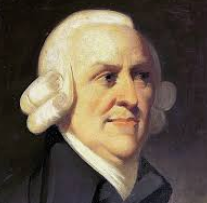
This disposition to admire, and almost to worship, the rich and powerful, and to despise or, at least, neglect persons of poor and mean conditions, though necessary both to establish and to maintain the distinction of ranks and the order of society, is, at the same time, the great and most universal cause of the corruption of our moral sentiments.
▼
Source
Section III, Chap. III.

3 months 3 weeks ago
Independence I have long considered as the grand blessing of life, the basis of every virtue; and independence I will ever secure by contracting my wants, though I were to live on a barren heath.
▼
Source
Dedication

3 months 3 weeks ago
Only when they must choose between competing theories do scientists behave like philosophers.
▼
Source
"Logic of Discovery or Psychology of Research?", Criticism and the growth of knowledge edited by Imre Lakatos and Alan Musgrave (1970)
3 months 3 weeks ago
Man loves liberty, even if he does not know that he loves it. He is driven by it and flees from where it does not exist.
3 months 3 weeks ago
Concerning the generation of animals akin to them, as hornets and wasps, the facts in all cases are similar to a certain extent, but are devoid of the extraordinary features which characterize bees; this we should expect, for they have nothing divine about them as the bees have.
▼
Source
Book III, 761a.2

3 months 3 weeks ago
Since is a society on the move, a society not in place, but on the way, towards an objective, having a direction, [then we need an (from the same root as umma) to lead us toward that objective].
▼
Source
Ali Shariati, in: The Islamic Quarterly, Vol. 27-29, (1983), p. 215.
3 months 3 weeks ago
For an author to write as he speaks is just as reprehensible as the opposite fault, to speak as he writes; for this gives a pedantic effect to what he says, and at the same time makes him hardly intelligible.
▼
Source
The Art of Literature
3 months 3 weeks ago
The state of health is a state of nonsensation, even of nonreality. As soon as we cease to suffer, we cease to exist.
3 months 3 weeks ago
For in every country of the world, I believe, the avarice and injustice of princes and sovereign states, abusing the confidence of their subjects, have by degrees diminished the real quantity of metal, which had been originally contained in their coins.
▼
Source
Chapter IV, p. 34.
3 months 3 weeks ago
The same energy of character which renders a man a daring villain would have rendered him useful to society, had that society been well organized.
▼
Source
Letter 19

3 months 3 weeks ago
Come the Day of Judgment, some believe that the body will be different from our present body. This is only transient, that will be eternal. For this also there are religious arguments.
▼
Source
Pat 5: The Day of Judgment; Opening sentence
3 months 3 weeks ago
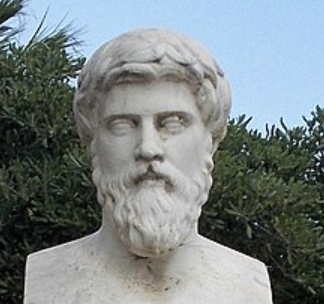
Dionysius the Elder, being asked whether he was at leisure, he replied, "God forbid that it should ever befall me!"
▼
Source
32 Dionysius

3 months 3 weeks ago
Not everything in religion is precious or deserving of reverence. There is an inheritance of anthropocentrism, the ugly fantasy that the Earth exists to serve humans, which most secular humanists share. There is the claim of religious authorities, also made by atheist regimes, to decide how people can express their sexuality, control their fertility and end their lives, which should be rejected categorically. Nobody should be allowed to curtail freedom in these ways, and no religion has the right to break the peace.
3 months 3 weeks ago
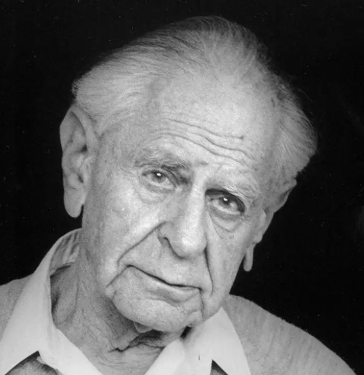
When I speak of reason or rationalism, all I mean is the conviction that we can learn through criticism of our mistakes and errors, especially through criticism by others, and eventually also through self-criticism. A rationalist is simply someone for whom it is more important to learn than to be proved right; someone who is willing to learn from others — not by simply taking over another's opinions, but by gladly allowing others to criticize his ideas and by gladly criticizing the ideas of others. The emphasis here is on the idea of criticism or, to be more precise, critical discussion. The genuine rationalist does not think that he or anyone else is in possession of the truth; nor does he think that mere criticism as such helps us achieve new ideas. But he does think that, in the sphere of ideas, only critical discussion can help us sort the wheat from the chaff. He is well aware that acceptance or rejection of an idea is never a purely rational matter; but he thinks that only critical discussion can give us the maturity to see an idea from more and more sides and to make a correct judgement of it.
▼
Source
"On Freedom" in All Life is Problem Solving (1999)
3 months 3 weeks ago
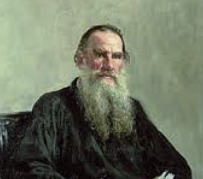
Men think it right to eat animals, because they are led to believe that God sanctions it. This is untrue. No matter in what books it may be written that it is not sinful to slay animals and to eat them, it is more clearly written in the heart of man than in any books that animals are to be pitied and should not be slain any more than human beings. We all know this if we do not choke the voice of our conscience.
▼
Source
The Pathway of Life: Teaching Love and Wisdom (posthumous), Part I, International Book Publishing Company, New York, 1919, p. 68
3 months 3 weeks ago
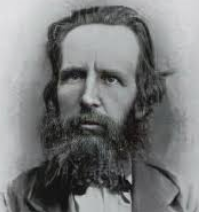
Man is a self-conscious Nothing.
▼
Source
Quoted by Thomas Ligotti in The Conspiracy Against The Human Race, 2011, p. 13.
3 months 3 weeks ago
Everything that depends on the action of nature is by nature as good as it can be, and similarly everything that depends on art or any rational cause, and especially if it depends on the best of all causes. To entrust to chance what is greatest and most noble would be a very defective arrangement.
▼
Source
Book I, 1099b.22: Quoted in Oxford Dictionary of Scientific Quotations (2005), 21:8.

3 months 3 weeks ago
From her involvement with the Student Nonviolent Coorditing Committee during the 1960s to her current leadership of the Institute for Multi-Racial Justice, Elizabeth (Betita) Martinez' work comprises one of the most important living histories of progressive activism in the contemporary era. Furthermore, her writings recording countless struggles for social justice-some won, some lost, some still raging with varying degrees of intensity, and many having international implications-offer us an invaluable reader in the rich history of radical activism in the Americas...Martínez' words are always powerful, never mournful as she addresses the role of U.S. people of color in forging the past, present and future of leftist activism... Her voice is of wisdom gained through a wide range of experiences across a broad spectrum of social movements...Her approach is no-nonsense, yet it reflects the sharp sense of humor that so effectively keeps the weightiness of her subjects from overwhelming...Betita Martinez' life and work stand as a living monument to the possibilities for success that reside in our collective knowledge, commitment, persistence and plain old hard work.
▼
Source
Forward to De Colores Means All of Us (2017)
3 months 3 weeks ago
No greater mistake can be made than to imagine that what has been written latest is always the more correct; that what is written later on is an improvement on what was written previously; and that every change means progress. Men who think and have correct judgment, and people who treat their subject earnestly, are all exceptions only. Vermin is the rule everywhere in the world: it is always at hand and busily engaged in trying to improve in its own way upon the mature deliberations of the thinkers.
3 months 3 weeks ago
Criticism is a misconception: we must read not to understand others but to understand ourselves.
3 months 3 weeks ago
Corn is a necessary, silver is only a superfluity.
▼
Source
Chapter XI, Part III, (First Period) p. 223.

3 months 3 weeks ago
It is now time, leaving every object of sense far behind, to contemplate, by a certain ascent, a beauty of a much higher order; a beauty not visible to the corporeal eye, but alone manifest to the brighter eye of the soul, independent of all corporeal aid. However, since, without some previous perception of beauty it is impossible to express by words the beauties of sense, but we must remain in the state of the blind, so neither can we ever speak of the beauty of offices and sciences, and whatever is allied to these, if deprived of their intimate possession. Thus we shall never be able to tell of virtue's brightness, unless by looking inward we perceive the fair countenance of justice and temperance, and are convinced that neither the evening nor morning star are half so beautiful and bright. But it is requisite to perceive objects of this kind by that eye by which the soul beholds such real beauties. Besides it is necessary that whoever perceives this species of beauty, should be seized with much greater delight, and more vehement admiration, than any corporeal beauty can excite; as now embracing beauty real and substantial. Such affections, I say, ought to be excited about true beauty, as admiration and sweet astonishment; desire also and love and a pleasant trepidation. For all souls, as I may say, are affected in this manner about invisible objects, but those the most who have the strongest propensity to their love; as it likewise happens about corporeal beauty; for all equally perceive beautiful corporeal forms, yet all are not equally excited, but lovers in the greatest degree.
3 months 3 weeks ago
Cicero said loud-bawling orators were driven by their weakness to noise, as lame men to take horse.
▼
Source
Cicero
3 months 3 weeks ago
For those who live inside a myth, it seems a self-evident fact. Human progress is a fact of this kind. If you accept it you have a place in the grand march of humanity. Humankind is, of course, not marching anywhere. ‘Humanity’ is a fiction composed from billions of individuals for each of whom life is singular and final. But the myth of progress is extremely potent. When it loses its power those who have lived by it are – as Conrad put it, describing Kayerts and Carlier – ‘like those lifelong prisoners who, liberated after many years, do not know what use to make of their freedoms’. When faith in the future is taken from them, so is the image they have of themselves. If they then opt for death, it is because without that faith they can no longer make sense of living.
▼
Source
An Old Chaos: The Call of Progress (pp. 6-7)
3 months 3 weeks ago
It seldom happens, however, that a great proprietor is a great improver.
▼
Source
Chapter IV, p. 420.
3 months 3 weeks ago
When one asked him what boys should learn, "That," said he, "which they shall use when men."
▼
Source
Of Agesilaus the Great
3 months 3 weeks ago
Through all of history and pre-history it has been accepted that there is something wrong with the human animal. Health may be the natural condition of other species, but in humans it is sickness that is normal. To be chronically unwell is part of what it means to be human. It is no accident that every culture has its own versions of therapy. Tribal shamans and modern psychotherapists answer the same needs and practise the same trade.
▼
Source
Beyond the Last Thought: Freud's cigars and the long way round to Nirvana (p. 84)
3 months 3 weeks ago
There is only one way to avoid criticism: do nothing, say nothing and be nothing.
▼
Source
Source: Elbert Hubbard, Little Journeys to the Homes of American Statesmen (1898), [http://hdl.handle.net/2027/osu.32435065322687?urlappend=%3Bseq=458 p. 370]: "If you would escape moral and physical assassination, do nothing, say nothing, be nothing—cour
3 months 3 weeks ago
In brief, it is my thesis that human misery is the most urgent problem of a rational public policy and that happiness is not such a problem.
▼
Source
p. 485
3 months 3 weeks ago
He stepped down, trying not to look long at her, as if she were the sun, yet he saw her, like the sun, even without looking.
▼
Source
Pt. I, ch. 9
3 months 3 weeks ago
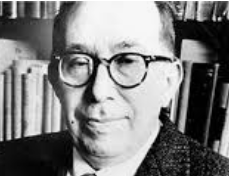
It is of the essence of traditions that they cover or conceal their humble foundations by erecting impressive edifices on them.
▼
Source
p. 31

3 months 3 weeks ago
It is easy to live for others; everybody does. I call on you to live for yourselves.
▼
Source
May 3, 1845
3 months 3 weeks ago
While jails and prisons have been dominant institutions for the control of men, mental institutions have served a similar purpose for women. That is, deviant men have been constructed as criminal, while deviant women have been constructed as insane.
▼
Source
Chapter Four
3 months 3 weeks ago
The reasons for persisting in Being seem less and less well founded, and our successors will find it easier than we to be rid of such obstinacy.
3 months 3 weeks ago
Mercantile jealousy is excited, and both inflames, and is itself inflamed, by the violence of national animosity:...
▼
Source
Chapter III, Part II, p. 534.
3 months 3 weeks ago
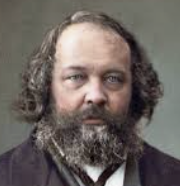
When we speak of justice we do not thereby mean the justice which is imparted to us in legal codes and by Roman law, founded for the most part on acts of force and violence consecrated by time and by the blessings of some church, Christian or pagan and, as such, accepted as an absolute, the rest being nothing but the logical consequence of the same. I speak of that justice which is based solely upon human conscience, the justice which you will rediscover deep in the conscience of every man, even in the conscience of the child, and which translates itself into simple equality. This justice, which is so universal but which nevertheless, owing to the encroachments of force and to the influence of religion, has never as yet prevailed in the world of politics, of law, or of economics, should serve as a basis for the new world. Without it there is no liberty, no republic, no prosperity, no peace! It should therefore preside at all our resolutions in order that we may effectively cooperate in establishing peace.
CivilSimian.com created by AxiomaticPanic, CivilSimian, Kalokagathia