
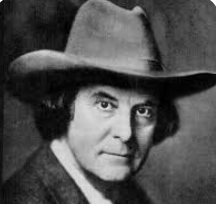
Elbert Hubbard
Member for
5 monthsElbert Hubbard — Roycroft, The Philistine, A Message to Garcia, and the American Arts and Crafts Philosophy (1856–1915)
Elbert Green Hubbard was an American writer, publisher, philosopher, and community founder — born in Bloomington, Illinois in 1856, a brilliant traveling salesman for the Larkin Soap Company who became one of its most successful salesmen and eventually a part owner, who walked away from business wealth in 1892 at the age of thirty-six to become a writer, briefly enrolling at Harvard, dropping out, walking across England, visiting William Morris at the Kelmscott Press, and returning to East Aurora, New York to found what became one of the most remarkable intentional communities in American cultural history: Roycroft.
He published two monthly magazines — The Philistine and The Fra — edited and largely wrote by himself, produced the fourteen-volume "Little Journeys to the Homes of the Great," wrote a single essay in 1899 that became one of the most widely reproduced texts in the history of American publishing, was mocked by socialists for selling out, celebrated by industrialists for vindicating enterprise, and described himself as an anarchist. He died on May 7, 1915, when a German submarine torpedoed the RMS Lusitania — turning with his second wife Alice toward a cabin on the upper deck, closing the door, and choosing to die together rather than risk separation in the water.
His central concern: that beauty, honest craft, individual initiative, and the life of the mind were not luxuries for the few but conditions of human dignity available to all — and that a society organized around mechanical mass production without art, without craftsmanship, without philosophy, was impoverishing itself in ways that wealth could not repair.
The Roycroft Community — Morris in America
Hubbard's visit to William Morris at the Kelmscott Press was the transformative encounter of his intellectual life. Morris had demonstrated that beautiful hand-crafted books — produced with care for typography, materials, and design — were a form of resistance to the dehumanizing uniformity of industrial mass production. The book as object, not merely the book as text, was a statement about what human making could be.
Hubbard returned to East Aurora and built a version of this vision that was distinctly American: larger, more commercial, more eclectic, less committed to socialist ideology but equally committed to craft. The Roycroft community at its peak in 1910 employed over 500 workers producing handmade books, furniture, copper metalwork, leather goods, stained glass, pottery, rugs, and jewelry — all bearing the Roycroft mark, all made by hand, all offered as evidence that beauty was compatible with industry if industry was organized around human skill rather than against it. Roycroft was simultaneously a business, a community, a philosophical experiment, and a tourist destination — visitors came from across America and were welcomed at the Roycroft Inn, whose rooms were named after figures Hubbard admired rather than numbered like a commercial hotel.
"East Aurora is not a locality — East Aurora is a condition of mind."
— Elbert Hubbard, Fra Elbertus
The Philistine — A Periodical of Protest
Hubbard's monthly magazine "The Philistine: A Periodical of Protest" was the primary vehicle for his philosophical writing. He edited and largely wrote it himself for twenty years, filling it with essays, epigrams, profiles, satire, and polemic — a voice that was recognizably American in its directness, its irreverence toward received authority, and its conviction that the examined life was available to anyone willing to do the examining. He adopted the persona "Fra Elbertus" — the friar, the monk of craft — and wore his hair in flowing locks in the manner of the composers he admired.
The magazine attracted a wide and eclectic readership: radicals, reformers, suffragists, freethinkers, and businessmen all found something in Hubbard's mixture of Emersonian individualism, Arts and Crafts aesthetics, and populist moral philosophy. The Roycroft Shops became a meeting ground for conventions of the kinds of people his writing attracted — a physical community organized around the values the magazine preached.
"I believe John Ruskin, William Morris, Henry Thoreau, Walt Whitman and Leo Tolstoy to be Prophets of God, and they should rank in mental reach and spiritual insight with Elijah, Hosea, Ezekiel and Isaiah."
— Hubbard, A Message to Garcia and Thirteen Other Things (1901)
A Message to Garcia — The Essay That Traveled the World
In March 1899, Hubbard published in The Philistine a short piece — written in a single sitting after a dinner conversation with his son — about an Army officer named Rowan who had been tasked during the Spanish-American War with delivering a message to the Cuban insurgent leader García, somewhere in the mountain fastnesses of Cuba, location unknown. Rowan, in Hubbard's telling, simply took the message and delivered it — no questions, no complaints, no hedging. The moral: this quality of initiative, of doing the task without being managed through it, was the rarest and most valuable human characteristic.
The essay became one of the most reproduced texts in publishing history. The New York Central Railroad distributed hundreds of thousands of copies. It was claimed — with characteristically Hubbardian exaggeration — to have been translated into Russian and given to every soldier in the Tsar's army, then found on Russian prisoners of war by the Japanese, translated again, and distributed to every Japanese government employee. Whether the specific distribution claims were accurate matters less than the underlying fact: the essay touched something that millions of readers across cultures and circumstances recognized as true and important — that the person who simply does the job, without requiring a committee meeting to explain why the job needs doing, is rarer and more valuable than almost any other kind of person.
"McKinley gave Rowan a letter to be delivered to García; Rowan took the letter and did not ask, 'Where is he at?' By the Eternal! there is a man whose form should be cast in deathless bronze and the statue placed in every college in the land."
— A Message to Garcia (1899)
The Anarchist Philosopher — Politics as Homespun Radicalism
Hubbard's political philosophy was a study in productive contradiction. He described himself as an anarchist and a socialist. He also employed 500 people, ran a profitable inn, sold handcrafted goods to wealthy collectors, and was mocked by the socialist press for having "sold out." His response was that he had not abandoned his ideals but had lost faith in socialism as a means of realizing them — that genuine freedom required economic independence, not collectivist management.
His 1910 pamphlet "Jesus Was an Anarchist" — an expansion of an earlier essay called "The Better Part" — argued that the radical moral philosophy of Jesus was not the property of any institution but pointed toward a vision of human freedom that all organized religion had systematically betrayed. His anarchism was less political program than moral stance: a suspicion of all authority that substituted institutional compliance for personal moral responsibility, a conviction that the good life required individuals who could think for themselves rather than await instructions.
"I am an Anarchist. All good men are Anarchists. All cultured, kindly men; all gentlemen; all just men are Anarchists. Jesus was an Anarchist."
— Hubbard, A Message to Garcia and Thirteen Other Things (1901)
Little Journeys — Biography as Philosophy
Hubbard's fourteen-volume "Little Journeys to the Homes of the Great" was his most sustained intellectual project — biographical essays on figures ranging from ancient philosophers to contemporary artists, scientists, reformers, and writers, organized not as scholarly biography but as philosophical encounter. The format was personal and intimate: Hubbard imagined himself visiting the subject's home, interweaving historical fact with moral commentary and personal reflection. The subjects ranged from Plato to Eliot, from Voltaire to Susan B. Anthony — a self-educated man's curriculum in human achievement, made available in affordable form to a mass readership.
The project was itself an enactment of his philosophy: that the wisdom of the great was not the property of universities but belonged to anyone willing to engage with it — that democratic culture required not the elimination of excellence but the democratization of access to it.
"His writings contain a bizarre mixture of radicalism and conservatism. He apotheosized work and efficiency in a vigorous, epigrammatic style. His homespun philosophy evolved from a loose William Morris-inspired socialism to an ardent defense of free enterprise and American know-how — without, he insisted, abandoning any of its original commitments."
The Lusitania — The Death He Chose
On May 7, 1915, the RMS Lusitania was torpedoed by a German submarine off the coast of Ireland. Hubbard and his wife Alice were aboard. A survivor, Ernest Cowper, wrote to their son describing the last moments: Hubbard turned to Alice after being asked what he intended to do, and without answering, took her hand and walked with her into a cabin on the upper deck, closing the door behind them. The witness understood what the gesture meant. They died together.
The manner of his death — deliberate, unhurried, with his wife — was widely reported and widely admired. It was, in its way, continuous with everything he had written: the man who did what needed to be done, without asking where to go or why, and without requiring anyone to manage him through it.
"As I moved to the other side of the ship, I called to him, 'What are you going to do?' and he just shook his head, while Mrs. Hubbard smiled and said, 'There does not seem to be anything to do.' He then turned with Mrs. Hubbard and entered a room on the top deck, the door of which was open, and closed it behind him."
— Ernest C. Cowper, eyewitness, letter to Elbert Hubbard II
Legacy — The American William Morris
Hubbard's legacy is split between his philosophical writing and his institutional achievement. As a philosopher he is a minor figure — an eclectic popularizer who synthesized Emerson, Ruskin, Whitman, Morris, and Tolstoy into an accessible homespun idiom rather than a systematic thinker. As an institution builder he was major: Roycroft was the most significant American manifestation of the Arts and Crafts movement, a working demonstration that beautiful craft and community life could coexist with American commercial culture rather than retreating from it.
On CivSim he belongs alongside Ruskin, Morris, and Thoreau — the tradition that located philosophical argument in the conditions of making and living rather than in academic abstraction. His challenge to Universal Humanism is the craft challenge: that a philosophy of human dignity must account for what people make and how they make it, that work organized around the elimination of skill and beauty impoverishes human life in ways that increased wages cannot compensate, and that the ancient connection between making well and living well is not a luxury but a need.
"God will not look you over for medals, diplomas, or degrees — but for scars."
— Elbert Hubbard
CivilSimian.com created by AxiomaticPanic, CivilSimian, Kalokagathia