

6 months 3 weeks ago
Love is the extremely difficult realisation that something other than oneself is real. Love, and so art and morals, is the discovery of reality.
▼
Source
source
"The Sublime and the Good", in the Chicago Review, Vol. 13 Issue 3 (Autumn 1959) p. 51.
8 months 4 days ago
Ah! yes, I know: those who see me rarely trust my word: I must look too intelligent to keep it.
▼
Source
source
Act 2, sc. 3

8 months 4 days ago
Not my idea of God, but God.

6 months 1 week ago
Nonviolence is not an absolute principle, but an open-ended struggle with violence and its countervailing forces.
▼
Source
source
p. 56

8 months 1 week ago
Ambition is not a vice of little people.
▼
Source
source
Book III, Ch. 10
6 months 3 weeks ago
No human acquisition is stable. Even what appears to us most completely won and consolidated can disappear in a few generations. This thing we call "civilization" - all these physical and moral comforts, all these conveniences, all these shelters, all these virtues and disciplines which have become habit now, on which we count, and which in effect constitute a repertory or system of securities which man made for himself like a raft in the initial shipwreck which living always is - all these securities are insecure securities which in the twinkling of an eye, at the least carelessness, escape from man's hands and vanish like phantoms.
▼
Source
source
p. 25
8 months 4 days ago
Your crystal? That's silly. Whom do you think you are fooling? Come on, everyone knows that I threw the baby out of the window. The crystal is shattered on earth, and I do not care. I am no longer anything but a skin, and my skin does not belong to you.
▼
Source
source
Estelle to Inès, Act 1, sc. 5

7 months 3 weeks ago
People are enticed by a desire which continually cheats them.'Nothing is enough,' they say, 'for you're only worth what you have.'
▼
Source
source
Book I, satire i, lines 61-62, as translated by N. Rudd
8 months 1 week ago
He who fears he shall suffer, already suffers what he fears.
▼
Source
source
Book III, Ch. 13




8 months 6 days ago
Modern physics... reduces matter to a set of events which proceed outward from a centre. If there is something further in the centre itself, we cannot know about it, and it is irrelevant to physics.
▼
Source
source
An Outline of Philosophy Ch.15 The Nature of our Knowledge of Physics, 1927
5 months 1 day ago
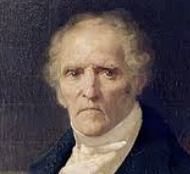
There is a class of writers who are ever boasting of the progress of civilization and of the human mind in modern times. If we were to credit their pretensions, we should be led to believe that the science of society had reached its highest degree of perfection, because old metaphysical and economic theories have been somewhat refined upon.In answer to their boasts of social progress, it is not sufficient to refer to the deeply-rooted social evils which exist, and which prey upon our boasted civilized social order. We will mention but a single one, the frightful increase of national debts and of taxation.
▼
Source
source
The Theory of Social Organization. Harmonian Man: Selected Writings of Charles Fourier

7 months 4 weeks ago
The problem is not to discover in oneself the truth of one's sex, but, rather, to use one's sexuality henceforth to arrive at a multiplicity of relationships. And, no doubt, homosexuality is not a form of desire but something desirable. Therefore, we have to work at becoming homosexuals.
▼
Source
source
"Friendship as a Way of Life," interview in Gai pied, April 1981, as translated in Ethics, Subjectivity and Truth (1994), pp. 135-136
6 months 3 weeks ago
It would be wrong to suppose that the man of any particular period always looks upon past times as below the level of his own, simply because they are past. It is enough to recall that to the seeming of Jorge Manrique, "Any time gone by was better."... From A.D. 150 on, this impression of a shrinking of vitality, of a falling from position, of decay and loss of pulse shows itself increasingly in the Roman Empire. Had not Horace already sung: "Our fathers, viler than our grandfathers, begot us who are even viler, and we shall bring forth a progeny more degenerate still"?
▼
Source
source
Horace, Odes, III.6] Chap. III: The Height Of The Times
7 months 3 weeks ago
He who has begun has half done. Dare to be wise; begin!
▼
Source
source
Book I, epistle ii, lines 40-41
8 months ago
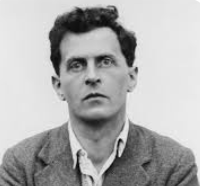
Philosophy is like trying to open a safe with a combination lock: each little adjustment of the dials seems to achieve nothing, only when everything is in place does the door open.
▼
Source
source
Philosophical Occasions 1912-1951 (1993) edited by James Carl Klagge and Alfred Nordmann

9 months 2 days ago
Once you've dissected a joke, you're about where you are when you've dissected a frog. It's dead.
▼
Source
source
Banquets of the Black Widowers (1984), p. 49; comparable to "Humor can be dissected, as a frog can, but the thing dies in the process and the innards are discouraging to any but the pure scientific mind."
6 months 4 days ago
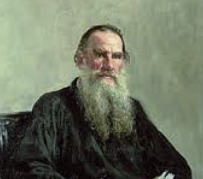
God is the infinite ALL. Man is only a finite manifestation of Him. Or better yet: God is that infinite All of which man knows himself to be a finite part. God alone exists truly. Man manifests Him in time, space and matter. The more God's manifestation in man (life) unites with the manifestations (lives) of other beings, the more man exists. This union with the lives of other beings is accomplished through love. God is not love, but the more there is of love, the more man manifests God, and the more he truly exists... We acknowledge God only when we are conscious of His manifestation in us. All conclusions and guidelines based on this consciousness should fully satisfy both our desire to know God as such as well as our desire to live a life based on this recognition.
▼
Source
source
Entry in Tolstoy's Diary
6 months 3 weeks ago
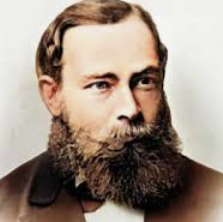
Being true is different from being taken as true, whether by one or by many or everybody, and in no case is it to be reduced to it. There is no contradiction in something's being true which everybody takes to be false. I understand by 'laws of logic' not psychological laws of takings-to-be-true, but laws of truth. ...If being true is thus independent of being acknowledged by somebody or other, then the laws of truth are not psychological laws: they are boundary stones set in an eternal foundation, which our thought can overflow, but never displace. It is because of this that they have authority for our thought if it would attain truth. They do not bear the relation to thought that the laws of grammar bear to language; they do not make explicit the nature of our human thinking and change as it changes.
▼
Source
source
Introduction, Tr. Montgomery Furth



4 months 2 days ago
We know in bodies only matter, and we observe the faculty of feeling only in bodies: on what foundation then can we erect an ideal being, disowned by all our knowledge?
▼
Source
source
Ch. VI Concerning the Sensitive Faculty of Matter
6 months 3 weeks ago
Whoever desires to live among men has to obey their laws-this is what the secular morality of Western civilization comes down to. ... Rationality in the form of such obedience swallows up everything, even the freedom to think.
▼
Source
source
p. 29.
9 months 5 days ago
They pronounce absurdly who thus speak, as the Pythagoreans assert: for at the same time they make the infinite to be essence, and distribute it into parts.
5 months ago
He whom God has touched will always be a being apart: he is, whatever he may do, a stranger among men; he is marked by a sign.
▼
Source
source
Oeuvres Complètes, vol. 3. L'Avenir de la Science (1890).
4 months 2 days ago
No state sorrier than that of the man who keeps up a continual round, and pries into "the secrets of the nether world," as saith the poet, and is curious in conjecture of what is in his neighbour's heart.
▼
Source
source
II, 13
6 months 3 weeks ago
Notwithstanding their attacks on the basic conception of rationalism, on synthetic a priori judgments, that is, material propositions that cannot be contradicted by any experience, the empiricist posits the forms of being as constant.
▼
Source
source
p. 146.
8 months 5 days ago
I soon perceived that she possessed in combination, the qualities which in all other persons whom I had known I had been only too happy to find singly. In her, complete emancipation from every kind of superstition (including that which attributes a pretended perfection to the order of nature and the universe), and an earnest protest against many things which are still part of the established constitution of society, resulted not from the hard intellect, but from strength of noble and elevated feeling, and co-existed with a highly reverential nature.
▼
Source
source
(p. 186)
6 months 3 weeks ago
It appears to me to be indisputable that he who I am to-day derives, by a continuous series of states of consciousness, from him who was in my body twenty years ago. Memory is the basis of individual personality, just as tradition is the basis of the collective personality of a people. We live in memory, and our spiritual life is at bottom simply the effort of our memory to persist, to transform itself into hope, the effort of our past to transform itself into our future.

6 months 3 weeks ago
The free will, the actual motor of reason in society, necessarily creates wrong. The individual must clash with the social order that claims to represent his own will in its objective form. But the wrong and the 'avenging justice' that remedies it not only expresses a 'higher logical necessity,' but also prepare the transition to a higher social form of freedom, the transition from abstract right to morality. For, in committing a wrong, and in accepting punishment for his deed, the individual becomes conscious of the 'infinite subjectivity' of his freedom. He learns that he is free only as a private person.
▼
Source
source
P. 198
6 months 3 weeks ago
Underlying even the so-called problem of knowledge there is simply this human feeling, just as underlying the inquiry into the "why," the cause, there is simply the search for the "wherefore," the end. All the rest is either to deceive oneself or to wish to deceive others; and to wish to deceive others in order to deceive oneself.
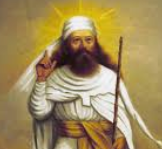
7 months 3 weeks ago
A reflective, contented mind is the best possession.
▼
Source
source
Ushtavaiti Gatha; Yasna 43, 15.
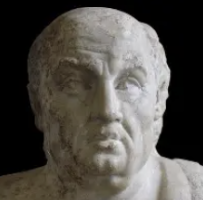
4 months 2 weeks ago
You do not know where death awaits you; so be ready for it everywhere.

8 months 2 weeks ago
So the Church too, like Mary, enjoys perpetual virginity and uncorrupted fecundity.
▼
Source
source
195:2
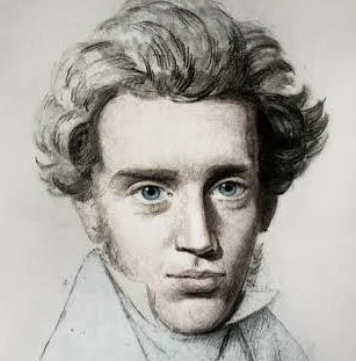
9 months 6 days ago
I have worked for this restlessness oriented toward inward deepening. But without authority. Instead of conceitedly making myself out to be a witness for the truth and causing others rashly to want to be the same, I am an unauthorized poet who influences by means of the ideas.
8 months 4 days ago
The real nature of the present revealed itself: it was what exists, all that was not present did not exist.

7 months 1 day ago
I ask myself; Why is it that only some people suffer? Why are only some selected from the ranks of normal people and put on the torture rack? Some religions maintain that God is trying us through suffering, or that we expiate evil and unbelief through it. If such an explanation can satisfy the religious man, it is not sufficient for anyone who notices that suffering is arbitrary and unjust, because the innocent often suffer most. There is no valid justification for suffering. Suffering has no hierarchy of values.
▼
Source
source
in essay: the monopoly of suffering
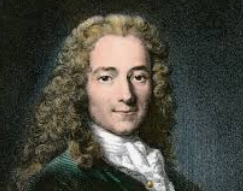
8 months 1 week ago
Divorce is probably of nearly the same age as marriage. I believe, however, that marriage is some weeks the more ancient.
▼
Source
source
"Divorce", 1771
8 months 6 days ago
I resolved from the beginning of my quest that I would not be misled by sentiment and desire into beliefs for which there was no good evidence.
▼
Source
source
Fact and Fiction (1961), Part I, Ch. 6: "The Pursuit of Truth", p. 37

6 months 3 weeks ago
Truth is sought not because it is truth but because it is good.
▼
Source
source
p. 213
4 months 2 weeks ago
I forbid you to be cast down or depressed. It is not enough if you do not shrink from work; ask for it.
6 months 3 weeks ago
Yes, yes, I see it all! - an enormous social activity, a mighty civilization, a profuseness of science, of art, of industry, of morality, and afterwords, when we have filled the world with industrial marvels, with great factories, with roads, museums and libraries, we shall fall exhausted at the foot of it all, and it will subsist - for whom? Was man made for science or was science made for man?
7 months 1 day ago
May some future student go over this ground again, and have the leisure to give his results to the world.
9 months 6 days ago
If one prefers to have little with blessing, to have truth with concern, to suffer instead of exulting over imagined victories, then one presumably will not be disposed to praise the knowledge, as if what it bestows were at all proportionate to the trouble it causes, although one would not therefore deny that through its pain it educates a person, if he is honest enough to want to be educated rather than to be deceived, out of the multiplicity to seek the one, out of abundance to seek the one thing needful, as this is plainly and simply offered precisely according to the need for it.

7 months 5 days ago
Whatever is supreme in a state, ought to have, as much as possible, its judicial authority so constituted as not only not to depend upon it, but in some sort to balance it. It ought to give a security to its justice against its power. It ought to make its judicature, as it were, something exterior to the state.

4 months 2 days ago
You, masters of the earth - princes, kings, emperors, powerful majesties, invincible conquerors - simply try to make the people go on such-and-such a day each year to a given place to dance. I ask little of you, but I dare give you a solemn challenge to succeed, whereas the humblest missionary will succeed and be obeyed two thousand years after his death. Every year the people gather around some rustic temple in the name of St John, St Martin, St Benedict, etc.; they come, animated by a feverish and yet innocent eagerness; religion sanctifies their joy and the joy embellishes religion; they forget their troubles; on leaving they think of the pleasure that they will have on the same day the following year, and the date is set in their minds.
CivilSimian.com created by AxiomaticPanic, CivilSimian, Kalokagathia