
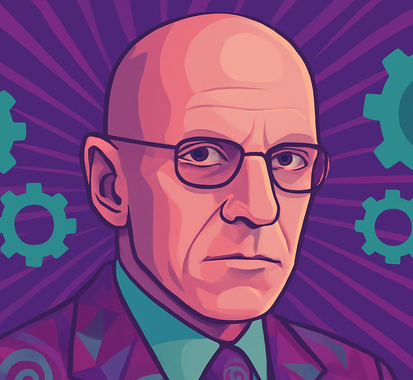
Michel Foucault — The Archaeologist of Power, Knowledge, and the Modern Soul (1926–1984)
Michel Foucault was a philosopher of unsettling clarity — a thinker who refused comforting stories about progress, truth, or human nature. He asked not what is true, but how certain things come to be treated as true, normal, or inevitable. His work exposed the hidden machinery of power operating beneath institutions, sciences, and even our most intimate ideas about ourselves.
An Outsider by Temperament
Born in Poitiers, France, into a family of surgeons, Foucault was expected to follow a respectable professional path. Instead, he gravitated toward philosophy, psychology, and history, while struggling with depression, identity, and a deep sense of alienation. These personal tensions shaped his lifelong suspicion of norms and classifications imposed in the name of health, reason, or morality.
Educated at the École Normale Supérieure, Foucault absorbed influences from Nietzsche, Heidegger, and French structuralism, yet never settled comfortably into any school. He remained intellectually nomadic, reinventing his methods repeatedly rather than building a closed system.
“I am not an archaeologist of things, but of discourse.”
Knowledge and Power — An Inseparable Pair
Foucault rejected the idea that knowledge is simply the discovery of objective truths. Instead, he argued that knowledge and power are deeply intertwined. Every system of knowledge — medicine, psychiatry, criminology, sexuality — emerges within networks of authority that shape what can be said, studied, or believed.
Power, for Foucault, is not merely repression from above. It is productive: it creates categories, identities, norms, and possibilities. Power does not only forbid — it produces reality itself.
“Power produces knowledge; power and knowledge directly imply one another.”
Madness, Medicine, and the Birth of Normality
In Madness and Civilization, Foucault traced how Western societies defined and confined madness, not as a neutral medical discovery but as a cultural decision. What counted as sanity, he showed, shifted alongside economic needs, moral anxieties, and institutional power.
Similar analyses followed in his studies of clinics, prisons, and punishment. Modern institutions claim to heal, correct, or rehabilitate, yet they also observe, classify, and discipline bodies and minds.
“The soul is the prison of the body.”
Discipline and Surveillance — The Modern Condition
In Discipline and Punish, Foucault described a historical shift from spectacular punishment to subtle control. Modern power operates through surveillance, normalization, and self-regulation. The famous metaphor of the panopticon captures this logic: people behave as if watched, even when no one is watching.
This insight proved prophetic. Schools, workplaces, hospitals, and digital platforms increasingly function through continuous assessment, data collection, and behavioral optimization. Control becomes internal, automatic, and invisible.
“Visibility is a trap.”
Sexuality, Identity, and the Self
In The History of Sexuality, Foucault overturned the idea that modern society represses sex. Instead, he argued that it endlessly talks about it, categorizes it, studies it, and turns it into a core of identity.
Sexuality, he claimed, is not a natural essence waiting to be liberated, but a historically constructed field of knowledge and power. Late in his life, Foucault turned toward ethics, exploring how individuals might consciously shape themselves through practices of freedom.
“Where there is power, there is resistance.”
Legacy — The Thinker Who Taught Us to Question the Obvious
Foucault left no moral program and no political blueprint. His legacy is methodological and critical: a relentless refusal to accept what presents itself as natural, neutral, or inevitable.
His influence spans philosophy, sociology, gender studies, political theory, history, and cultural criticism. Foucault taught generations of thinkers to ask a dangerous question: not “Is this true?” but “Who benefits from this being true?”
CivilSimian.com created by AxiomaticPanic, CivilSimian, Kalokagathia