
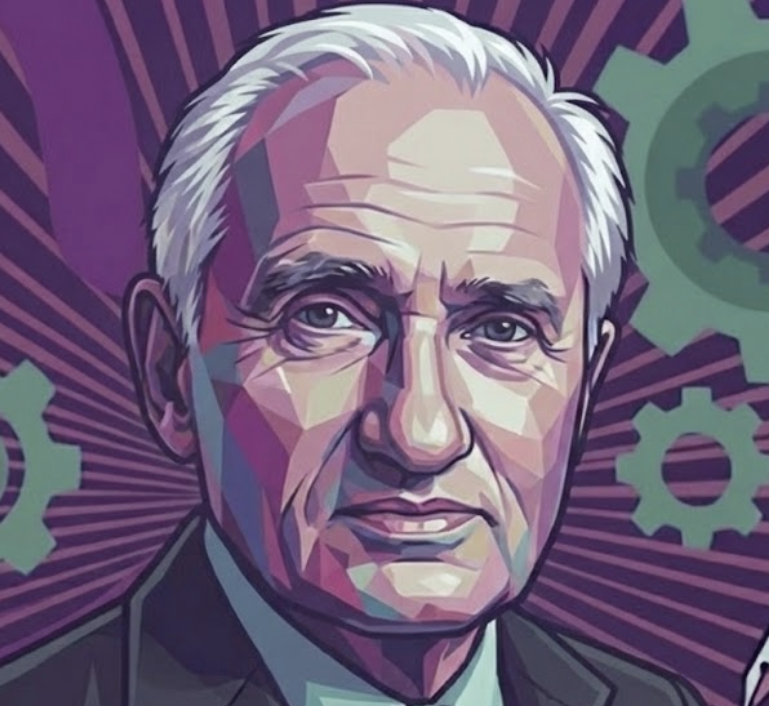
Jürgen Habermas — The Philosopher of Reason, Dialogue, and Democratic Hope (1929– )
Jürgen Habermas stands as one of the most determined defenders of reason in modern philosophy. Writing in the long shadow of fascism, war, and the collapse of Enlightenment confidence, he refused both cynical relativism and authoritarian certainty. His life’s work asks a stubborn question: how can rationality survive in a pluralistic, media-saturated, power-laden modern world?
Formed in the Ruins of Germany
Habermas was born in Düsseldorf in 1929 and came of age amid the moral devastation of postwar Germany. The legacy of Nazism shaped his philosophy from the beginning. He believed that any serious thinking after Auschwitz must confront how reason itself had been twisted into an instrument of domination.
Unlike thinkers who abandoned Enlightenment ideals altogether, Habermas sought to reconstruct them on firmer ground. He became associated with the second generation of the Frankfurt School, following figures like Adorno and Horkheimer, but he refused their near-total pessimism about modern society.
“The unforced force of the better argument.”
Communicative Reason — Meaning Through Dialogue
Habermas’s central idea is communicative rationality. Against views that reduce reason to calculation, strategy, or power, he argued that human beings possess a different kind of rationality rooted in everyday communication. When people speak, they implicitly raise claims to truth, sincerity, and rightness — claims that can be challenged and defended.
Rationality, on this view, is not something imposed from above, but something that emerges between people when they aim at mutual understanding rather than manipulation. Language is not merely a tool; it is the medium of social coordination itself.
“Only those norms can claim validity that meet with the approval of all affected in their capacity as participants in a practical discourse.”
The Public Sphere — Democracy as Ongoing Conversation
In The Structural Transformation of the Public Sphere, Habermas traced the rise of spaces where private individuals could debate matters of common concern — salons, newspapers, cafés. Democracy, he argued, depends not only on institutions and laws, but on the health of these communicative spaces.
He warned that modern capitalism and mass media tend to colonize public discourse, turning citizens into spectators and consumers rather than participants. When communication is distorted by money or power, democratic legitimacy erodes from within.
“Democracy thrives on communication.”
Law, Morality, and Discourse Ethics
Habermas extended his theory of communication into ethics and law. Moral norms, he argued, are not grounded in divine command, tradition, or intuition, but in the possibility of rational agreement under fair conditions of dialogue. This approach, known as discourse ethics, treats morality as an ongoing social practice rather than a fixed code.
Law, in turn, provides the institutional framework that stabilizes these fragile agreements. Legitimate law must be both legally enforceable and discursively justifiable to the citizens it governs.
“The legitimacy of law depends on the quality of public reasoning.”
Habermas vs. Postmodernism
Habermas famously clashed with postmodern thinkers such as Foucault and Derrida. Where they emphasized power, contingency, and instability, Habermas insisted that critique itself presupposes standards of reason and validity. To abandon these standards entirely, he argued, is to undermine the very possibility of emancipation.
His position is not naïve optimism but disciplined hope: reason survives not as certainty, but as a practice — fragile, revisable, and always incomplete.
“Reason is not a possession — it is a process.”
Legacy — Reason Without Illusions
Habermas remains one of the most influential living philosophers, shaping debates in political theory, law, sociology, and ethics. His work offers neither utopia nor despair, but a demanding vision of democracy as an unfinished project.
In an age of polarization, propaganda, and algorithmic distortion, Habermas’s insistence on dialogue, accountability, and shared reasoning feels less like academic theory and more like a survival skill.
CivilSimian.com created by AxiomaticPanic, CivilSimian, Kalokagathia