
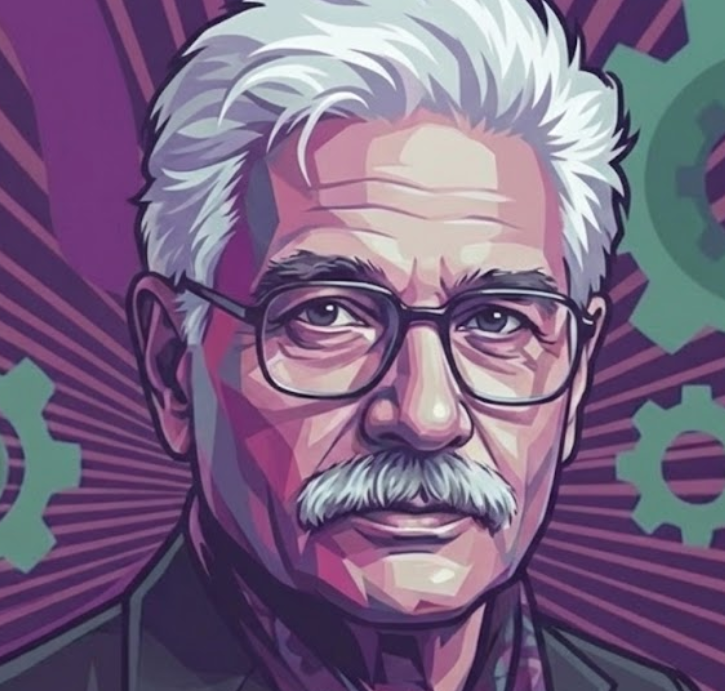
Jacques Derrida — The Philosopher Who Unsettled Meaning from Within (1930–2004)
Jacques Derrida is often described as a destroyer of meaning, but this caricature misses the deeper strangeness of his work. Derrida did not deny truth, language, or reason; he asked how they are possible at all. His philosophy exposes the hidden assumptions that allow meaning to function, showing that what appears solid is always sustained by fragile, shifting relations. To read Derrida is to discover that certainty depends on what it excludes.
Origins at the Margins of Europe
Derrida was born in El Biar, Algeria, then a French colony, into a Sephardic Jewish family living at the edges of French identity. As a child, he experienced exclusion under Vichy anti-Jewish laws, an early lesson in how systems define themselves by drawing boundaries — who belongs, who speaks, who counts.
This experience of marginality shaped his lifelong sensitivity to exclusion, hierarchy, and silence. When Derrida later entered the French philosophical establishment, trained at the École Normale Supérieure, he brought with him a suspicion of any system that claimed completeness or purity.
“What is at stake is meaning, and meaning is never present all at once.”
Deconstruction — Not Destruction, but Exposure
Derrida’s most famous contribution, deconstruction, is often misunderstood as a method for tearing texts apart. In fact, it is a way of reading that reveals how texts depend on unstable distinctions — speech over writing, presence over absence, reason over emotion, center over margin.
Deconstruction shows that these hierarchies cannot sustain themselves. The privileged term relies on what it excludes. Writing, long treated as secondary to speech, turns out to be the condition that makes speech meaningful at all. Meaning is never fully present; it is always deferred, sliding along chains of difference.
“There is nothing outside the text.”
Différance — Meaning as Delay and Difference
One of Derrida’s most subtle ideas is différance — a word that combines difference and deferral. Meaning arises not from direct reference to things, but from the way signs differ from one another within a system. At the same time, meaning is always postponed, never arriving as a final, stable presence.
The famous misspelling — replacing an “e” with an “a” — cannot be heard in speech, only seen in writing. This silent difference embodies Derrida’s claim: language works through distinctions that escape immediate awareness. What seems obvious rests on what cannot be fully grasped.
“Meaning is always deferred — it is never simply present.”
Ethics, Responsibility, and the Impossible
In his later work, Derrida turned increasingly toward ethics and politics. He argued that true responsibility arises precisely where rules fail. A decision that can be justified by a formula is not a decision at all; it is obedience. Ethical action begins in uncertainty, when one must act without guarantees.
Concepts like justice, hospitality, forgiveness, and democracy, Derrida claimed, are always to come — ideals that guide action without ever being fully realized. Their impossibility is not a defect but their moral force. They demand vigilance, humility, and openness to the other.
“Justice is not calculable.”
A Public Thinker Against Closure
Though often portrayed as obscurantist, Derrida was deeply engaged with political realities — colonialism, apartheid, nationalism, and human rights. He opposed dogmatism wherever it appeared, including within philosophy itself.
His style — slow, recursive, playful with language — was inseparable from his argument. To write clearly but falsely would betray thought. Difficulty, for Derrida, was sometimes the price of honesty.
“Every reading is a rewriting.”
Legacy — Thinking Without Final Ground
Derrida’s influence extends across philosophy, literature, law, architecture, anthropology, and political theory. He did not leave behind a system to follow, but a practice of vigilance — a way of reading that resists premature closure.
His work reminds us that meaning is not given once and for all. It is negotiated, contested, and haunted by what it excludes. Derrida remains a philosopher of discomfort — unsettling, demanding, and indispensable in any serious attempt to think honestly about language, power, and responsibility.
CivilSimian.com created by AxiomaticPanic, CivilSimian, Kalokagathia