
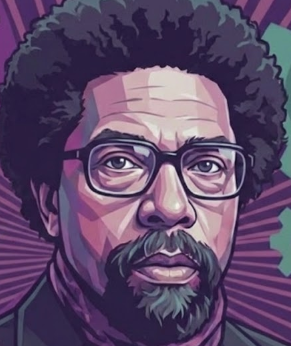
Cornel West — The Philosopher of Prophetic Love, Democracy, and Radical Truth-Telling (1953– )
Cornel West is a philosopher in the oldest sense of the word — a public truth-teller who refuses the safety of academic distance. Drawing from the Black prophetic tradition, pragmatism, Christianity, Marxism, and existentialism, West insists that philosophy must confront suffering, injustice, and despair without surrendering hope. His work is animated by a single moral demand: that democracy means nothing without justice, and justice means nothing without love.
Roots in Struggle and the Black Prophetic Tradition
Born in Tulsa, Oklahoma — a city marked by the legacy of racial violence — Cornel West grew up in Sacramento, California, immersed in the Black Baptist Church and the legacy of the Civil Rights Movement. From an early age, he absorbed the rhythms of gospel preaching and the moral urgency of figures like Martin Luther King Jr. These influences shaped a lifelong commitment to what he calls the prophetic tradition: speaking truth to power with courage, humility, and compassion.
West excelled academically, studying at Harvard, Princeton, and Yale, where he was trained in analytic philosophy even as he resisted its emotional detachment. He refused to treat philosophy as an abstract puzzle-solving exercise, insisting instead that ideas must be accountable to lived experience — especially the experience of those most crushed by history.
“Justice is what love looks like in public.”
Prophetic Pragmatism — Truth Without Illusions
West describes his philosophical stance as prophetic pragmatism. From American pragmatists like William James and John Dewey, he takes the idea that truth must be tested in practice rather than frozen into dogma. From the prophetic tradition, he takes moral urgency — the refusal to normalize injustice or excuse cruelty.
Against both technocratic liberalism and rigid ideology, West argues for a tragic yet hopeful vision of democracy: one that acknowledges failure, corruption, and suffering while still fighting for dignity and solidarity. Hope, for West, is not optimism — it is a stubborn refusal to give up on humanity.
“You can’t lead the people if you don’t love the people.”
Race, Empire, and the Critique of Power
In works like Race Matters and Democracy Matters, West exposes how racism, militarism, and market fundamentalism hollow out democratic ideals. He rejects the comforting myth of linear racial progress, arguing that each generation must confront injustice anew.
West is unsparing in his criticism — of conservatives who defend hierarchy, liberals who manage inequality rather than confront it, and Black elites who confuse representation with liberation. Yet his critique is never cynical. It is rooted in a deep faith in human possibility, even amid catastrophe.
“Never forget that justice is what love looks like in public, just like tenderness is what love feels like in private.”
Love, Tragedy, and the Courage to Care
At the heart of West’s philosophy is love — not sentimental affection, but a fierce commitment to the dignity of others. To love, he argues, is to risk heartbreak in a world structured to crush hope. Tragedy is unavoidable, but indifference is a moral failure.
Influenced by figures like Kierkegaard, Chekhov, and the blues tradition, West embraces the painful honesty of confronting suffering without illusion. He calls this stance tragicomic hope: laughing without denial, struggling without guarantees, and loving without the promise of success.
“To be a human being is to be a lover.”
Public Intellectual and Democratic Conscience
West has consistently stepped beyond the academy — appearing in debates, protests, sermons, classrooms, music collaborations, and political movements. He has criticized presidents of every stripe and refused party loyalty when it conflicts with moral principle. For him, intellectual integrity means independence from power.
This willingness to stand alone has cost him institutional comfort, but it has made him one of the most respected moral voices in American public life — a reminder that democracy depends on citizens willing to speak uncomfortable truths.
“The condition of truth is to allow suffering to speak.”
Legacy — A Voice of Courage in an Age of Cynicism
Cornel West stands in a lineage of Socrates, Frederick Douglass, W. E. B. Du Bois, and Martin Luther King Jr. — thinkers who understood philosophy as a moral vocation rather than a technical specialty. His work challenges citizens to reject despair, resist injustice, and cultivate love in the face of cruelty.
In an era saturated with spectacle and cynicism, West remains a rare figure: a philosopher who believes that ideas still matter, that democracy is worth fighting for, and that love — disciplined, courageous, and honest — remains the deepest force for human renewal.
CivilSimian.com created by AxiomaticPanic, CivilSimian, Kalokagathia