
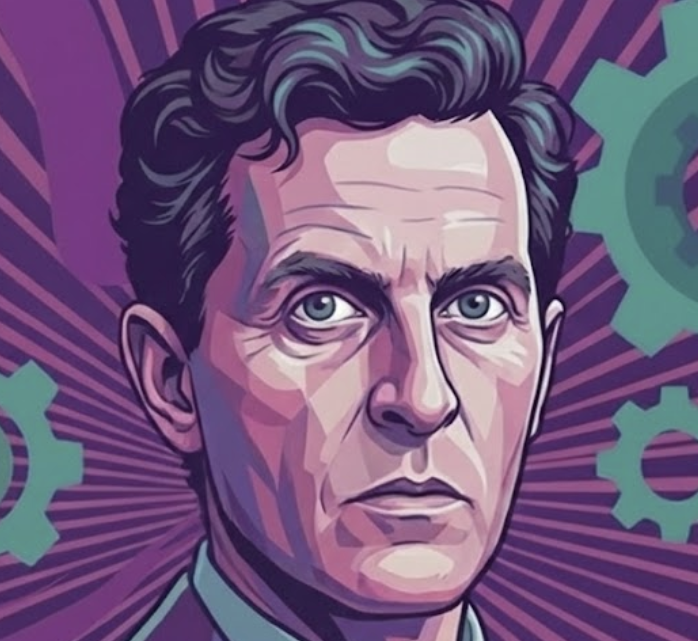
Ludwig Wittgenstein — The Philosopher Who Rebuilt Language from the Inside Out (1889–1951)
Wittgenstein was one of philosophy’s great anomalies — a man who wrote only a few hundred pages, abandoned his own systems, and changed the field twice. His thought moves between mathematical logic and the subtleties of everyday speech, between austere analysis and a kind of philosophical therapy. He believed that many of our deepest confusions arise not from the world itself, but from the way language misleads us about what we can meaningfully say.
A Turbulent Life at the Edges of Genius
Born into one of Vienna’s wealthiest families, Wittgenstein grew up in a home steeped in art, music, and intellectual ferment. Restless and intense, he first studied engineering before drifting toward the foundations of mathematics — a path that led him to Cambridge and into the orbit of Bertrand Russell. Russell immediately recognized his brilliance, predicting that Wittgenstein would surpass everyone in the field.
Yet Wittgenstein’s life was never smooth. His personality was ascetic, demanding, often severe. He renounced his inheritance, volunteered for front-line service in World War I, and even considered becoming a schoolteacher or a monastery gardener. Philosophy, for him, was not a profession but an attempt to purify thought.
“Whereof one cannot speak, thereof one must remain silent.”
The Tractatus — A Picture of Logic and the Limits of Language
Wittgenstein’s first book, the Tractatus Logico-Philosophicus, is a cryptic masterpiece of compressed thought. Written during the war, it proposes that language works by picturing facts — that meaningful propositions mirror the logical structure of the world. Anything that cannot be pictured in this way is nonsense: metaphysics, ethics, theology, even much of philosophy itself.
Yet this was no triumphalist system. The book ends with the most famous ladder in philosophy — the claim that once you understand the propositions of the Tractatus, you must throw them away, because they themselves rely on a perspective that cannot be said. Wittgenstein believed he had solved all philosophical problems and promptly left the field.
“My propositions are elucidatory in this way: he who understands me finally recognizes them as nonsense.”
The Later Philosophy — Language as Use, Mind as Practice
Years later, Wittgenstein returned to philosophy with a radically different view. He abandoned the idea that language mirrors reality through logic. Instead, he argued that meaning arises from the way words are used in practical activities — what he called “language games.” Thought is woven into life, and misunderstanding arises when we tear words out of the contexts that give them significance.
His later work, especially the Philosophical Investigations, took aim at philosophical puzzles as knots produced by linguistic confusion. Instead of constructing systems, he aimed to dissolve illusions, freeing us from the temptation to misuse language in ways that generate pseudo-problems.
“Don’t think, look!”
A Teacher of Intensity and Unsettling Clarity
Wittgenstein’s lectures at Cambridge were legendary. He spoke without notes, pacing, falling into silence, rewriting thoughts in real time. Students described the experience as watching someone think at full force, wrestling ideas into submission. He demanded honesty — not agreement, but clarity without self-deception.
His personal relationships were equally intense, marked by loyalty, conflict, and a relentless demand for authenticity. He believed philosophy was a kind of therapy: not a search for grand theories but an attempt to resolve inner tensions created by misused concepts.
“Philosophy is a battle against the bewitchment of our intelligence by means of language.”
Legacy — The Man Who Split Philosophy in Two
Wittgenstein’s influence is extraordinary. The early Wittgenstein shaped logical positivism and analytic philosophy. The later Wittgenstein overturned both, inspiring ordinary language philosophy and transforming debates about meaning, mind, and rule-following. In continental circles he influenced phenomenology, literary theory, and even anthropology.
His work left behind no single doctrine but a method: a reminder that clarity begins by examining how we speak. He remains a singular figure — austere, paradoxical, brilliant — and his writing continues to unsettle, illuminate, and challenge those drawn into his orbit.
“A serious and good philosophical work could be written consisting entirely of jokes.”
CivilSimian.com created by AxiomaticPanic, CivilSimian, Kalokagathia