
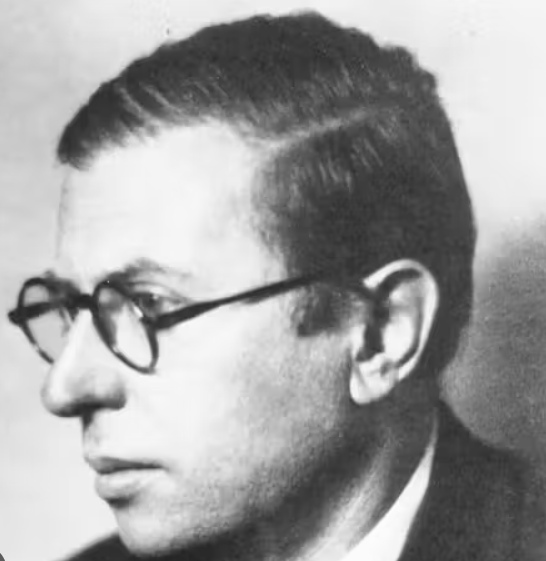
Existentialist Prophet of Freedom, Responsibility, and Radical Choice
1905–1980
Jean-Paul Sartre made existence precede essence—a philosophical revolution that placed human freedom and responsibility at the center of everything. As philosopher, novelist, playwright, and political activist, he insisted that we are "condemned to be free," that there is no fixed human nature, and that we create ourselves through our choices. His existentialism became the defining philosophy of post-war Europe.
The Making of an Intellectual
Born in Paris, Sartre lost his father as an infant and was raised by his grandfather, a language teacher who gave him free access to an enormous library. This solitary childhood among books shaped him profoundly—he lived in words before he lived in the world. At the École Normale Supérieure, he met Simone de Beauvoir, beginning a legendary partnership that would last fifty years.
Early on, Sartre studied phenomenology in Germany, absorbing Husserl and Heidegger's insights about consciousness and being. But where Heidegger emphasized Being, Sartre would emphasize Nothingness—the gap between what we are and what we might become, the freedom that makes us both creators and responsible for what we create.
Man is condemned to be free; because once thrown into the world, he is responsible for everything he does.
Being and Nothingness — The Architecture of Freedom
Sartre's masterwork distinguished between being-in-itself (objects that simply are) and being-for-itself (consciousness that is always becoming). Human consciousness is defined by lack—we're never complete, never finished, always projecting ourselves toward future possibilities. This "nothingness" at our core is what makes freedom possible and inescapable.
Consciousness is intentional—always directed toward something beyond itself. We exist as perpetual transcendence, never coinciding with ourselves. When we try to be a fixed thing—a waiter, a bourgeois, a coward—we engage in bad faith, denying the freedom that defines us. Authenticity requires acknowledging that we're always choosing, always responsible.
We are our choices.
Existence Precedes Essence
In his famous lecture "Existentialism Is a Humanism," Sartre declared that humans have no predetermined nature or purpose. Unlike a paper knife, which is designed for a specific function, we exist first and define ourselves afterward through action. There is no God to give us essence, no human nature to appeal to, no script to follow.
This might sound liberating, but Sartre emphasized its terrible burden: we cannot escape responsibility by blaming circumstances, upbringing, or nature. Even refusing to choose is a choice. Even in extreme situations—occupation, torture, imprisonment—we remain free in how we respond. Freedom isn't a gift but a condemnation we cannot refuse.
Life has no meaning the moment you lose the illusion of being eternal.
Bad Faith and Authenticity
Sartre's concept of bad faith captures how we flee from freedom. The famous waiter in the café plays at being a waiter too perfectly, treating his role as his essence rather than his choice. The woman on a date pretends not to notice her companion's advances, treating her hand as an independent object. Both deny their freedom to choose differently.
Authenticity means accepting that we are what we make ourselves, that no role exhausts our identity, that we're always more than our past. This doesn't mean constant reinvention but rather living with full awareness that our identity is something we create moment by moment, never something simply given or fixed.
Freedom is what you do with what's been done to you.
Hell Is Other People — The Look and Recognition
Sartre's play No Exit gave us the famous line "hell is other people." He didn't mean we should avoid others but that others threaten our freedom by objectifying us. When someone looks at me, I become an object in their world—judged, categorized, fixed. I experience shame not for what I've done but for being seen, for becoming a thing under another's gaze.
Yet we also need others for self-awareness. I discover myself through how others see me. This creates perpetual conflict: I need others' recognition to exist as a subject, but their recognition turns me into an object. Love, Sartre argued pessimistically, is the doomed attempt to possess another's freedom while remaining free oneself.
If you're lonely when you're alone, you're in bad company.
Engagement and Political Responsibility
After World War II, Sartre became increasingly political. He joined the French Resistance, and the experience convinced him that philosophy must engage with concrete historical situations. The intellectual cannot remain detached—to refuse political commitment is itself a political choice supporting the status quo.
His Marxist phase saw him arguing that existentialism and Marxism could complement each other—existentialism providing the theory of individual freedom and choice, Marxism analyzing the material conditions that constrain those choices. Though he broke with the Communist Party over Soviet repression, he remained committed to revolutionary politics and anti-colonialism throughout his life.
When the rich wage war, it's the poor who die.
Literature as Philosophy
Sartre believed philosophy and literature were inseparable. His novels Nausea and The Roads to Freedom trilogy, his plays No Exit, The Flies, and Dirty Hands weren't merely illustrations of his philosophy but ways of doing philosophy through concrete situations and embodied experience.
In Nausea, the protagonist Roquentin discovers the absurd contingency of existence—that things simply are, without reason or necessity. This nausea at existence's brute facticity leads to both despair and possibility: if there's no inherent meaning, we're free to create meaning through our projects and commitments.
Everything has been figured out, except how to live.
Sartre and Beauvoir — Partnership in Philosophy
Sartre's relationship with Simone de Beauvoir was intellectual collaboration as much as romantic partnership. They influenced each other profoundly—Beauvoir's The Second Sex applied existentialist insights to gender, showing how women are made into the "Other," denied their freedom and transcendence. Their open relationship scandalized bourgeois society while embodying their philosophy of freedom.
Beauvoir challenged and refined Sartre's ideas, particularly on embodiment and situation. While Sartre emphasized radical freedom, Beauvoir showed how concrete circumstances—gender, race, class—constrain our possibilities. Together they demonstrated that existentialism wasn't abstract theory but a lived practice of freedom, responsibility, and authentic relationship.
Only the guy who isn't rowing has time to rock the boat.
Legacy — The Burden and Gift of Freedom
When Sartre died in 1980, fifty thousand people followed his funeral procession through Paris. He had become the public intellectual, writing for newspapers, signing petitions, confronting power. He declined the Nobel Prize in 1964, refusing institutional recognition that might compromise his independence.
Sartre's existentialism—once dismissed as pessimistic—now appears prophetic. In an age of algorithmic determination, genetic explanation, and neuroscientific reductionism, his insistence on radical freedom and responsibility challenges all attempts to explain away human agency. We are, he insisted to the end, not what circumstances make us but what we make of what circumstances make us. That terrifying freedom remains both our burden and our dignity.
Life begins on the other side of despair.
CivilSimian.com created by AxiomaticPanic, CivilSimian, Kalokagathia