
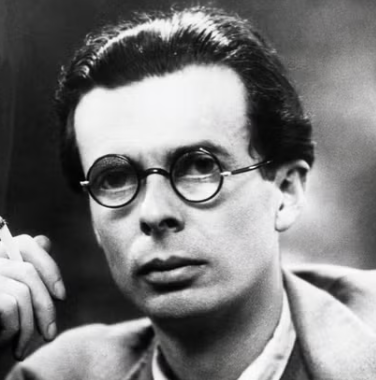
Visionary of Consciousness, Critic of Modernity, and Prophet of Human Potential
1894–1963
Aldous Huxley was a novelist, essayist, and explorer of human consciousness who refused to accept the boundaries between literature, science, mysticism, and philosophy. From dystopian warnings about technological control to mystical investigations of perception and reality, Huxley spent his life asking how humanity might transcend its limitations and realize its highest possibilities.
Brilliant Beginnings, Darkened by Tragedy
Born into one of England's most distinguished intellectual families—his grandfather was Thomas Henry Huxley, "Darwin's Bulldog"—Aldous seemed destined for scientific greatness. But at sixteen, a severe eye infection left him nearly blind for years, derailing plans for a medical career and forcing him into a life of letters rather than laboratories.
This early encounter with limitation and altered perception would haunt his work. Unable to see the world normally, Huxley became obsessed with the nature of perception itself—how we construct reality, what lies beyond ordinary consciousness, and whether human beings might expand their awareness beyond conventional boundaries.
There are things known and there are things unknown, and in between are the doors of perception.
Brave New World — Dystopian Prophet
Huxley's 1932 masterpiece Brave New World imagined a future where humanity trades freedom for comfort, depth for distraction, and authentic experience for engineered pleasure. In this world, technology doesn't oppress through violence but through seduction—soma drugs, endless entertainment, and social conditioning that makes people love their servitude.
The novel proved eerily prescient. Huxley foresaw genetic engineering, pharmaceutical mood management, mass consumerism, and the use of pleasure as political control. Unlike Orwell's boot stamping on a human face, Huxley feared we would come to love our oppression, unable even to recognize what we'd lost.
Most human beings have an almost infinite capacity for taking things for granted.
The Perennial Philosophy — Unity Beneath Diversity
Moving beyond critique, Huxley sought wisdom in the world's mystical traditions. His study The Perennial Philosophy argued that beneath the surface diversity of religions lies a common core: the recognition that ultimate reality is divine, that the soul can unite with this reality, and that ethical living and contemplative practice open the door to transcendence.
This wasn't fuzzy syncretism but careful scholarship. Huxley gathered evidence from Christian mystics, Hindu Vedanta, Buddhist meditation masters, and Sufi poets, showing remarkable convergence on fundamental insights about consciousness, unity, and the illusion of the separate self.
The more powerful and original a mind, the more it will incline towards the religion of solitude.
The Doors of Perception — Consciousness Expansion
In 1953, Huxley participated in what would become one of the most influential experiments in modern thought: a carefully controlled mescaline experience, documented in The Doors of Perception. He described how ordinary objects became saturated with significance, how the "reducing valve" of normal consciousness opened, revealing reality's infinite depths.
This wasn't advocacy for recreational drug use but serious investigation into the mind's potential. Huxley believed psychedelics might offer glimpses of mystical states previously accessible only through years of disciplined practice. The experience confirmed his suspicion that ordinary perception filters out far more than it lets in.
Experience is not what happens to you; it's what you do with what happens to you.
Island — The Utopian Vision
Late in life, Huxley offered a counterpoint to Brave New World. His novel Island depicted a society that had achieved what modernity promised but failed to deliver: technology in service of human flourishing, education aimed at liberation rather than conditioning, and spiritual practice integrated with scientific understanding.
The island of Pala combined Eastern wisdom with Western science, psychedelics with meditation, ecological sustainability with prosperity. It was Huxley's final statement on what humanity might become if we chose wisdom over mere cleverness, being over having, and consciousness over consumption.
Facts do not cease to exist because they are ignored.
The Human Potential Movement
Huxley's influence extended far beyond literature. His ideas helped catalyze the human potential movement, inspiring figures like Timothy Leary, Alan Watts, and Abraham Maslow. He advocated for education that develops the whole person, technologies that enhance rather than diminish consciousness, and social systems that honor human dignity and potential.
He saw humanity at a crossroads: technological power was accelerating, but wisdom lagged dangerously behind. We could use our capabilities to create either enlightened societies or sophisticated nightmares. The choice, he insisted, remained open.
There is only one corner of the universe you can be certain of improving, and that's your own self.
Legacy — The Examined Life in Technological Age
Huxley died on November 22, 1963—the same day as C.S. Lewis and John F. Kennedy—but his questions endure. How do we remain human in an age of technological transformation? How do we cultivate wisdom when information overwhelms understanding? How do we expand consciousness while maintaining groundedness?
His work remains urgently relevant as we navigate artificial intelligence, genetic engineering, pharmaceutical mood management, and virtual realities. Huxley showed that critique without vision leads to despair, while vision without critique leads to naivety. We need both—the clear-eyed realism to see our dangers and the imaginative courage to envision our possibilities.
The spiritual journey does not consist of arriving at a new destination where a person gains what he did not have, or becomes what he is not. It consists in the dissipation of one's own ignorance concerning oneself and life, and the gradual growth of that understanding which begins the spiritual awakening.
CivilSimian.com created by AxiomaticPanic, CivilSimian, Kalokagathia