
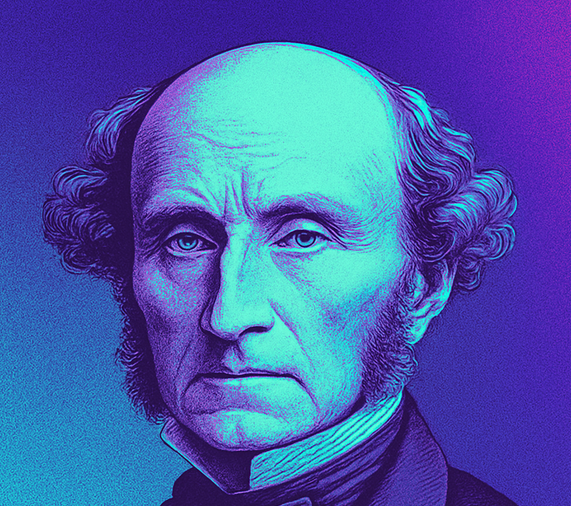
John Stuart Mill — The Champion of Liberty, Reason, and the Individual (1806–1873)
Mill stands at the crossroads of the Enlightenment and modern liberal democracy. He was a brilliant, introverted thinker shaped by intense education and personal struggle, determined to defend the freedom of the individual against conformity, tyranny, and the weight of unexamined custom.
A Mind Forged in Discipline — and Saved by Poetry
Born in London and rigorously educated by his father, James Mill, the young John Stuart Mill was reading Greek at three and tackling logic by twelve. His early life was governed almost entirely by rational training, leaving little room for emotion or play. This produced a brilliant intellect, but also led to a severe mental crisis in his twenties.
It was poetry, especially Wordsworth, that revived him — teaching him that human happiness required not only reason, but feeling, imagination, and a rich inner life.
“The despotism of custom is the standing hindrance to human advancement.”
Liberty — A Defense of the Individual Against the Mass
Mill is best known for On Liberty, one of the most influential works in political philosophy. He argued that society must protect the freedom of thought, expression, and lifestyle — not just from governments, but from the tyranny of public opinion.
His core principle remains a cornerstone of modern liberal thought: power should only be exercised over someone against their will to prevent harm to others, not because their choices are unpopular or unconventional.
“Over himself, over his own body and mind, the individual is sovereign.”
Utilitarianism with a Human Face
Mill refined the utilitarian ethics of Bentham, insisting that happiness is not merely pleasure but the flourishing of higher human capacities. Intellectual and moral pleasures, he argued, carry more weight than simple physical gratification because they express the full development of human nature.
He famously argued that it is “better to be a human being dissatisfied than a pig satisfied,” placing dignity and personal growth at the center of moral life.
“He who knows only his own side of the case knows little of that.”
Feminism, Democracy, and Social Progress
Mill was far ahead of his time in advocating women’s rights and broader democratic participation. With Harriet Taylor, his intellectual partner and later wife, he developed arguments for gender equality that would influence generations of thinkers.
In The Subjection of Women, he condemned the legal and social structures that kept women subordinate, comparing them to a caste system upheld by custom rather than justice.
“The principle which regulates the existing social relations between the two sexes is wrong in itself.”
Legacy — The Voice of Liberal Democracy
Mill remains one of the essential architects of modern democratic life. His defense of free expression influences every debate about censorship and dissent. His theory of individuality underpins contemporary ideas about selfhood and personal autonomy. His work on equality continues to shape feminist, political, and ethical thought.
His vision endures: a society where human beings are free to experiment with life, pursue truth, and cultivate their unique talents — provided they do not harm others in the process.
“Genius can only breathe freely in an atmosphere of freedom.”
CivilSimian.com created by AxiomaticPanic, CivilSimian, Kalokagathia