
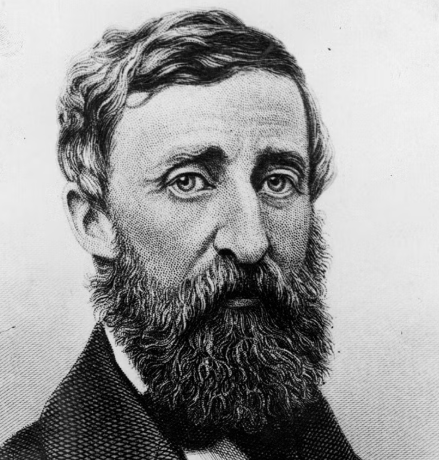
Henry David Thoreau — The Philosopher of Nature, Simplicity, and Civil Conscience (1817–1862)
Thoreau carved out a philosophy of fierce independence and quiet revolution. A wanderer of forests and a critic of empires, he believed that a person discovers truth not in crowds or governments but in solitude, conscience, and the living world. His writing is a sustained invitation to live deliberately and refuse all that numbs the spirit.
A Life Built on Simplicity and Defiance
Born in Concord, Massachusetts, Thoreau grew up surrounded by the intellectual atmosphere of early American Transcendentalism. He absorbed the influence of Emerson, yet carved out his own distinct path. His two-year experiment at Walden Pond became a symbolic declaration: that life can be lived more freely, more honestly, and more intensely when stripped of unnecessary complication.
“Our life is frittered away by detail… simplify, simplify.”
Walden — A Manual for Living Deliberately
Thoreau’s Walden was not a retreat from the world so much as a challenge to it. He sought a life where attention was sharp, days were long, and every moment carried meaning. His observations of ponds, seasons, and animals are woven together with fierce reflections on work, consumption, and the modern human tendency to lose oneself in busyness.
The pond becomes a mirror — not only of nature’s beauty but of the inner life he believed each person must cultivate. Thoreau’s nature writing is never just descriptive; it is philosophical meditation disguised as field notes.
“Heaven is under our feet as well as over our heads.”
Civil Disobedience — When Conscience Becomes Law
Thoreau’s political thinking was a quiet fire. His refusal to pay taxes in protest of slavery and the Mexican–American War led to a night in jail, which inspired his essay Civil Disobedience. The piece argues that when laws violate moral truth, the individual must refuse cooperation — peacefully, courageously, and openly.
This simple yet radical idea became a touchstone for global movements. Gandhi, Tolstoy, Martin Luther King Jr., and countless others found in Thoreau a blueprint for principled resistance. His legacy is a reminder that philosophy matters most when it is lived.
“Disobedience is the true foundation of liberty.”
Nature, Freedom, and the Inner Frontier
Thoreau’s journals — thousands of pages — reveal a man who treated every walk as an act of philosophy. He mapped the changing colors of leaves, the ice on the pond, the behavior of animals, all while probing questions of justice, mortality, and the meaning of work.
His philosophy blends environmental awareness, spiritual searching, and political critique into one vision: a life where the outer landscape shapes the inner one. For Thoreau, nature is not scenery but a teacher, a companion, and a persistent moral presence.
“What lies behind us and what lies ahead of us are tiny matters compared to what lives within us.”
Legacy — The Poet of the Unfinished Self
Thoreau remains one of America’s most singular voices. His commitment to personal integrity, ecological reverence, and moral courage continues to shape environmentalism, civil rights, and political thought. Few writers have fused observation and reflection with such clarity or demanded so much honesty from their readers.
Whether seen as a rebel, a naturalist, or a sage of simplicity, Thoreau stands as a reminder that a single individual with a disciplined conscience can reshape the moral landscape of a nation.
“Go confidently in the direction of your dreams. Live the life you have imagined.”
CivilSimian.com created by AxiomaticPanic, CivilSimian, Kalokagathia