
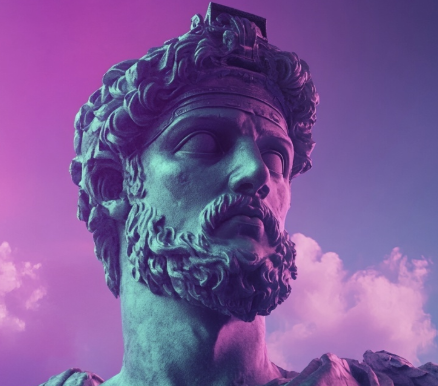
Marcus Aurelius — The Philosopher Emperor and the Practice of Stoicism (121–180 AD)
Marcus Aurelius was Roman Emperor from 161 to 180 AD — the last of the Five Good Emperors — and the only philosopher-king in the ancient world who actually held supreme power for a significant span of time.
His "Meditations" — private notes written to himself during military campaigns on the Danube frontier, never intended for publication — have become one of the most widely read works of practical philosophy in human history.
His central concern: that the only thing within a person's control is their own judgment and response — and that the whole work of a life is the daily, never-finished practice of bringing that response into alignment with reason, virtue, and the nature of things.
The Meditations — Writing to Oneself
The "Meditations" are unlike any other philosophical text in the Western tradition. They are not arguments addressed to an audience, not a systematic treatise, not a dialogue. They are a man talking to himself — reminding, reproaching, encouraging, returning again and again to the same handful of principles as if repetition alone could make them stick.
Written in Greek, the private language of philosophy in a Latin-speaking court, they were never polished for publication. Their roughness is part of their power — you are watching a person of genuine intelligence and genuine authority struggling, day after day, to be the person his philosophy demands.
He fails, repeatedly. He gets angry. He grows impatient. He is tempted by flattery and worn down by obligation. The "Meditations" are the record of his attempts to do better — not the serene reflections of a sage but the working notes of a man who found virtue difficult and kept trying anyway.
That is precisely why they have endured.
"You have power over your mind, not outside events. Realize this, and you will find strength."
Stoic Philosophy — The Core Doctrine
Marcus inherited from the Stoic tradition — above all from Epictetus, the freed slave whose "Discourses" he had read as a young man and never stopped returning to — a set of doctrines as austere as they are practical.
The fundamental distinction is between what is "up to us" — our judgments, intentions, desires, and responses — and what is not — our bodies, our reputations, our circumstances, the actions of other people, the movements of the world. Unhappiness arises from confusing the two: from wanting what we cannot control or fearing the loss of what was never truly ours.
The Stoics did not counsel indifference to the world. Marcus ruled an empire, commanded armies, administered justice, and raised children — none of which he treated as unimportant. But he tried to hold all of it lightly — to do his duty with full effort while remaining inwardly free from attachment to outcomes he could not guarantee.
Virtue, not success, was the goal. The virtuous action has its value in the doing, regardless of what follows from it.
"The impediment to action advances action. What stands in the way becomes the way."
Universal Brotherhood and the Rational Community
Marcus was a Stoic cosmopolitan — committed to the doctrine that all human beings share in a single rational nature and are therefore members of a single community that transcends the boundaries of city, nation, and empire.
This was not an abstract conviction. It shaped how he tried to govern — with a degree of clemency and concern for justice unusual in the ancient world — and how he tried to treat the people around him, including those who frustrated, betrayed, or opposed him.
He returned constantly in the "Meditations" to the exercise of imagining the inner life of those who angered him — their fears, their limitations, their reasons — as a way of replacing contempt with something closer to understanding. The man who wrongs you, he wrote, does so out of ignorance of what is truly good. Pity is more appropriate than anger, and correction more appropriate than punishment.
This was Stoic ethics at its most demanding — and most humane.
"We are all working together to one end — some with knowledge and design, others without knowing what they do."
The Emperor at War — Power and Its Burdens
Marcus spent much of his reign not in Rome but on the northern frontier, fighting the Marcomanni and other Germanic tribes in wars that were grinding, unglamorous, and seemingly endless. He had not sought empire — it was thrust upon him — and he found its obligations a constant drain on the philosophical life he would have preferred.
The contrast between the "Meditations" and their context is one of history's more striking ironies: among the most humane documents of inner life ever written, composed by a man commanding the largest military force in the world while his legions fought and died in the mud of the Danube.
He also presided over persecutions of Christians — not as a policy of his own design but through a legal framework he did not dismantle. His record on this is a complication that honest accounts of his reign cannot ignore.
Power did not corrupt him — but it did not leave him untouched either. He was a good emperor by ancient standards, and by ancient standards the bar was not always high.
"Never esteem anything as of advantage to you that will make you break your word or lose your self-respect."
Legacy — The Book That Would Not Stay Private
The "Meditations" survived by accident — preserved in a single manuscript tradition, unknown to the medieval West, rediscovered and printed in the sixteenth century. Marcus would almost certainly have preferred oblivion. The notes were for himself, not posterity.
Posterity ignored his preference. The book has been read continuously since its rediscovery by soldiers, statesmen, philosophers, and ordinary people looking for a way to hold themselves together under the pressure of a difficult world.
Its appeal crosses every cultural and ideological boundary — Stoicism is the only ancient philosophy that has generated a serious contemporary revival, with practitioners ranging from cognitive behavioral therapists to military commanders to Silicon Valley entrepreneurs. Not all of these applications are equally faithful to what Marcus actually meant. But the hunger they express is genuine — for a philosophy that is practical, honest about difficulty, and demanding without being punishing.
Marcus offers no false comfort. He does not promise that virtue will be rewarded, that the good will prosper, or that the universe is just. He promises only that the response to whatever happens remains, always, within reach — and that this is enough.
"Confine yourself to the present."
CivilSimian.com created by AxiomaticPanic, CivilSimian, Kalokagathia