
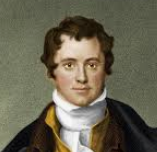
Humphry Davy — Electricity, Elements, and the Romance of Science (1778–1829)
Humphry Davy was a British chemist whose spectacular experimental genius transformed the science of chemistry in the opening decades of the nineteenth century, isolating more new elements than any scientist before or since and laying the foundations of electrochemistry.
A poet as well as a scientist, a friend of Coleridge and Wordsworth, and the most celebrated public lecturer of his age, he embodied the Romantic conviction that science and imagination were not opposites but expressions of the same fundamental wonder before nature.
His central concern: that nature yields its deepest secrets not to passive observation but to bold experimental intervention — and that the pursuit of those secrets is among the most exhilarating things a human being can do.
Electrochemistry and the Isolation of Elements
Davy's greatest experimental achievement was his systematic use of the voltaic pile — the newly invented electric battery — to decompose chemical compounds that no other method had been able to break apart.
In 1807 he passed electrical current through molten potash and soda, isolating for the first time the metallic elements potassium and sodium — metals so reactive they burn on contact with water and had never been seen in pure form. He reportedly danced around the laboratory in excitement when potassium first appeared, gleaming and metallic, from what everyone had assumed was a simple mineral salt.
In rapid succession he went on to isolate calcium, magnesium, barium, boron, and strontium — six new elements in two years, a pace of discovery without parallel in the history of chemistry. He also demonstrated that chlorine was an element rather than a compound, overturning the dominant theory of the day.
His electrochemical work established that chemical affinity and electrical attraction were expressions of the same underlying force — an insight that pointed directly toward the unified field theories that would occupy physics a century later.
"Nothing is so fatal to the progress of the human mind as to suppose that our views of science are ultimate — that there are no mysteries in nature — that our triumphs are complete."
Nitrous Oxide and the Experimental Self
As a young man at the Pneumatic Institution in Bristol, Davy investigated the physiological effects of gases — breathing them himself with a recklessness that damaged his health and might easily have killed him.
His experiments with nitrous oxide produced the first systematic account of its effects — euphoria, laughter, altered perception, temporary pain relief — and his 1800 report suggested it might be used to dull the pain of surgical operations. The medical establishment ignored the suggestion for forty years, during which countless patients underwent surgery without anaesthesia. When general anaesthesia finally arrived in the 1840s, Davy's early observation was belatedly recognized as prophetic.
His willingness to use himself as a subject was characteristic — courageous, occasionally foolish, always driven by the conviction that direct experience was the only honest route to knowledge.
Coleridge, Southey, and other literary friends joined the nitrous oxide sessions, finding in the gas a chemical shortcut to the altered states their poetry sought.
"I felt a sense of tangible extension highly pleasurable in every limb; my visible impressions were dazzling and apparently magnified — I seemed to exist in a world of newly connected ideas."
The Miner's Safety Lamp
In 1815 Davy was approached by a committee of Newcastle mine owners following a series of catastrophic explosions caused by miners' open-flame lamps igniting underground gas. He investigated the problem with characteristic speed and ingenuity.
Within weeks he had established the principles by which a flame enclosed in fine wire gauze could not ignite the surrounding atmosphere — the heat dissipating through the metal before it could trigger explosion. The Davy lamp saved thousands of lives and remained in use in British mines for over a century.
He refused to patent the invention, insisting that a discovery made possible by public science should be available to all without restriction. It was a gesture consistent with his view that knowledge, like nature itself, belongs to everyone.
The lamp also made deeper mining profitable — a consequence Davy welcomed for its economic benefits and that later historians have noted as an early example of safety innovation enabling rather than constraining industrial expansion.
"The lantern of safety in the hand of science is more powerful than the sword of the conqueror."
Science, Poetry, and the Romantic Imagination
Davy wrote poetry throughout his life and maintained that science and literature were kindred expressions of the same imaginative impulse. He was among the first to argue publicly that the scientist required not just method but creative vision — the capacity to see what no experiment had yet revealed and design the experiment that would reveal it.
His friendship with Coleridge was philosophically serious — both men believed that the division between scientific and poetic understanding of nature was artificial and impoverishing. Coleridge attended Davy's lectures at the Royal Institution partly to improve his metaphors, and Davy revised Coleridge's manuscripts.
His own late work "Consolations in Travel" — written while dying and published posthumously — took the form of philosophical dialogues on science, the soul, and the nature of existence, revealing a mind that had never separated the laboratory from the larger questions of human meaning.
He was, in the fullest sense, a Romantic scientist — one who found in the structure of matter not just mechanism but wonder.
"The most important of my discoveries have been suggested to me by my failures."
Legacy — The Discoverer and His Discovery
Davy became President of the Royal Society in 1820 and was knighted and then made a baronet — the first scientist elevated to that rank purely on the basis of his discoveries. He was the most famous scientist in Britain and one of the most famous in Europe.
His most consequential act of discovery may have been recognizing Michael Faraday — then a bookbinder's apprentice who had attended his lectures and sent him a bound copy of his own notes — and hiring him as a laboratory assistant. Faraday went on to discover electromagnetic induction, the foundation of every electrical generator and motor ever built. Davy, who could be vain and competitive, reportedly said in his later years that Faraday was the greatest discovery he had ever made.
The remark has a grace to it — the acknowledgment that the most important thing a scientist of the first rank can do is sometimes to recognize and enable the scientist of the second.
Davy died in Geneva in 1829, aged fifty, his health broken by decades of chemical exposure. He left behind a science transformed, a generation inspired, and a reminder that the boundary between the laboratory and the imagination is one that the best scientists have always refused to respect.
"Life is made up not of great sacrifices or duties, but of little things in which smiles and kindnesses and small obligations, given habitually, are what win and preserve the heart."
CivilSimian.com created by AxiomaticPanic, CivilSimian, Kalokagathia