
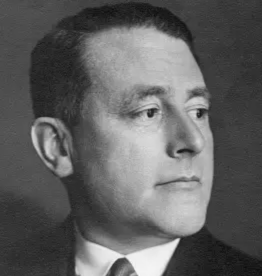
Carl Schmitt — Sovereignty, the Political, and the Limits of Liberalism (1888–1985)
Carl Schmitt was a German jurist and political theorist whose penetrating and deeply unsettling analyses of sovereignty, constitutional law, and the nature of political conflict made him one of the most influential — and most dangerous — legal and political thinkers of the twentieth century.
A committed member of the Nazi party from 1933, who provided intellectual justification for some of its early measures, he cannot be separated from what he enabled — yet his core concepts have proven impossible for serious political theory to ignore, appearing in the work of thinkers across the entire political spectrum.
His central concern: that liberalism evades the fundamental truth of politics — that conflict, decision, and the distinction between friend and enemy are not problems to be dissolved by procedure but the irreducible core of political life itself.
Sovereignty and the State of Exception
Schmitt's most quoted formulation opens his 1922 work "Political Theology": sovereign is he who decides on the exception.
The argument was precise and disturbing. Legal orders, he pointed out, presuppose normal conditions — they are designed to function when circumstances are stable. But who decides when circumstances have become so abnormal that the normal legal order must be suspended? That decision cannot itself be governed by the legal order, because it is precisely the legal order's applicability that is in question.
The sovereign, on this account, is not defined by routine authority but by the capacity to step outside the legal order when it cannot govern itself — to decide in the space where law runs out.
Liberal constitutionalism, Schmitt argued, never resolves this problem — it merely conceals it. Every legal order rests on a decision that the order itself cannot justify.
"Sovereign is he who decides on the exception."
The Concept of the Political
In his 1932 work "The Concept of the Political," Schmitt argued that the defining criterion of the political is the distinction between friend and enemy.
This was not a moral distinction — enemy does not mean evil — nor an economic or aesthetic one. The political enemy is simply the other, the stranger whose difference is existentially threatening in a way that makes conflict possible up to the point of physical annihilation.
Liberalism, he argued, systematically denies this distinction — attempting to replace political conflict with economic competition or moral debate. But the attempt does not dissolve the friend-enemy distinction; it merely disguises it, leaving liberal societies defenseless against adversaries who have not made the same mistake.
The argument has been used to justify authoritarian politics. It has also been used by critics of liberalism across the left and right to name something that liberal theory genuinely struggles to account for.
"Tell me who your enemy is and I will tell you who you are."
The Critique of Liberalism and Parliamentary Democracy
Schmitt's "The Crisis of Parliamentary Democracy" argued that the intellectual foundations of liberal parliamentarism — the belief that open public debate leads to truth and legitimate governance — had been quietly abandoned while the institutional forms persisted.
Modern parliaments, he observed, did not actually govern through debate. Decisions were made in committee rooms and party negotiations; the chamber speeches were performance for the public record. The ideal of rational deliberation had been replaced by the reality of competing interest groups — and nobody was saying so honestly.
He distinguished liberalism, which is about individual rights and rational procedure, from democracy, which is about the identity of rulers and ruled — arguing that the two are not naturally allied and can come into sharp conflict.
This separation of liberalism and democracy has proven one of his most durable and widely applied distinctions.
"All significant concepts of the modern theory of the state are secularized theological concepts."
Nazism and the Moral Reckoning
Schmitt joined the Nazi party in May 1933 and in the following years provided legal and theoretical justifications for measures including the Enabling Act, the Night of the Long Knives, and antisemitic legislation. He called himself the "Crown Jurist of the Third Reich."
He was removed from his SS position in 1936 after internal party attacks, largely on grounds that his earlier Catholicism and opportunism made him suspect. He survived the war, was interned briefly by Allied authorities, and retired to his hometown of Plettenberg, where he continued writing and receiving visitors until his death at ninety-six.
He never recanted, never apologized, and never acknowledged moral responsibility for his role in the Nazi legal order. This is not a footnote to his thought — it is a fact about his character that bears directly on how his ideas should be read and how cautiously they should be applied.
His concepts did not cause Nazism. But he placed them in its service willingly, and that willingness is part of the historical record of what those concepts can do.
"I am fully aware of the power of the dark things."
— from Schmitt's postwar "Glossarium," the closest he came to self-reflection
Legacy — The Theorist No One Can Dismiss
Schmitt's posthumous influence is one of intellectual history's more unsettling phenomena. His work has been seriously engaged by Walter Benjamin, Jürgen Habermas, Jacques Derrida, Giorgio Agamben, Chantal Mouffe, and Hannah Arendt — thinkers who explicitly opposed everything he stood for politically yet found his conceptual apparatus impossible to bypass.
The state of exception has become a central concept in critiques of emergency powers and the post-9/11 security state. The friend-enemy distinction has been applied to analyze identity politics, culture war, and the dynamics of polarization. The critique of liberal parliamentarism has been taken up by the left as readily as the right.
Reading Schmitt seriously requires holding the genuine diagnostic power of his concepts alongside the genuine horror of what he did with them — and resisting the temptation to resolve the tension by either dismissing him entirely or rehabilitating him too cleanly.
He is perhaps the most extreme case in the philosophical canon of ideas that illuminate and endanger simultaneously — a thinker whose work demands engagement precisely because its dangers are real.
"The exception is more interesting than the rule. The rule proves nothing; the exception proves everything."
CivilSimian.com created by AxiomaticPanic, CivilSimian, Kalokagathia