
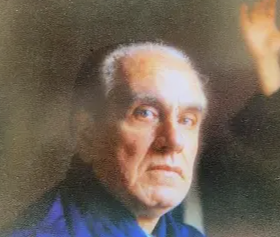
Julius Evola — Tradition, Hierarchy, and the Revolt Against the Modern World (1898–1974)
Julius Evola was an Italian philosopher, esotericist, and cultural critic whose radical traditionalism placed him among the most controversial and unconventional thinkers of the twentieth century.
Moving through Dadaism, Eastern philosophy, and occultism before arriving at his mature doctrine of Tradition, he constructed a sweeping critique of modernity rooted in the metaphysics of sacred hierarchy.
His central concern: that the modern world represents not progress but a catastrophic descent — a falling away from a primordial sacred order that only the most radical spiritual revolt could reverse.
The Doctrine of Tradition
Evola drew heavily on René Guénon's concept of the Primordial Tradition — the idea that beneath the surface diversity of the world's great religions lies a single esoteric metaphysical truth, accessible only to a spiritual elite.
Where Guénon turned toward Islam and contemplative withdrawal, Evola developed an activist, warrior-aristocratic variant. His Tradition was not merely mystical but political — a hierarchical order in which spiritual, martial, and civic authority were fused under the principle of the sacred.
He drew on Hindu cosmology, Roman religion, Norse myth, and alchemy to construct a vision of civilization at its height — and to diagnose precisely how far the modern world had fallen from it.
For Evola, every equalizing, democratizing, and materializing tendency in modernity was a symptom of spiritual degeneration.
"The fundamental thing is to get up, to not lie down under the blows of fate, to remain standing under any circumstances."
Revolt Against the Modern World
Evola's most ambitious work presented a grand historical narrative of civilizational decline, tracing the fall from a primordial Solar, warrior-aristocratic civilization through successive ages of degradation — mirroring the Hindu concept of the Kali Yuga, the Dark Age.
Democracy, capitalism, Marxism, and Christianity in its popular forms were all condemned as expressions of the same underlying inversion — the replacement of quality by quantity, of the sacred by the profane, of natural hierarchy by mass leveling.
His target was not this or that political system but the entire direction of Western history since the medieval synthesis began to crack — a critique so total that it could find no comfortable home in any existing political movement.
Evola was not a conservative. He wanted not to conserve modernity but to repudiate it entirely.
"We are at the end of a cycle, and the task is not to build something new but to remain upright amid the ruins."
Politics, Fascism, and Uneasy Alliances
Evola's relationship with fascism was one of critical proximity. He was drawn to its anti-liberal and anti-egalitarian energies but held both Mussolini's movement and National Socialism in partial contempt — too populist, too racial-biological, insufficiently rooted in genuine spiritual hierarchy.
He lectured in Nazi Germany and corresponded with SS ideologues, yet he criticized Nazi racial theory as a materialist distortion — race for Evola was ultimately spiritual, not biological. After the war he was tried in Italy for his writings and acquitted, the court finding his ideas too esoteric to constitute practical incitement.
His post-war work counseled a posture he called "riding the tiger" — not collaboration with the modern world nor futile frontal resistance, but inner detachment and readiness, preserving the flame of Tradition until the cycle turned.
He appealed to those who found conventional right-wing politics spiritually insufficient.
"Fascism was not reactionary enough for me — it did not go back far enough."
Esotericism, Magic, and Inner Development
Alongside his political philosophy, Evola wrote extensively on practical esotericism — works on Tantra, alchemy, the Hermetic tradition, and the inner disciplines of the warrior path.
These were not peripheral interests but central to his project. The restoration of Tradition required individuals capable of embodying its principles — men who had undergone genuine inner transformation, not merely adopted correct political opinions.
His "The Yoga of Power" and "The Hermetic Tradition" remain serious engagements with their source material, whatever one thinks of the broader framework they serve.
For Evola the esoteric and the political were inseparable: outer order could only be restored by those who had first established inner order.
"The true elite is not defined by birth or wealth but by an inner quality — a flame that either burns in a man or does not."
Legacy — Influence and Danger
Evola's influence on the post-war radical right was substantial and lasting. His works circulated through Italian neo-fascist movements, shaped the European New Right, and in recent decades have found new audiences through translations and digital dissemination.
Figures from Steve Bannon to various European identitarian movements have cited him as an influence, a fact that has brought renewed scholarly and journalistic attention to ideas long confined to the political margins.
Reading Evola seriously requires holding two things simultaneously: that his critique of modernity draws on genuine philosophical sources and raises questions that do not dissolve on contact — and that his framework has historically served as intellectual scaffolding for movements responsible for real harm.
He is not safely ignorable, nor safely admired.
"I am a superfascist. I go beyond fascism — not to the right or left, but upward."
CivilSimian.com created by AxiomaticPanic, CivilSimian, Kalokagathia