
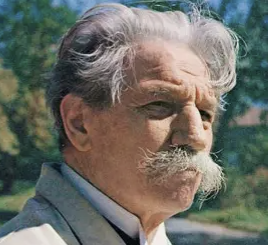
Albert Schweitzer — Reverence for Life (1875–1965)
Albert Schweitzer was a German-French philosopher, theologian, physician, and humanitarian whose life united deep thought with extraordinary action.
A renowned scholar and musician, he later turned to medicine, founding a hospital in Central Africa where he spent much of his life serving others.
His central message: all life is sacred — and ethics begins with a profound respect for every living being.
Reverence for Life
Schweitzer’s philosophy rests on a simple but powerful insight: every living thing possesses a will to live.
From this, he developed his principle of “reverence for life” — an ethical commitment to respect and protect all forms of existence.
Morality, in his view, arises not from abstract rules, but from direct encounter with living beings.
Compassion becomes the foundation of ethical responsibility.
“I am life which wills to live, in the midst of life which wills to live.”
Life of Service
Schweitzer believed that ethical understanding must be lived in action.
He left behind a successful academic career to study medicine, seeking to directly help those in need.
His hospital work became a concrete expression of his philosophical beliefs.
For him, true knowledge required responsibility toward others.
“Example is not the main thing in influencing others. It is the only thing.”
Critique of Modern Civilization
Schweitzer warned that modern civilization risked losing its ethical foundation.
Scientific and technological progress, he argued, had advanced faster than moral awareness.
Without reverence for life, progress could become destructive.
True advancement must unite knowledge with compassion.
“Man has lost the capacity to foresee and to forestall. He will end by destroying the earth.”
Ethics and Spirituality
As a theologian, Schweitzer emphasized a lived spirituality grounded in ethical action.
He focused less on doctrine and more on compassion, humility, and responsibility.
Spiritual life, for him, was inseparable from how we treat others.
Ethics and faith were expressions of the same principle.
“Ethics is nothing else than reverence for life.”
Legacy — Living the Principle
Albert Schweitzer remains a powerful example of philosophy lived in action.
His life demonstrated that ideas gain meaning only when they are practiced.
He continues to inspire a deeper ethical awareness toward all forms of life.
Not through abstraction, but through daily acts of care and responsibility.
“Until he extends his circle of compassion to all living things, man will not himself find peace.”
CivilSimian.com created by AxiomaticPanic, CivilSimian, Kalokagathia