
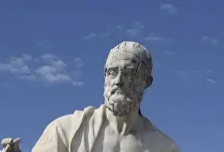
Polybius — The Historian of Power and the Cycle of Governments (c. 200–118 BCE)
Polybius was a Greek historian and political thinker who sought to explain one of the most astonishing events of the ancient world: the rapid rise of Rome to dominance over the Mediterranean.
His work did more than record history. It attempted to uncover the underlying mechanisms that cause states to rise, stabilize, decay, and collapse.
Polybius believed that political systems follow recurring patterns — a cycle that repeatedly transforms one form of government into another.
A Greek in the Roman World
Polybius was born in the Greek city of Megalopolis during a period when Greece was increasingly dominated by Rome.
After political conflicts, he was taken to Rome as a hostage.
Instead of resisting his circumstances, he used the opportunity to study Roman institutions firsthand.
Through friendships with influential Roman leaders, he gained rare insight into the workings of the Roman Republic.
“The study of history is the best education for public life.”
Explaining the Rise of Rome
Polybius wrote a monumental work called The Histories.
In it, he examined how Rome expanded from a regional power into a vast empire in only a few generations.
Unlike many earlier historians, Polybius emphasized careful investigation, eyewitness testimony, and political analysis.
For him, history was not merely storytelling — it was a scientific attempt to understand political cause and effect.
“The knowledge of past events is the key to understanding the future.”
The Cycle of Governments
Polybius developed a theory known as anacyclosis, the cycle of political regimes.
According to this theory, governments evolve through predictable stages:
monarchy, tyranny, aristocracy, oligarchy, democracy, and finally mob rule.
Each system eventually decays because power becomes corrupted over time.
After chaos, the cycle begins again with the rise of a new strong leader.
“All constitutions are subject to change and decay.”
The Mixed Constitution
Polybius believed Rome had discovered a way to slow this destructive cycle.
The Roman Republic combined elements of several different forms of government.
The consuls represented monarchy, the Senate represented aristocracy, and the popular assemblies represented democracy.
Because these institutions balanced and restrained each other, the system remained stable longer than most governments.
This idea later influenced political thinkers who designed modern constitutional systems.
“A balanced constitution protects a state from the extremes of power.”
Legacy — The Science of Political History
Polybius helped transform the study of history into a disciplined investigation of political systems.
His analysis of constitutional balance influenced later thinkers such as Machiavelli and Montesquieu.
His ideas also helped shape the development of modern republican government.
Polybius believed that history should not simply record events, but reveal the patterns that govern political life.
By studying those patterns, societies might avoid repeating the same mistakes.
“History is philosophy teaching by examples.”
CivilSimian.com created by AxiomaticPanic, CivilSimian, Kalokagathia