
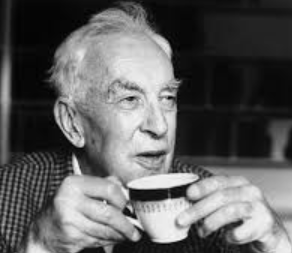
Arnold J. Toynbee — The Historian of Civilizations, Challenge, and Destiny (1889–1975)
Arnold J. Toynbee was the cartographer of civilizations — a thinker who sought patterns not in individual events, but in the grand rise and fall of entire cultures. Against narrow national histories, he proposed a planetary perspective: humanity’s story is not a sequence of isolated nations, but a drama of civilizations responding to challenge, creating meaning, and confronting decline.
A Historian of the Whole Human Story
Born in London and educated at Oxford, Toynbee devoted his life to understanding history on the largest scale possible. He believed historians had focused too narrowly on states and wars, missing the deeper processes that shape cultures across centuries.
His monumental work, A Study of History, attempted to analyze dozens of civilizations — from ancient Egypt to modern Western society — searching for recurring patterns in their development and collapse.
“Civilizations die from suicide, not by murder.”
Challenge and Response
Toynbee’s central theory is known as challenge and response. Civilizations, he argued, do not grow automatically. They arise when societies confront difficult conditions — harsh environments, invasions, crises — and creatively respond to them.
When challenges are met with imagination and discipline, cultures flourish. When they are met with rigidity or complacency, decline begins.
History, in this sense, is less a record of fate than a test of creativity.
“A challenge is an opportunity to grow.”
Creative Minorities and Social Decay
Toynbee believed civilizations are guided by what he called creative minorities — small groups capable of inspiring society through example, innovation, and moral vision.
Decline begins when these leaders stop creating and instead try to preserve their authority through force or imitation. When the creative minority becomes a dominant minority, vitality gives way to stagnation.
Civilizations collapse not simply because of external enemies, but because their internal sources of renewal dry up.
“The supreme accomplishment is to blur the line between work and play.”
Religion and the Fate of Civilizations
Unlike many modern historians, Toynbee believed spiritual traditions were central to cultural vitality. He argued that religions often emerge during periods of crisis, offering new moral visions capable of renewing societies.
For him, history was not purely material or political. It was also spiritual — a record of humanity’s search for meaning.
Civilizations that lose this dimension, he believed, risk losing their sense of purpose.
“The measure of a civilization is its ability to face crisis creatively.”
Criticism and Controversy
Toynbee’s sweeping approach attracted both admiration and skepticism. Some scholars praised his ambition and breadth; others argued that his generalizations oversimplified history’s complexity.
Yet even critics acknowledged that he revived an older philosophical ambition: to understand history not merely as chronology, but as intelligible pattern.
Legacy — Seeing Humanity as One Story
Toynbee’s lasting contribution lies in scale. He encouraged readers to step back from national narratives and see humanity as a single unfolding drama, shaped by shared challenges and recurring possibilities.
His work reminds us that civilizations are not permanent structures. They are living processes, sustained only as long as imagination, responsibility, and moral energy endure.
To study history, in Toynbee’s spirit, is not merely to learn about the past — it is to ask whether we are equal to the challenges of our own time.
“History is a vision of God’s creation on the move.”
CivilSimian.com created by AxiomaticPanic, CivilSimian, Kalokagathia