
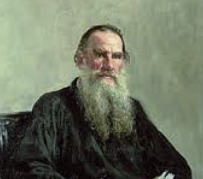
Leo Tolstoy — The Novelist of Moral Reckoning, History, and Radical Conscience (1828–1910)
Leo Tolstoy was a writer who refused to let art remain merely beautiful. He believed literature should interrogate life itself — its violence, its vanity, its suffering, and its possibility for moral renewal. Few figures in world history traveled so far from aristocratic privilege to spiritual rebellion, from literary mastery to a relentless critique of power, wealth, and institutional religion. His life became an extension of his philosophy: a long, unfinished argument with the world.
Aristocratic Origins and Moral Unease
Born into the Russian landed nobility, Tolstoy inherited wealth, title, and social position. Yet from an early age he was plagued by self-criticism, guilt, and a sense that aristocratic life was hollow. He gambled, drank, pursued pleasure, and recorded his moral failures with brutal honesty in his diaries.
This inner conflict — between privilege and conscience — never left him. It became the engine of his greatest works: the tension between how people live and how they know they ought to live.
“I know that most men — including those at ease with problems of the greatest complexity — can seldom accept even the simplest and most obvious truth if it would oblige them to admit the falseness of conclusions which they have proudly taught to others.”
War and Peace — History Without Heroes
Tolstoy’s monumental novel War and Peace shattered conventional historical storytelling. Rather than glorifying generals and great men, Tolstoy portrayed history as the product of countless small actions, misunderstandings, accidents, and private motives.
Napoleon is not a genius. Battles are not rational. Strategy dissolves into chaos. History, Tolstoy argued, is not guided by heroic will but by forces no one fully controls.
At the same time, the novel explores love, family, faith, and death — the intimate struggles that persist regardless of empires and wars.
“The strongest of all warriors are these two — Time and Patience.”
Anna Karenina — The Tragedy of Social Judgment
In Anna Karenina, Tolstoy turned from historical vastness to moral psychology. The novel examines love, adultery, social hypocrisy, and the crushing power of moral judgment.
Anna’s tragedy is not merely personal. It is social. She is destroyed less by passion than by a society that punishes her while excusing the same behavior in men.
Alongside Anna’s fall, Tolstoy presents Levin — a stand-in for his own spiritual struggles — searching for meaning through work, family, and faith.
“All happy families resemble one another, each unhappy family is unhappy in its own way.”
Spiritual Crisis and the Search for Meaning
At the height of fame and success, Tolstoy fell into a profound existential crisis. He contemplated suicide, unable to justify life in the face of death. Wealth, art, and reputation offered no answers.
His reflections culminated in A Confession, where he describes discovering meaning not in philosophy or science, but in the simple faith of ordinary people — a faith rooted in humility, labor, and ethical living.
From this point on, Tolstoy became a religious radical, rejecting church authority, sacraments, and theological abstraction.
“The sole meaning of life is to serve humanity.”
Radical Ethics — Nonviolence and Christian Anarchism
Tolstoy interpreted Christianity not as doctrine, but as a moral practice. He emphasized the Sermon on the Mount, especially the command to resist evil without violence.
From this followed sweeping conclusions: rejection of war, the state, coercive law, private property, and institutional religion. He advocated pacifism, voluntary poverty, manual labor, and universal compassion.
These ideas influenced figures such as Gandhi and Martin Luther King Jr., even as they scandalized church and state alike. Tolstoy was excommunicated, but unmoved.
“Everyone thinks of changing the world, but no one thinks of changing himself.”
Art, Simplicity, and Moral Responsibility
Late in life, Tolstoy turned against much of high art — including his own earlier novels. In What Is Art?, he argued that true art must communicate sincere moral feeling accessible to ordinary people.
Art that serves elites, aesthetic pleasure, or ego, he considered corrupt. This extreme position alienated admirers but revealed Tolstoy’s uncompromising integrity.
Final Years and a Symbolic Death
Tolstoy’s later life was marked by conflict — with his wife, his family, and his own contradictions. He preached poverty while living on an estate. He sought simplicity while remaining world-famous.
In 1910, at the age of eighty-two, he fled his home in search of solitude and consistency. He fell ill and died at a small railway station — a fitting end for a man who spent his life in restless moral motion.
Legacy — Literature as Moral Trial
Tolstoy stands as one of humanity’s great moral witnesses. His novels are unmatched in psychological depth, social vision, and ethical seriousness.
Yet his true legacy lies beyond literature. He challenged readers to ask whether beauty without goodness is enough, whether success excuses injustice, and whether a meaningful life demands personal transformation.
Tolstoy does not comfort. He confronts. He insists that to live honestly is harder than to write brilliantly — and more necessary.
“The two most powerful warriors are patience and time.”
CivilSimian.com created by AxiomaticPanic, CivilSimian, Kalokagathia