
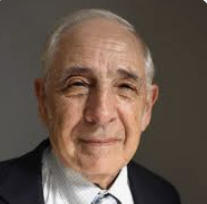
John Searle — The Philosopher of Mind, Meaning, and Social Reality (1932– )
John Searle is the philosopher who refused to let philosophy drift away from how the world actually works. In an era dominated by abstraction, formalism, and computational metaphors, Searle insisted on stubborn questions: How does meaning arise? What is consciousness? And how can social institutions exist if they are made only of beliefs and rules? His work stands at the intersection of language, mind, and society, relentlessly defending common sense without surrendering rigor.
From Oxford to Berkeley
Born in Denver and educated at the University of Wisconsin and Oxford, Searle studied under J. L. Austin, one of the founders of ordinary language philosophy. From Austin, Searle inherited a deep suspicion of philosophical pseudo-problems generated by misuse of language.
He spent most of his career at the University of California, Berkeley, where he became a central figure in analytic philosophy. Unlike many of his contemporaries, Searle never specialized narrowly. He moved freely between philosophy of language, philosophy of mind, social ontology, and political theory.
“Philosophy is about getting things right, not about winning arguments.”
Speech Acts — Language as Action
Searle’s early work developed speech act theory, building on Austin’s insight that language does not merely describe the world — it does things.
When we promise, order, apologize, or declare, we are not reporting facts. We are performing actions governed by social rules. Meaning, therefore, is not reducible to truth conditions alone, but depends on intentions, conventions, and context.
This move shifted philosophy of language away from abstract symbols toward human practices.
“Speaking a language is engaging in a rule-governed form of behavior.”
Intentionality — The Mind About Something
Central to Searle’s philosophy is intentionality — the capacity of mental states to be about something. Beliefs are about facts. Desires are about goals. Thoughts refer beyond themselves.
Intentionality, Searle argued, cannot be reduced to syntax, symbols, or computation. It is a biological feature of minds, grounded in consciousness and causal powers.
This commitment would put him in direct conflict with artificial intelligence research.
“The mind is not a computer program.”
The Chinese Room — A Challenge to Artificial Intelligence
Searle’s most famous argument is the Chinese Room thought experiment. Imagine a person who does not understand Chinese locked in a room with a rulebook that allows them to manipulate Chinese symbols correctly. To outsiders, the room appears to understand Chinese.
But inside, there is no understanding — only symbol manipulation. Syntax alone, Searle concluded, is not sufficient for semantics.
Strong AI — the claim that computers literally understand — collapses under this distinction.
“Syntax is not semantics.”
Biological Naturalism — Consciousness Without Dualism
Searle rejected both Cartesian dualism and reductive materialism. Consciousness, he argued, is a real, irreducible biological phenomenon — like digestion or photosynthesis.
Mental states are caused by brain processes and realized in the brain, but they cannot be eliminated or explained away. Subjectivity is not an illusion — it is a feature of the natural world.
Any theory that denies consciousness, Searle insisted, has already misunderstood what it seeks to explain.
Social Reality — How Institutions Exist
Later in his career, Searle turned to social ontology. Money, governments, marriages, universities — none of these exist in the way mountains do. Yet they are undeniably real.
Searle explained this through collective intentionality and status functions. We collectively assign functions to objects and persons that exist only because we recognize them.
A piece of paper is money because we treat it as money. Institutional facts rest on shared acceptance, not physical structure.
“We make the social world, but not just as we please.”
Politics, Rationality, and Free Speech
Searle also wrote extensively on political philosophy, defending Enlightenment rationality, liberal democracy, and freedom of expression.
He criticized postmodern relativism for undermining the very idea of truth, and identity politics for replacing reasoned debate with moral intimidation. Philosophy, he believed, must remain committed to clarity and argument, even when unpopular.
Legacy — Common Sense with Teeth
John Searle stands as one of the last great system-builders in analytic philosophy — a thinker willing to confront mind, meaning, and society within a single coherent framework.
He is admired and criticized in equal measure, but rarely ignored. His work reminds philosophy that clarity is not simplicity, and that reality does not disappear just because theories find it inconvenient.
In a landscape crowded with abstractions, Searle remains stubbornly anchored to how things actually are.
“Consciousness is not something we invented. It is part of the natural world.”
CivilSimian.com created by AxiomaticPanic, CivilSimian, Kalokagathia