
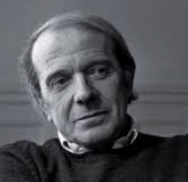
Gilles Deleuze — The Philosopher of Difference, Desire, and Becoming (1925–1995)
Gilles Deleuze was philosophy’s great insurgent — a thinker who rejected identity, hierarchy, and fixed essences in favor of movement, multiplicity, and creative transformation. Where philosophy had long asked “What is this?”, Deleuze asked a more dangerous question: What can this become? His work dissolves stable categories, treats thought as an experiment, and insists that life always exceeds the concepts that try to capture it.
A Philosopher Against Recognition
Born in Paris, Deleuze came of age during World War II and was educated in a French academic culture still dominated by tradition and commentary. From the beginning, he resisted philosophy as interpretation or repetition.
Deleuze believed that most thinking is lazy — content to recognize what it already knows. True thought, he argued, does not arise from recognition, but from shock, encounter, and disruption. Philosophy should not explain the world, but force thought to move.
“Thinking is not a natural exercise. Thought is forced.”
Difference Without Identity
Western philosophy, Deleuze argued, had always subordinated difference to identity. Difference was treated as deviation — something defined by what it is not.
In Difference and Repetition, Deleuze reversed this logic. Difference comes first. Identity is a secondary effect — a temporary stabilization within a field of variation.
Reality is not composed of fixed beings, but of processes, intensities, and relations. Repetition, in this sense, never reproduces the same — it always produces something new.
“Difference must be shown differing.”
Immanence — A World Without Transcendence
Deleuze was a philosopher of immanence. He rejected appeals to transcendent principles — God, universal reason, moral law, or fixed human nature.
Everything that exists unfolds on a single plane: a plane of immanence, where forces interact, bodies affect one another, and new forms emerge.
There is no higher realm judging life. Values arise from life itself — from what enhances or diminishes its power to act.
“There is no transcendence; everything happens on the plane of immanence.”
Desire Without Lack — Deleuze and Guattari
Deleuze’s collaboration with Félix Guattari produced some of the most explosive philosophy of the twentieth century. In Anti-Oedipus, they launched a frontal attack on psychoanalysis, especially the idea that desire is defined by lack.
Desire, they argued, is productive — not something missing, but something that builds, connects, and flows. Social systems do not repress desire; they organize it.
Capitalism, they claimed, both unleashes desire and traps it, decoding flows only to recode them as profit.
“Desire produces reality.”
Rhizomes, Assemblages, and Lines of Flight
Against hierarchical models of thought, Deleuze proposed the rhizome — a structure without a center, beginning, or end. Any point can connect to any other.
Social formations, ideas, identities, and bodies are best understood as assemblages — temporary constellations of forces, practices, and relations.
Within these assemblages, lines of flight open paths of escape and transformation — moments when something breaks free and becomes something else.
“Make a rhizome, not a tree.”
Art, Cinema, and the Power of Sensation
Deleuze treated art as philosophy’s ally. Painters, writers, and filmmakers, he believed, think through sensation rather than concepts.
His books on cinema introduced the ideas of the movement-image and the time-image, showing how film can think time directly, beyond linear narrative or representation.
Art does not represent the world. It creates percepts and affects — new ways of seeing and feeling.
Illness, Writing, and a Philosophical Exit
Deleuze suffered from severe respiratory illness for much of his life, which increasingly limited his ability to speak and teach. Writing became both his refuge and his resistance.
In 1995, facing unbearable physical constraints, he ended his life. For Deleuze, existence was inseparable from the ability to create, to connect, to transform.
Legacy — Philosophy as Experiment
Deleuze left behind no doctrine, no moral system, no political program. He left tools.
His influence stretches across philosophy, political theory, art, architecture, cultural studies, and activism. He taught generations of thinkers to distrust fixed identities and to ask what new forms of life might be possible.
Deleuze’s philosophy is not something to believe — it is something to use. A map, not a tracing.
“A philosophy is not a reflection; it is a creation.”
CivilSimian.com created by AxiomaticPanic, CivilSimian, Kalokagathia