
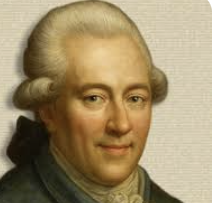
Georg Christoph Lichtenberg — The Enlightenment’s Master of Wit, Skepticism, and Intellectual Honesty (1742–1799)
Georg Christoph Lichtenberg was philosophy’s sharpest observer of human pretension — a physicist by profession, a satirist by temperament, and a thinker whose fragments cut deeper than many grand systems. He distrusted metaphysical certainty, mocked self-importance wherever he found it, and believed that intellectual humility was the beginning of wisdom. In an age of reason, Lichtenberg reminded reason to laugh at itself.
A Life Between Science and Satire
Born in Ober-Ramstadt, Germany, the youngest child of a Protestant minister, Lichtenberg grew up poor, physically fragile, and intellectually ferocious. Severe spinal deformities marked him for life, shaping both his outsider perspective and his merciless sensitivity to hypocrisy.
He studied mathematics and physics and eventually became a professor at Göttingen, where he introduced experimental physics to German university education. Yet it was never systems or doctrines that interested him most — it was people: their vanities, illusions, and capacity for self-deception.
“I cannot say whether things will get better if we change; what I can say is they must change if they are to get better.”
The Aphorist — Thinking in Lightning Strikes
Lichtenberg is best known for his Sudelbücher — notebooks of aphorisms, observations, jokes, philosophical insights, and merciless self-criticism. He never intended them for publication, which gives them a rare honesty.
These fragments refuse system-building. Instead, they probe thought at its weakest points: where language seduces, where certainty hardens into stupidity, and where moral posturing replaces understanding.
Lichtenberg believed that insight arrives suddenly, not through grand theories but through attentive noticing — what slips, what contradicts, what flatters the ego.
“A book is a mirror: if an ass peers into it, you can’t expect an apostle to look out.”
Skepticism Without Cynicism
Lichtenberg was a skeptic, but not a nihilist. He did not deny truth; he denied easy access to it.
He distrusted metaphysics that soared above experience, moral systems that excused cruelty, and philosophies that replaced curiosity with certainty. Thought, he argued, should remain provisional, alert to error, and aware of its own blind spots.
Even the self, he believed, should be treated cautiously. Instead of saying “I think,” Lichtenberg famously suggested, one should say “it thinks” — an early intuition that consciousness is not fully under personal control.
“Instead of ‘I think,’ one should say ‘it thinks,’ as one says ‘it thunders.’”
Enlightenment Without Illusions
Though a man of the Enlightenment, Lichtenberg refused its self-congratulation. Reason, he argued, does not automatically make people humane. Intelligence can sharpen cruelty just as easily as compassion.
He mocked moral vanity, nationalist arrogance, and the habit of using abstract ideals to justify concrete harm. Progress, in his view, was fragile — always threatened by self-love and dogma.
True enlightenment required constant self-examination, not slogans.
“Nothing contributes so much to the calm of the mind as a firm resolution not to take anything personally.”
Science, Electricity, and the Physical World
Lichtenberg was a serious experimental physicist. His work on electricity led to the discovery of branching electrical discharge patterns now called Lichtenberg figures.
He believed science should remain grounded in experiment, not speculation. Like his philosophy, his physics emphasized observation, humility, and resistance to grand metaphysical claims.
Knowledge, whether scientific or philosophical, should illuminate — not intoxicate.
Legacy — The Philosopher Who Refused to Pretend
Lichtenberg left no system, founded no school, and claimed no disciples. Yet his influence runs deep — from Nietzsche and Freud to modern aphorists and skeptics.
He remains a model of intellectual honesty: a thinker who preferred clarity to comfort, questions to answers, and laughter to self-importance.
In a world still crowded with certainty, Lichtenberg’s fragments remind us that wisdom often arrives disguised as a joke.
“Doubt is not a pleasant condition, but certainty is absurd.”
CivilSimian.com created by AxiomaticPanic, CivilSimian, Kalokagathia