
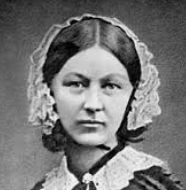
Florence Nightingale — The Reformer of Care, Statistics, and Moral Responsibility (1820–1910)
Florence Nightingale was far more than “the lady with the lamp.” She was a fierce reformer, a pioneering statistician, and a moral thinker who transformed nursing from domestic charity into a disciplined, evidence-based profession. In an age that confined women to obedience and decorum, Nightingale insisted that care itself was a form of knowledge — and that bad systems, not bad people, were the true enemies of health.
A Calling Against Expectation
Born into a wealthy British family, Nightingale was expected to marry well and live comfortably. Instead, she experienced what she described as a divine calling — not to religion in the narrow sense, but to service guided by reason and discipline.
Her desire to become a nurse scandalized her family. Nursing was associated with untrained labor, moral suspicion, and low social status. Nightingale persisted anyway, educating herself in hospitals and institutions across Europe, studying sanitation, administration, and medical organization with relentless seriousness.
“I attribute my success to this: I never gave or took any excuse.”
The Crimean War — Systems That Kill
Nightingale rose to public prominence during the Crimean War, when she led a group of nurses to military hospitals plagued by filth, overcrowding, and disease. Soldiers were dying not from battle wounds, but from infection, contaminated water, and poor ventilation.
Nightingale understood what others refused to see: suffering was not inevitable. It was organized. By improving sanitation, nutrition, cleanliness, and airflow, she dramatically reduced mortality rates — in some cases by more than half.
Her nightly rounds with a lamp made her a symbol, but her true work was administrative, analytical, and systemic.
“The very first requirement in a hospital is that it should do the sick no harm.”
Statistics as a Moral Weapon
Nightingale was a pioneering statistician, one of the first women admitted to the Royal Statistical Society. She believed numbers could expose injustice more forcefully than rhetoric.
She developed innovative visual tools, including the famous polar area diagram, to show how preventable disease, not combat, was killing soldiers. These graphics transformed abstract data into undeniable moral evidence.
For Nightingale, statistics were not cold abstractions — they were a way of making suffering visible to those in power.
“To understand God’s thoughts, we must study statistics, for these are the measure of His purpose.”
Nursing as Knowledge and Discipline
Nightingale rejected the idea that nursing was merely compassionate instinct. Care, she argued, requires training, observation, judgment, and accountability. Kindness without competence could be lethal.
In Notes on Nursing, she articulated principles that remain foundational: attention to environment, hygiene, rest, nutrition, and the patient’s experience. She framed nursing as a science of conditions — creating circumstances in which the body can heal itself.
In 1860, she founded the Nightingale Training School, professionalizing nursing and reshaping healthcare worldwide.
“Nursing is an art; and if it is to be made an art, it requires an exclusive devotion.”
Religion Without Dogma
Nightingale was deeply religious, but fiercely unorthodox. She rejected punitive theology, predestination, and blind obedience to authority.
God, for Nightingale, was not a ruler suspending natural laws, but the source of order within them. To understand divine will was to understand how the world works — and to act responsibly within it.
Neglect, ignorance, and indifference were not sins forgiven by faith, but moral failures to be corrected through knowledge.
Chronic Illness and Invisible Power
Much of Nightingale’s later life was spent in severe chronic illness, possibly contracted during the Crimean War. She became largely housebound, yet her influence only grew.
From her bedroom, she advised governments, redesigned hospitals, reformed military medicine, and shaped public health policy across the British Empire. Power, for Nightingale, did not require visibility. It required clarity.
Legacy — Care as a Form of Justice
Florence Nightingale transformed how societies think about care. She revealed that suffering often comes from neglectful systems, not fate. Clean water, fresh air, rest, and dignity are not luxuries — they are ethical necessities.
Her legacy lives in modern nursing, public health, evidence-based medicine, and the use of data to drive reform. She stands as a reminder that compassion without structure fails — and that knowledge, when guided by conscience, can save lives on a massive scale.
“Live life when you have it. Life is a splendid gift.”
CivilSimian.com created by AxiomaticPanic, CivilSimian, Kalokagathia