
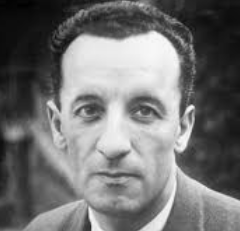
Maurice Merleau-Ponty — Embodiment, Perception, and the Flesh of the World (1908–1961)
Maurice Merleau-Ponty was the philosopher who returned thought to the body. Against traditions that treated perception as a mental copy of an external world, he argued that consciousness is always already embedded in living, moving flesh. We do not first think and then perceive. We perceive before we reflect, and thinking grows out of this bodily contact with the world.
Between Philosophy, Psychology, and Politics
Educated at the École Normale Supérieure alongside Sartre and de Beauvoir, Merleau-Ponty moved fluidly between phenomenology, psychology, and social theory. He drew heavily on Gestalt psychology and neurological studies, refusing to separate philosophical questions from empirical research.
Philosophy, for him, was not the construction of abstract systems, but a clarification of how experience actually unfolds.
“The body is our general medium for having a world.”
Perception Before Thought
Merleau-Ponty rejected the idea that perception is built from raw sensations assembled by the mind. We do not receive scattered data and then construct objects. We immediately perceive meaningful structures: faces, gestures, paths, dangers, invitations.
The world shows up already organized around our capacities for action. Seeing is not passive reception. It is active involvement.
Perception is therefore not a representation of the world, but our way of inhabiting it.
“I do not have a body, I am my body.”
The Lived Body, Not the Mechanical Body
Science describes the body as an object among objects — measurable, divisible, predictable. Merleau-Ponty did not deny this description, but argued that it misses what matters most.
The body we live is not a machine we operate. It is the center of orientation, habit, and skill. We reach for a cup without calculating trajectories. We walk without solving equations.
Intelligence is already in movement.
“Consciousness is in the first place not a matter of ‘I think’ but of ‘I can.’”
Intersubjectivity — Shared Worlds
Other people are not theoretical problems to be solved. We encounter them directly through gesture, expression, and action. Meaning appears between bodies before it becomes an idea.
Language, too, is not merely a code for transmitting thoughts. It is a bodily practice that creates shared worlds of significance.
Communication works because we already inhabit overlapping fields of experience.
“Speech is the surplus of our existence over natural being.”
The Flesh of the World
In his later work, Merleau-Ponty introduced the idea of flesh — not as physical tissue alone, but as the shared texture of perceiver and perceived.
Seeing and being seen, touching and being touched, fold into one another. The body and the world are intertwined, not separated by an absolute divide.
Subject and object emerge from a deeper field of participation.
Politics and Ambiguity
Merleau-Ponty believed political life was irreducibly ambiguous. Pure moral certainty, he warned, often ignores the complexity of historical situations.
He briefly supported Marxism after World War II, then distanced himself as authoritarian realities became clear. His political thought emphasized responsibility without dogmatism.
Action always occurs within imperfect knowledge.
Legacy — Thinking with the Body
Merleau-Ponty reshaped phenomenology by grounding it in perception and movement. His influence reaches into cognitive science, embodied AI, psychology, architecture, art theory, and feminist philosophy.
He reminds philosophy that the world is not first a picture to be inspected, but a field of action to be lived.
Thought begins not in detached observation, but in the thickness of experience.
“We are not in front of the world, we are in it.”
CivilSimian.com created by AxiomaticPanic, CivilSimian, Kalokagathia