
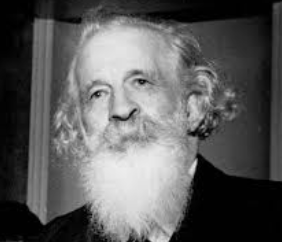
Gaston Bachelard — Science, Imagination, and the Ruptures of Knowledge (1884–1962)
Gaston Bachelard was a philosopher of breaks rather than bridges. He believed that knowledge does not grow smoothly, but advances through shocks, reversals, and acts of intellectual violence against our most comforting intuitions. At the same time, he was a poet of the imagination, treating dreams, images, and reverie as serious philosophical forces. Few thinkers held science and poetry together with such disciplined contradiction.
From Postman to Philosopher of Science
Bachelard’s life itself defied intellectual pedigree. Born in rural France, he worked as a postal clerk before studying physics, mathematics, and philosophy. He entered academia late, carrying with him a deep respect for scientific labor rather than philosophical abstraction.
This background shaped his outlook. Philosophy, for Bachelard, was not timeless speculation. It was historical, technical, and inseparable from actual scientific practice. To understand reason, one had to study how science really changes.
“Science advances through a series of rectified errors.”
Epistemological Obstacles
Bachelard’s central concept was the epistemological obstacle. The greatest barriers to knowledge, he argued, are not ignorance or lack of data, but prior knowledge itself — habits of thought, images, metaphors, and common-sense intuitions that silently distort understanding.
Everyday experience, far from grounding science, actively misleads it. Heat does not flow like a fluid. Nature does not obey human-scale intuition. Science progresses only by breaking with the obvious.
“Common sense is the enemy of science.”
Epistemological Rupture
Knowledge does not evolve continuously. Bachelard rejected the idea of steady accumulation. Instead, science advances through epistemological ruptures — moments when entire conceptual frameworks collapse and are replaced.
Modern physics, chemistry, and mathematics do not refine ancient thought — they contradict it. To learn is to unlearn. Scientific reason is forged by actively opposing its own past.
“There is no truth except that which is thought against.”
The New Scientific Mind
Bachelard described modern science as requiring a new kind of rationality. Classical realism, sensory intuition, and naive materialism are inadequate for quantum theory or relativity.
Scientific objects are not given — they are constructed. Instruments, mathematics, and theory precede observation. Reason no longer mirrors nature; it produces intelligible structures through disciplined abstraction.
The Poetics of Imagination
Strikingly, the same philosopher who attacked imagination in science celebrated it elsewhere. In works like The Poetics of Space, Bachelard turned to dreams, images, and reverie as sources of meaning.
Fire, water, air, and earth became symbolic forces shaping inner life. Here imagination was not an obstacle, but a mode of dwelling — a way humans inhabit the world poetically.
“The imagination invents more than things; it invents new ways of being.”
Science by Day, Poetry by Night
Bachelard insisted there was no contradiction between his two philosophies. Science requires disciplined rupture from imagination. Poetry requires free immersion within it.
Confusing the two leads to bad science and shallow poetry. Keeping them distinct allows both reason and reverie to flourish.
Legacy — Thinking Against Oneself
Bachelard influenced philosophers of science, historians of knowledge, and later thinkers like Foucault and Althusser. His emphasis on rupture, construction, and discontinuity reshaped how intellectual history is written.
His enduring lesson is severe but liberating: thought advances only by resisting itself. To know more, one must dare to think differently — and accept that yesterday’s clarity is today’s obstacle.
“Knowledge is always a reform of illusion.”
CivilSimian.com created by AxiomaticPanic, CivilSimian, Kalokagathia