
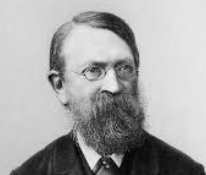
Ernst Mach — The Philosopher of Sensation, Science, and the War on Metaphysics (1838–1916)
Ernst Mach was a relentless minimalist. He believed science had gone astray whenever it spoke of invisible entities, absolute spaces, or metaphysical foundations. For Mach, knowledge begins not with things-in-themselves, but with experience — raw sensation organized economically. His philosophy stripped science down to what can actually be observed, reshaping physics, psychology, and the philosophy of science in the process.
A Scientist Before a Philosopher
Born in Moravia (then part of the Austrian Empire), Mach was trained as a physicist, not a metaphysician. His early work focused on optics, acoustics, and physiology — especially the relationship between physical stimuli and perception.
This empirical grounding shaped everything that followed. Mach never treated philosophy as an abstract discipline. For him, philosophy existed to clarify scientific concepts, eliminate confusion, and prevent theoretical excess. If a concept could not be tied to experience, it was suspect.
“Science is a minimal problem-solving activity.”
Sensations as the Elements of the World
Mach’s most radical claim was deceptively simple: the basic elements of reality are sensations. Colors, sounds, pressures, spatial relations — these are not representations of an underlying reality, but the raw material from which both physical objects and mental states are constructed.
The distinction between mind and world, subject and object, dissolves at this level. Both are arrangements of the same experiential elements. What we call a “thing” is simply a stable pattern within the stream of sensation.
“The world consists only of our sensations.”
Against Absolute Space and Time
Mach is perhaps best known for his critique of Newtonian mechanics. Newton had posited absolute space and absolute time — invisible frameworks within which motion occurs. Mach rejected this as metaphysical excess.
Motion, Mach argued, is always relational. An object’s movement only makes sense in relation to other objects in the universe. There is no need to posit an unseen container of space when relations suffice.
This idea became known as Mach’s Principle: the inertia of a body is determined by its relation to the mass distribution of the universe. Though Mach himself left it vague, it would later influence Einstein’s thinking during the development of general relativity.
“Absolute space and absolute time are metaphysical monstrosities.”
Economy of Thought
Mach believed that scientific theories are tools, not mirrors of reality. Their value lies in how efficiently they organize experience and predict future sensations. Truth is not correspondence with hidden structures, but practical success and coherence.
This idea — the economy of thought — treated scientific laws as compressed summaries of experience. When theories become bloated with unobservable entities, they lose their purpose.
“Concepts are summaries of experience.”
Influence on Logical Positivism
Mach’s hostility toward metaphysics and his insistence on empirical grounding made him a hero to the Vienna Circle. Logical positivists saw him as a philosophical ancestor — someone who had already begun the purge of unverifiable concepts.
Though Mach himself rejected formal logic and was skeptical of rigid verification principles, his spirit animates positivism: clarity, restraint, and suspicion toward grand speculation.
Conflict with Atomism
Ironically, Mach’s empiricism led him to reject atomic theory — at least until atoms could be directly observed. He viewed atoms as useful fictions, not established realities.
Later experimental confirmation of atoms is often cited as Mach’s greatest mistake. Yet his caution illustrates his deeper commitment: science must not outrun experience. Even successful theories deserve philosophical restraint.
Legacy — The Philosopher Who Humbled Science
Mach occupies a strange position in intellectual history. He influenced Einstein, inspired logical positivism, and shaped philosophy of science — yet he left behind no grand system.
His legacy is an attitude: skepticism toward metaphysics, respect for experience, and humility about what science can claim. Mach reminds us that knowledge advances not by piling on assumptions, but by carefully trimming them away.
“The aim of science is not things themselves, but relations among them.”
CivilSimian.com created by AxiomaticPanic, CivilSimian, Kalokagathia