
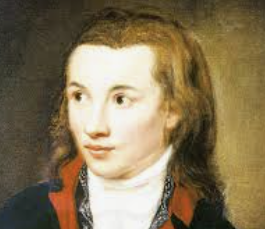
Novalis — The Philosopher-Poet of Romanticism, Night, and Infinite Becoming (1772–1801)
Novalis, born Friedrich von Hardenberg, was the mystic heart of German Romanticism. Where Enlightenment thinkers sought clarity, system, and control, Novalis sought depth, intimacy, and transformation. He believed philosophy should not merely explain the world, but re-enchant it — revealing reality as unfinished, symbolic, and boundlessly alive.
A Short Life, An Immense Imagination
Novalis was born into a conservative Protestant family in Saxony and trained in law, mining engineering, and natural science. Unlike many Romantics, he was technically skilled and scientifically literate, deeply interested in mathematics, chemistry, and geology. Yet he felt that modern rationality had drained the world of meaning.
His life was brief and intense. The early death of his beloved fiancée, Sophie von Kühn, marked him permanently. Rather than collapsing into despair, Novalis transformed grief into philosophy and poetry, interpreting death not as annihilation but as passage into deeper unity.
“Philosophy is really homesickness — an urge to be at home everywhere.”
Romanticism — Against the Flat World
Novalis belonged to the early German Romantic circle alongside Friedrich Schlegel and Ludwig Tieck. Together they rejected the Enlightenment picture of a purely mechanical universe. Reason alone, Novalis argued, fragments experience. Only imagination, poetry, and feeling can restore wholeness.
To “romanticize” the world did not mean to escape reality, but to deepen it — to see the finite as a doorway to the infinite, the ordinary as saturated with mystery. Romanticism, for Novalis, was a metaphysical stance.
“The world must be romanticized.”
Night, Death, and Transcendence
In his Hymns to the Night, Novalis inverted the Enlightenment symbolism of light and darkness. Daylight reason divides and analyzes, but night reunites. Night dissolves boundaries between self and world, life and death, finite and infinite.
Death, for Novalis, is not mere negation. It is a return, a descent into the hidden unity beneath appearances. Love and death intertwine, not as morbid obsessions, but as pathways to transcendence.
“In death, love is sweetest.”
Knowledge, Symbol, and the Living Whole
Novalis rejected the idea that knowledge consists in domination over nature. True knowing, he believed, is participatory. The knower and the known are not separate substances, but moments within a single living whole.
Symbols, myths, and poetry are therefore not childish illusions, but higher forms of understanding. They express truths that cannot be reduced to concepts without losing their essence. Philosophy, at its highest level, becomes poetic.
“Everywhere we seek the absolute, and always find only things.”
Religion Without Dogma
Though deeply spiritual, Novalis rejected rigid theology. He imagined a future religion rooted not in authority, but in inward transformation. Christianity, in his view, was a poetic revelation of love, sacrifice, and unity — not a closed system of propositions.
Faith was not obedience to doctrine, but an orientation of the soul toward infinity. In this sense, Novalis anticipated later existential and phenomenological approaches to religion.
Legacy — The Romantic Philosopher of Longing
Novalis died of tuberculosis at jus
CivilSimian.com created by AxiomaticPanic, CivilSimian, Kalokagathia