
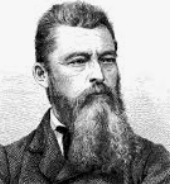
Ludwig Andreas Feuerbach
1804–1872
Ludwig Andreas Feuerbach was a German philosopher best known for dismantling classical theology from the inside and redirecting philosophy toward the human, the material, and the sensuous. Emerging from the shadow of German Idealism—particularly Hegel—Feuerbach argued that philosophy had mistaken abstractions for realities and ideas for living beings. His work marked a decisive turn away from metaphysics toward anthropology.
Feuerbach’s central claim is disarmingly radical: God is a projection of human nature. In The Essence of Christianity (1841), he argues that divine attributes—omniscience, goodness, infinity—are human qualities externalized, exaggerated, and alienated from their true source. Theology, in this view, is anthropology in disguise. Humans unknowingly worship their own idealized essence.
Against Hegel’s abstract Absolute Spirit, Feuerbach insisted on the primacy of the sensuous, embodied human being. Thought does not create reality; living humans do. Knowledge begins not in logic but in perception, emotion, and bodily existence. Love, not reason, is the deepest philosophical fact. Where idealism dissolves the world into concepts, Feuerbach brings it back to flesh and blood.
Politically and historically, Feuerbach serves as a hinge figure. He helped clear the ground for materialism and profoundly influenced Karl Marx, who adopted Feuerbach’s critique of religion while rejecting his passivity. Where Feuerbach stopped at interpretation, Marx demanded transformation.
Feuerbach’s legacy lies in his insistence that philosophy must begin with real human beings rather than divine abstractions. He shattered the spell of metaphysical theology and forced philosophy to confront a dangerous question: if God is our creation, what responsibility do we bear for the world we inhabit?
CivilSimian.com created by AxiomaticPanic, CivilSimian, Kalokagathia