
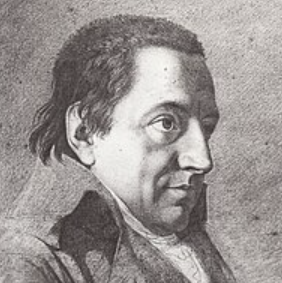
Johann Gottlieb Fichte — The Philosopher of the Self, Freedom, and Moral Action (1762–1814)
Johann Gottlieb Fichte was the philosopher who radicalized Kant’s revolution. Where Kant had drawn limits around human knowledge, Fichte asked a more incendiary question: what if reality itself is grounded in the activity of the self? His philosophy places freedom, responsibility, and ethical striving at the very heart of existence, making the human subject not a spectator of the world, but its active origin.
From Poverty to Philosophy
Born into poverty in rural Saxony, Fichte’s early life was marked by hardship and ambition. His intellectual promise caught the attention of local patrons, allowing him access to education that would otherwise have been impossible. This background left a lasting imprint: Fichte never viewed philosophy as a detached academic exercise, but as a matter of dignity, struggle, and moral self-assertion.
His life changed dramatically when he encountered Kant’s philosophy. After writing an anonymous book defending Kant, he was initially mistaken for Kant himself — an error that launched Fichte into sudden fame. Kant soon clarified the authorship, but the torch had already been passed. Fichte was emerging as the next major figure of German Idealism.
“The vocation of man is to act.”
The Wissenschaftslehre — Philosophy from the Act of the I
Fichte’s central work, the Wissenschaftslehre (“Doctrine of Science”), is not a single book but a series of evolving presentations. Its starting point is radical: the foundation of all knowledge is the I — not as a thing, but as an activity. The self posits itself, and in doing so, posits the not-self as a limit to overcome.
Reality, in this view, is not given once and for all. It emerges through the dynamic tension between the self and the world it resists. Consciousness is action. Knowing is doing. Philosophy, therefore, must begin not with objects, but with freedom in motion.
“The I posits itself, and by virtue of this mere positing exists.”
Freedom as the Core of Reality
For Fichte, freedom is not optional or secondary — it is the essence of human existence. To be human is to strive, to choose, to encounter resistance and respond with action. Even the experience of an external world is meaningful only as a challenge to moral agency.
This emphasis gave his philosophy an intensely ethical character. Knowledge exists for the sake of action. Thought exists to guide duty. The self becomes fully real only through commitment to moral law, not as obedience to authority, but as self-legislation.
“No one can live in indifference; no one can renounce freedom.”
Politics, Education, and the Nation
Fichte extended his philosophy into politics and education. During the Napoleonic occupation of Germany, he delivered his famous Addresses to the German Nation, calling for moral renewal through education, cultural unity, and ethical discipline.
These lectures made him a foundational figure in modern nationalism — both inspiring movements for collective self-determination and raising troubling questions about exclusion and identity. Fichte believed education should shape free, morally responsible citizens, capable of sustaining a just society.
“Education should aim at forming free men, not obedient subjects.”
Conflict, Atheism, and Exile
Fichte’s uncompromising style earned him both devoted followers and fierce enemies. He was accused of atheism after arguing that God should be understood not as a personal being, but as the moral order of the world itself. The controversy cost him his academic position and forced him into exile.
Rather than retreat, Fichte doubled down. Philosophy, he insisted, must be lived. To betray truth for safety would be the ultimate failure of the self.
“What sort of philosophy one chooses depends on what sort of person one is.”
Legacy — The Philosopher of Radical Subjectivity
Fichte stands as the bridge between Kant and later idealists like Schelling and Hegel. He transformed philosophy from an inquiry into limits of knowledge into an exploration of freedom, action, and self-creation. His influence can be felt in existentialism, phenomenology, and political theory.
He remains a demanding thinker — one who insists that philosophy is not about contemplation alone, but about becoming the kind of being who can bear responsibility for a world. In Fichte’s hands, the self is not given — it is forged.
“Act! Act! That is what we are here for.”
CivilSimian.com created by AxiomaticPanic, CivilSimian, Kalokagathia